Israel’s Nova Lumos puts solar power into off-grid African communities

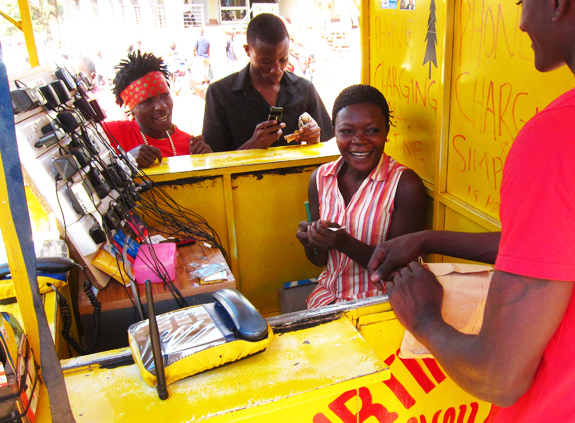
cell phone charging in AfricaIt’s hard to imagine the concept of a “power pimp” in Africa unless you have lived there. But it makes sense and cents on a continent that lacks a unified power system. There is basically no electric power in most rural places unless you are enterprising enough to own a battery and generator of some sort –– making you the “pimp” by letting other people charge their cell phones at crazy inflated prices.

It’s a problem that humanitarians worldwide seek to address, but an Israeli solution would do this using a cell phone. The idea of Nova Lumos is to buy solar power by phone on a needs basis, putting the middleman (that pimp) out of business.
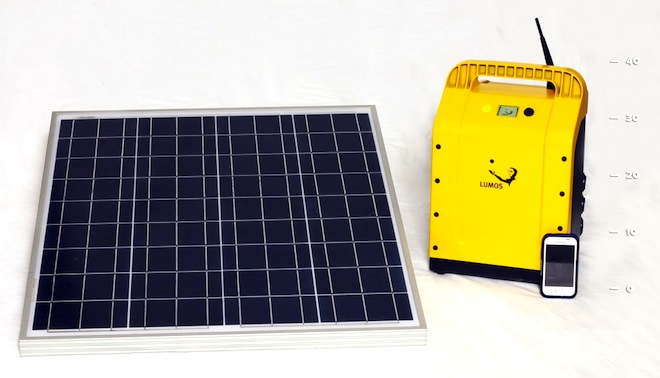
Nova Lumos, Electricity in a box, solar energy, Israel clean tech, developing world energy, solar energy cheaper than kerosene

Davidi Vortman, general manager of the company, tells ISRAEL21c that the idea is to sell small mobile solar systems to individuals –– for charging cell phones, lights or small appliances –– paid for in affordable increments using a cell phone.

“The system is small enough for one person to carry and simple enough for a person to put on the roof. Just connect it without any technician; and use a cell phone to operate it through a mobile phone with a simple SMS,” Vortman tells me.

Off-grid and green

Could Lumos save the day for about 1.5 billion people in Africa and Asia who don’t have access to power? The system provides access to green energy, a practical off-grid solution, a security system to protect the mobile pack and a good business opportunity to mobile providers in Africa, who can lease the Lumos pack as a bundled service.

“Africans don’t talk as much as they’d like to, not because they don’t have money to talk, but because they don’t have money to buy the charge,” explains Vortman. “When you think about the alternatives, there are the electricity pimps, a local entrepreneur with a car battery and generator and a kerosene candle for light, or a generator, which 99 percent cannot afford.

“With no grid there is no way to buy electricity. We believe distributed electricity would make more sense,” he says.

Cell phones for Africans are lifelines: a tool for banking, communicating and accessing the Internet. Some 800 million cell phones are being used across the continent, and it is clearly an important emerging market in both high-tech communications and green technologies.

“We need to make technology available in a way that is different,” says Vortman. “If they would have said years ago that 80 percent of Africans would have cell phones today, you’d think they were joking. There are no landlines, but they just leaped to mobile. The same with banking, where they use their cell phone and now have the largest market for that. They just leaped. I think with energy it must work the same way.”

Pilots in two countries

Energy is a harder sell than apps.

While apps from Israel to manage police forces (like Nowforce) or low-tech browsers (like VascoDe) are an easy sell, it has proven harder to get Africans hooked on green power – mainly because of the prohibitive cost.

Paying in increments by phone could eliminate this barrier. The challenging part will be securing the systems and penetrating the market before other companies jump on the bandwagon.

Nova Lumos was founded in 2012 and is now carrying out pilot projects to test the system using several hundred units in Nigeria and Guinea.

In the far future, the plan is to offer this unique approach to developed countries in need of a secure and reliable solution for far-flung locations. For example, Lumos could also be a provider of pay-as-you-go systems that purify water.

Founders of the company all come with expertise in large-scale solar energy installations in Israel, and in the networking and communications high-tech business. Vortman used to work at Nice and Comverse, managing large business units.

“I always felt that I wanted to do something different – something that impacts people,” he says.

Merging the two worlds of green energy and high-tech, as many Israeli companies are starting to do, might just save the day — and the planet.

Karin Kloosterman
Karin Kloostermanhttp://www.greenprophet.com
Karin Kloosterman is an award-winning journalist, innovation strategist, and founder of Green Prophet, one of the Middle East’s pioneering sustainability platforms. She has ranked in the Top 10 of Verizon innovation competitions, participated in NASA-linked challenges, and spoken worldwide on climate, food security, and future resilience. With an IoT technology patent, features in Canada’s National Post, and leadership inside teams building next-generation agricultural and planetary systems — including Mars-farming concepts — Karin operates at the intersection of storytelling, science, and systems change. She doesn’t report on the future – she helps design it. Reach out directly to [email protected]
1 COMMENT
  1. The product is good,durability & interesting. my concern here is to reduce monthly amount or charges and number of year for setlement please.

LEAVE A REPLY

Please enter your comment!
Please enter your name here

TRENDING

Astro uses AI to help procure land for renewable energy

For oil-rich, environmentally vigilant Gulf states, Astro isn’t just another startup story. It is a blueprint for accelerating an energy transition that is now existential, not optional.

Earth building with Dead Sea salt bricks

Researchers develop a brick made largely from recycled Dead Sea salt—offering a potential alternative to carbon-intensive cement.

Farm To Table Israel Connects People To The Land

Farm To Table Israel is transforming the traditional dining experience into a hands-on journey.

How Renewable Energy is Revolutionizing the Way We Power Our World

Solar has become the star of the transition thanks to modular hardware and straightforward installation. It fits dense cities and remote towns alike. Many companies are turning to rooftop arrays and carport systems - and exploring commercial solar installation as a practical way to lock in future savings.

Leading Through a Dual-Energy Transition: Balancing Decarbonisation with Energy Security

Experience in one area of the energy industry isn't enough to guarantee readiness across all the others. That's where a structured program like an MBA in energy can come in. Today's advanced curricula explore energy economics, finance, policy, and strategic management alongside the technical subjects. And when pursuing an energy MBA online, professionals can skill up and retrain without having to step out of the labor market -- an important perk at a time when skilled professionals are already in short supply.

Qatar’s climate hypocrisy rides the London Underground

Qatar remains a master of doublethink—burning gas by the megaton while selling “sustainability” to a world desperate for clean air. Wake up from your slumber people.

How Quality of Hire Shapes Modern Recruitment

A 2024 survey by Deloitte found that 76% of talent leaders now consider long-term retention and workforce contribution among their most important hiring success metrics—far surpassing time-to-fill or cost-per-hire. As the expectations for new hires deepen, companies must also confront the inherent challenges in redefining and accurately measuring hiring quality.

8 Team-Building Exercises to Start the Week Off 

Team building to change the world! The best renewable energy companies are ones that function.

Thank you, LinkedIn — and what your Jobs on the Rise report means for sustainable careers

While “green jobs” aren’t always labeled as such, many of the fastest-growing roles are directly enabling the energy transition, climate resilience, and lower-carbon systems: Number one on their list is Artificial Intelligence engineers. But what does that mean? Vibe coding Claude? 

Somali pirates steal oil tankers

The pirates often stage their heists out of Somalia, a lawless country, with a weak central government that is grappling with a violent Islamist insurgency. Using speedboats that swarm the targets, the machine-gun-toting pirates take control of merchant ships and then hold the vessels, crew and cargo for ransom.

Leopoldo Alejandro Betancourt López Turned Ocean Plastic Into Profitable Sunglasses

Few fashion accessories carry the environmental burden of sunglasses. Most frames are constructed from petroleum-based plastics and acrylic polymers that linger in landfills for centuries, shedding microplastics into soil and waterways long after they've been discarded. Leopoldo Alejandro Betancourt López, president of the Spanish eyewear brand Hawkers, saw this problem differently than most industry executives.

Why Dr. Tony Jacob Sees Texas Business Egos as Warning Signs

Everything's bigger in Texas. Except business egos.  Dr. Tony Jacob figured...

Israel and America Sign Renewable Energy Cooperation Deal

Other announcements made at the conference include the Timna Renewable Energy Park, which will be a center for R&D, and the AORA Solar Thermal Module at Kibbutz Samar, the world's first commercial hybrid solar gas-turbine power plant that is already nearing completion. Solel Solar Systems announced it was beginning construction of a 50 MW solar field in Lebrija, Spain, and Brightsource Energy made a pre-conference announcement that it had inked the world's largest solar deal to date with Southern California Edison (SCE).

Related Articles

Popular Categories