
Building Integrated Photovoltaics Slash Energy Costs in Abu Dhabi

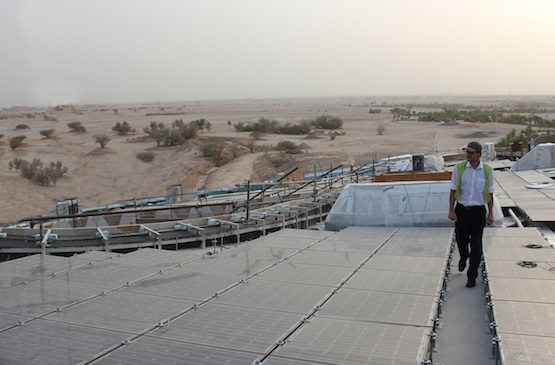
building integrated PV, BIPV, Dieter MoorDieter Moor of ertex solar examines the installation of his company’s solar project in Al Ain.

Finally the Middle East is attuned to the numerous benefits of solar energy, and large scale Photovoltaic (PV) and Concentrated Solar Power (CSP) plants are popping up all over the region. There’s Shams 1 outside of Abu Dhabi, the largest CSP plant in the world, Egypt’s hybrid CSP plant, Kuraymat, and most recently, Masdar inaugurated the largest PV plant in Africa, which is now generating a whopping 10 percent of Mauritania’s energy supply.

But small scale solar is catching on less quickly. In addition to being prohibitively expensive for most people, the government offers very little incentive for residents of the Middle East and North Africa (MENA) to coat their roofs with costly solar modules. It’s a shame, because a new study shows that affixing Building Integrated Photovoltaics (BIPV) to windows in Abu Dhabi could slash energy costs by as much as 33.5 percent.

BIPV = very good

Mohammad Katanbaf, an architect at KEO International Consultants Abu Dhabi, recently set out to determine how much energy businesses would save if they incorporated a certain number of BIPVs on their windows, according to The National.

For the sake of accuracy, he used very sophisticated computer modeling to match the United Arab Emirates’ specific climate, since temperature, wind, dust and other climatic conditions affect the efficiency of solar modules.

He told the paper that although he was expecting savings, their full extent surprised him. Trouble is, it’ll be a cold day in the desert if they are ever widely used, since the cost of BIPV modules is 30 percent higher than regular PV panels and even those aren’t hugely popular.

Elsewhere, feed-in-tariffs, a government protocol that purchases clean energy from whoever’s got extra, encourages residents and corporations to incorporate BIPVs or regular panels as a long term investment.

But in MENA, not only are governments a little slow to establish attractive FiT plans, but they also subsidize energy costs such that none but the most devout environmentalists are really motivated to spend the money necessary to either get off or reduce their dependence on the grid.

(Curiously, Iran did quit dirty energy subsidies and survived the ordeal – before the west intensified sanctions.)

Daniel Pedroso, Regional Manager of BIPV manufacturer Isofoton told The National that BIPVs won’t become a viable option in the Emirates until the government creates incentives that make the investment worthwhile.

The option is on the table, and Dubai’s Electricity and Water Authority (Dewa) is looking into it, but nobody is going to make sudden moves given the overall instability gripping the region.

And if you want to geek out on the stats, Katanbaf published his findings in the January edition of the journal Engineering.

Top image via ertex solar

Tafline Laylin
Tafline Laylinhttp://www.greenprophet.com
As a tour leader who led “eco-friendly” camping trips throughout North America, Tafline soon realized that she was instead leaving behind a trail of gas fumes, plastic bottles and Pringles. In fact, wherever she traveled – whether it was Viet Nam or South Africa or England – it became clear how inefficiently the mandate to re-think our consumer culture is reaching the general public. Born in Iran, raised in South Africa and the United States, she currently splits her time between Africa and the Middle East. Tafline can be reached at tafline (at) greenprophet (dot) com.

TRENDING

EU startup aiming to generate energy on moon villages

Stepping up to democratize the moon is an EU-funded company, Deep Space Energy, which has just raised more than $1 million USD as a seed fund to help it create energy generators on the moon.

Astro uses AI to help procure land for renewable energy

For oil-rich, environmentally vigilant Gulf states, Astro isn’t just another startup story. It is a blueprint for accelerating an energy transition that is now existential, not optional.

Leading Through a Dual-Energy Transition: Balancing Decarbonisation with Energy Security

Experience in one area of the energy industry isn't enough to guarantee readiness across all the others. That's where a structured program like an MBA in energy can come in. Today's advanced curricula explore energy economics, finance, policy, and strategic management alongside the technical subjects. And when pursuing an energy MBA online, professionals can skill up and retrain without having to step out of the labor market -- an important perk at a time when skilled professionals are already in short supply.

M2PV Capital Targets the American Southwest as Its Launchpad for Off-Grid EV Growth

In the American Southwest, electric vehicles face extreme heat, long travel distances, and limited grid access that expose the real infrastructure gaps behind the EV transition. M2PV Capital is building off-grid charging and power systems designed to operate independently in the region’s most demanding conditions.

What Renewable Energy Means for Long-Term Environmental Planning

In the context of American energy policy (setting the stage for the world as oil prices are in USD), the relevance of renewable energy planning is increasingly evident. Federal agencies are preparing final biofuel blending mandates under the Renewable Fuel Standard, with decisions expected early in 2026 after delays that have left investors and producers in limbo.

Turning Your Energy Consultancy into an LLC: 4 Legal Steps for Founders in Texas

If you are starting a renewable energy business in Texas, learn how to start an LLC by the books.

Tracking the Impacts of a Hydroelectric Dam Along the Tigris River

For the next two months, I'll be taking a break from my usual Green Prophet posts to report on a transnational environmental issue: the Ilısu Dam currently under construction in Turkey, and the ways it will transform life along the Tigris River.

6 Payment Processors With the Fastest Onboarding for SMBs

Get your SMB up and running fast with these 6 payment processors. Compare the quickest onboarding options to start accepting customer payments without delay.

Qatar’s climate hypocrisy rides the London Underground

Qatar remains a master of doublethink—burning gas by the megaton while selling “sustainability” to a world desperate for clean air. Wake up from your slumber people.

How Quality of Hire Shapes Modern Recruitment

A 2024 survey by Deloitte found that 76% of talent leaders now consider long-term retention and workforce contribution among their most important hiring success metrics—far surpassing time-to-fill or cost-per-hire. As the expectations for new hires deepen, companies must also confront the inherent challenges in redefining and accurately measuring hiring quality.

8 Team-Building Exercises to Start the Week Off 

Team building to change the world! The best renewable energy companies are ones that function.

Thank you, LinkedIn — and what your Jobs on the Rise report means for sustainable careers

While “green jobs” aren’t always labeled as such, many of the fastest-growing roles are directly enabling the energy transition, climate resilience, and lower-carbon systems: Number one on their list is Artificial Intelligence engineers. But what does that mean? Vibe coding Claude? 

Somali pirates steal oil tankers

The pirates often stage their heists out of Somalia, a lawless country, with a weak central government that is grappling with a violent Islamist insurgency. Using speedboats that swarm the targets, the machine-gun-toting pirates take control of merchant ships and then hold the vessels, crew and cargo for ransom.

Related Articles

Popular Categories