Food Waste in Rich Countries – The Most Un-Green Act of All

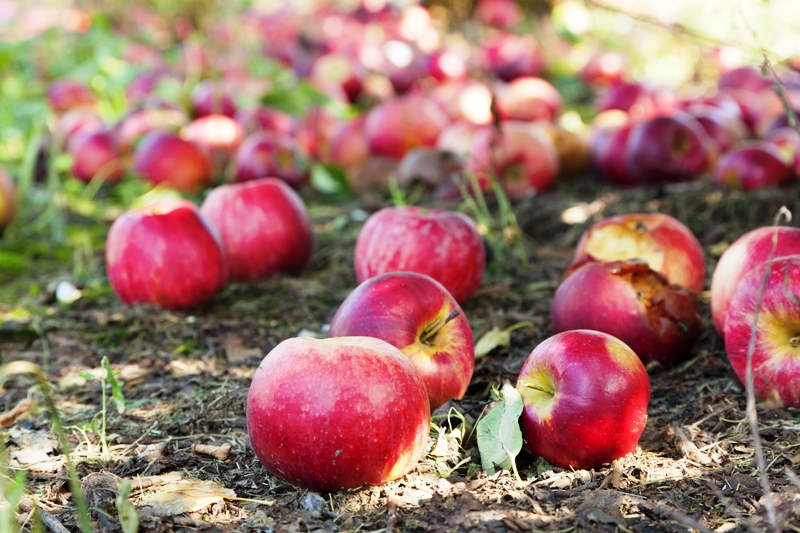
 fallen applesEven fallen fruit, like these apples, can be eaten if harvested properly

Serious and even dire food shortages in Mid East countries like Egypt, combined with projected sharp increases in food prices in Arab Spring countries in 2013 are sharp indicators that millions – perhaps billions of people are now facing even more lack of nutrients due to not having enough to eat. But ever increasing realities of global warming and climate change, especially desertification in  many Mid East countries are not  the main issues causing food shortages in many countries. Lack of food is also due to  sheer wasteful food production and distribution practices by both farmers and sellers of foodstuffs – often before much of it reaches the consumers who purchase it.

A weekend article recently published in Israel’s Haaretz magazine reported that this small country of 7 million inhabitants literally throws away nearly half the food produced and purchased there – often before it even reaches the supermarket shelves.

This food, consisting of vegetables, meat, dairy products and “dry foods” is often discarded if it doesn’t have a certain size, color or texture; or simply if it nears stamped expiration dates. This irony results in literally tons of food that might otherwise be entirely suitable for human consumption being thrown out into landfills and garbage dumps.

Although Israel’s per-capita income levels puts it above many neighboring counties as far as household affluence goes, there are still thousands of people living there who are classified as being under the established poverty level; and whose family members, especially the elderly and children often do not have enough food to eat to maintain proper nutrition.

Income disparities between affluent communities and poorer communities often determine how much food is actually eaten or simply thrown out. Less fortunate people are said to have varying degrees of “food insecurity”  by not knowing whether their families will have enough to eat.

As reported in Haaretz, Ilan Gilboa, a sanitation engineer for a large waste management company, said: “A poor family will eat a whole watermelon and roast the seeds, too; a rich family will eat a few slices and discard the rest. A poor family will make toast from yesterday’s bread; a rich family will throw out what’s left of the day’s bread that same evening.”

This comment is an understatement about how much food is wasted by various households. But the problem of wasted food supplies falls just as much in the entire production an distribution network, including the large supermarket chains which have purchasing quality agreements with their suppliers concerning the quality of food that is purchased by them and sold to the public.

Regarding the poor, there are organizations such as the Leket National Food Bank that try to “recycle” leftover and thrown out food for redistribution to the needy. But even their efforts are often not adequate enough as they only manage to redistribute only a small percentage of food that winds up being sent to the dump.

As overall food supplies becomes more scarce due to increased populations and climatic and other ecologic factors, the day may come when food supplies as many now know them will be only a distant dream. Food producers and distributors can be more green by helping to reduce the amount of discarded foodstuffs while still available.

More articles on food wastes and shortage issues in the Mid East and world at large:

Food Shortages Could Force the World to go Veggie

Arab Spring Countries Face Increased Risk of Food Price Shocks in 2013

A Farmer’s Market in Dead, Dry Qatar

Hilton Hotels to Share Food Wastes in Hungry Egypt

Image Apples on the ground , by Shutterstock

Maurice Picow
Maurice Picowhttps://www.greenprophet.com/
Maurice Picow grew up in Oklahoma City, U.S.A., where he received a B.S. Degree in Business Administration. Following graduation, Maurice embarked on a career as a real estate broker before making the decision to move to Israel. After arriving in Israel, he came involved in the insurance agency business and later in the moving and international relocation fields. Maurice became interested in writing news and commentary articles in the late 1990’s, and now writes feature articles for the The Jerusalem Post as well as being a regular contributor to Green Prophet. He has also written a non-fiction study on Islam, a two volume adventure novel, and is completing a romance novel about a forbidden love affair. Writing topics of particular interest for Green Prophet are those dealing with global warming and climate change, as well as clean technology - particularly electric cars.
1 COMMENT

Comments are closed.

TRENDING

Make nettle dumplings, also known as nettles malfatti

Springtime foraging yields a harvest of wild greens to cook at home, like nettles. Make delicious nettles malfatti dumplings with this recipe.

Earth building with Dead Sea salt bricks

Researchers develop a brick made largely from recycled Dead Sea salt—offering a potential alternative to carbon-intensive cement.

Farm To Table Israel Connects People To The Land

Farm To Table Israel is transforming the traditional dining experience into a hands-on journey.

Remilk makes cloned milk so cows don’t need to suffer and it’s hormone-free

This week, Israel’s precision-fermentation milk from Remilk is finally appearing on supermarket shelves. Staff members have been posting photos in Hebrew, smiling, tasting, and clearly enjoying the moment — not because it’s science fiction, but because it tastes like the real thing.

An Army of Healers Wins the 2025 IIE Goldberg Prize for Peace in the Middle East

In a region more accustomed to headlines of loss than of listening, the Institute of International Education (IIE) has chosen to honor something quietly radical: healing. The 2025 Victor J. Goldberg Prize for Peace in the Middle East has been awarded to Nitsan Joy Gordon and Jawdat Lajon Kasab, the co-founders of the Army of Healers, for building spaces where Israelis and Palestinians — Jews, Muslims, Christians, Druze, and Bedouins — can grieve, speak, and rebuild trust together.

Turning Your Energy Consultancy into an LLC: 4 Legal Steps for Founders in Texas

If you are starting a renewable energy business in Texas, learn how to start an LLC by the books.

Tracking the Impacts of a Hydroelectric Dam Along the Tigris River

For the next two months, I'll be taking a break from my usual Green Prophet posts to report on a transnational environmental issue: the Ilısu Dam currently under construction in Turkey, and the ways it will transform life along the Tigris River.

6 Payment Processors With the Fastest Onboarding for SMBs

Get your SMB up and running fast with these 6 payment processors. Compare the quickest onboarding options to start accepting customer payments without delay.

Qatar’s climate hypocrisy rides the London Underground

Qatar remains a master of doublethink—burning gas by the megaton while selling “sustainability” to a world desperate for clean air. Wake up from your slumber people.

How Quality of Hire Shapes Modern Recruitment

A 2024 survey by Deloitte found that 76% of talent leaders now consider long-term retention and workforce contribution among their most important hiring success metrics—far surpassing time-to-fill or cost-per-hire. As the expectations for new hires deepen, companies must also confront the inherent challenges in redefining and accurately measuring hiring quality.

8 Team-Building Exercises to Start the Week Off 

Team building to change the world! The best renewable energy companies are ones that function.

Thank you, LinkedIn — and what your Jobs on the Rise report means for sustainable careers

While “green jobs” aren’t always labeled as such, many of the fastest-growing roles are directly enabling the energy transition, climate resilience, and lower-carbon systems: Number one on their list is Artificial Intelligence engineers. But what does that mean? Vibe coding Claude? 

Somali pirates steal oil tankers

The pirates often stage their heists out of Somalia, a lawless country, with a weak central government that is grappling with a violent Islamist insurgency. Using speedboats that swarm the targets, the machine-gun-toting pirates take control of merchant ships and then hold the vessels, crew and cargo for ransom.

Related Articles

Popular Categories