

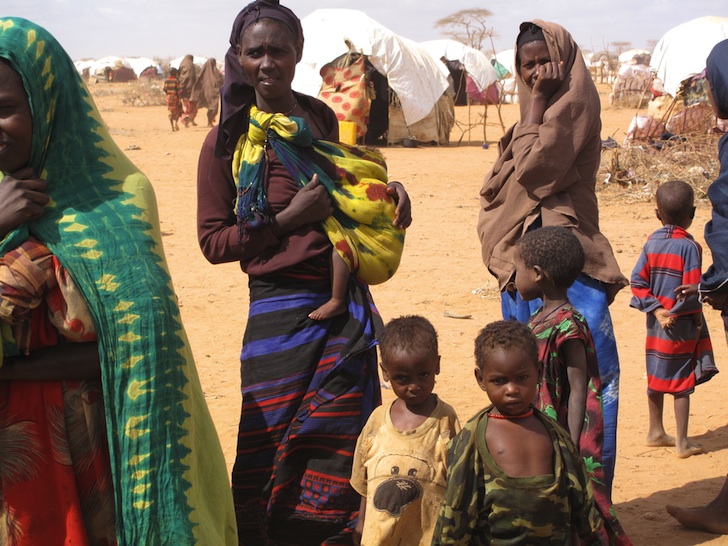
 Up to 100,000 people died in Somalia during the 2011 famine that devastated the Horn of Africa, and British scientists have reported that climate change is partly responsible. The short rains at the end of 2010 failed as a result of natural variations in weather caused by La Nina, Peter Stott of Britain’s Met Office told the Associated Press, but the early 2011 long rains that typically occur around March and April are said to have failed because of climate change.
From Drought to Famine
Oxfam International was one of many aid organizations on the ground during the drought that gripped Ethiopia, Kenya and Somalia in 2011. And then, as the crisis grew, the drought was officially upgraded to a famine.
But this was no happy upgrade. Tens of thousands of people flocked to refugee camps in Kenya seeking food when the failure of both the short and long rains eradicated all hope of food production. Many mothers were forced to bury their babies along the way, and many more never survived the arduous journey.
Somalia was particularly hard hit because al-Shabab – an Islamic extremist group that controls large areas of the country that were hit by the famine – either refused entry to aid workers or diverted resources for their own use.
At the time, environmentalists who have for decades warned governments that rising levels of greenhouse gas emissions in our atmosphere would eventually alter climate patterns suspected that global warming played a role in this humanitarian crisis.
Those suspicions have been confirmed by scientists working with Britain’s weather service, who cite “very strong evidence” that increased levels of heat-trapping gases are partly to blame.
Stem Greenhouse Gas Emissions
Oxfam International’s Country Director Senait Gebregziabher warned that failure to stem the concentration of greenhouse gas emissions in our atmosphere will further disrupt Somalia’s already unstable weather patterns, which would be disastrous given the pastoral population’s dependence on the land for their sustenance.
Sadly, this story is not limited to East Africa.
Last year thousands of people in the Sahel went hungry for similar reasons, the United States experienced the worst drought since the infamous dustbowl, as well as the worst wildfires on record, and Jordan’s water resources are drying up and the Kingdom’s residents subside on water levels that are far below those recommended by the World Health Organization (WHO).
This list goes on, but what to do?
I am writing this post on a KLM flight from the United States to Kenya, two years after the crisis began. This is my second cross-continental flight in two months, which means that despite all my meat-abstaining efforts, I am part of the problem. After all, the airline industry relies heavily on greenhouse gas emitting fossil fuels for its survival.
Yet there are signs that change is afoot. KLM recently launched flights powered by biodiesel, and oil rich nations, such as Abu Dhabi, Qatar and Saudi Arabia are phasing in renewable energy generation at different rates.
There is no question that we are making the shift to a cleaner future. Germany is a leader in this endeavor and even some of the world’s smallest and least developed nations are getting on board. The question remains: can we make a global shift fast enough to avert more famines like the one in 2011?
Image of Somalian women at refugee camp, Shutterstock


@Amy
The ‘maybes’ you talk about are actually better termed scientific probabilities. And the probabilities of a warming planet are on the rise every day.
99.99 % of scientists across the world agree that the current temperature rises we are witnessing today, are related to human release of CO2 emissions. Of course when projecting to the future you can never be certain, and so the probabilities arise.
At the end, it is not really rocket science. The blanket of CO2 in getting thicker, and as it does, we are slowly warming up.
Amy Whitson,
Planet Earth is slowly shrinking with each volcano, earthquake and ton of coal, oil and other minerals dug and pumped up out of the ground. But the number of people keeps growing and needing more resources to feed and support them. That is a collision course we may not survive unless we learn to peacefully reduce our human population with family planning education, and safely recycle 100% of all our human-generated waste materials, all the garbage, trash, junk, smoke and fumes. We don’t have much time left to change our bad habits or suffer ecocide and extinction.
Science says comet hits are eventual but science has NEVER said climate change was. Deny that. The Truth Makes Climate Change Unsustainable:
-Not one single IPCC warning says it “WILL” happen only might and could and possibly and maybe happen and……
Find us one IPCC warning that isn’t swimming in “maybes”.
Help my house is on fire maybe?
Climate change would have been a comet hit of an emergency and if “maybe” is a good enough to cause 27 years of needless CO2 panic, surely history will call us all witch burning end of the world freaks.
Nice job girls.
i just finished reading this article and i am really amazed and i am optimistic, there steel is a hope as long as we have some people who cares and gives much concern about these issues, i am willing to study and know more about these issue climate change specially the impact of the climate change on the pastoral communities who are more vulnerable i want to undertake a research in southern part of Somalia 1 wish i could get the personal contact to get some consultation
thank u
Ahmed
[email protected]