

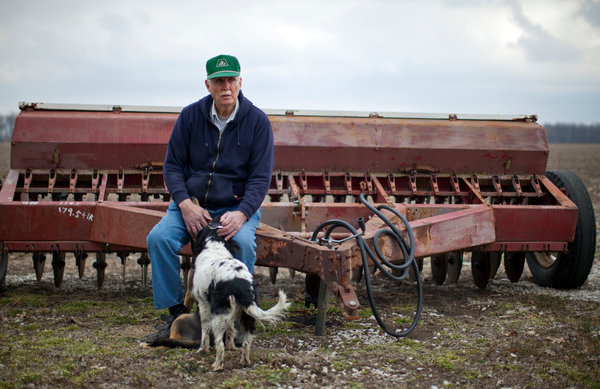
 Vernon Hugh Bowman, farmer vs Monsanto, billion dollar seed and biotech company.
It sounds like something from a book about the perils of the future, a future that is strangely today reality: The seed-engineering company Monsanto genetically engineers seeds to have desirable traits that make them hearty or the plants resistant to the effects of herbicides like Roundup. But when farmers buy and use these seeds they must sign away rights to use the seeds of future generations. After all, Monsanto is investing in the biotechnology (the company reasons) and it needs to ensure future business for its investment.
Holding back the use of one’s self-made seeds sounds almost as bizarre as bottled air in the Lorax, or the bottling of water. But in the case of water, bottled O2 and seeds: these things do happen in our polluted world.
Environmentalists typically are against the practices of Monsanto, claiming that there are certain inalienable rights people and farmers have when they buy seeds. Some farmers in Egypt have resisted Monsanto’s GM maize, while a new company from Israel called Morflora claims to have a new way of washing seeds to avoid Monsanto’s ethical problems altogether. But farmers need to think about their future, and profits. They buy Monsanto seeds because in some markets it is the only way to stay relevant.
So far Monsanto has been a winner in cases against farmers it has taken to court who have gone against the company’s terms, recounts a recent story in the New York Times. Now an American farmer Vernon Hugh Bowman, from Indiana has gone against Monsanto by using soy seeds produced by his crop. The trick: he bought his own seeds back from a grain elevator which sells the seeds for animal food.
According to the Times article: “the 75-year-old farmer from southwestern Indiana will face off Tuesday against the world’s largest seed company, Monsanto, in a Supreme Court case that could have a huge impact on the future of genetically modified crops, and also affect other fields from medical research to software.”
Bowman pleads that he honored Monsanto’s agreement and didn’t use the seeds from his harvest and noted that the contract he signed didn’t make provisions for him buying the same seeds back from another party. He told the NYT that he didn’t want to pay Monsanto huge sums of money for their soy seeds because he planted his crop late in the season, after the wheat harvest, and that it was bound to fail.
He lost to a district court hearing in 2007, and had to pay Monsanto more than $80,000 for infringing on patents owned by the company.
But now Bowman who is planning to fight till the end says, “I was prepared to let them run over me, but I wasn’t getting out of the road.”
Once the beans are sold to the grain elevator, Bowman claims that Monsanto has no more rights to them. And this is what he is bringing with him to court.
He is being helped by lawyers working pro bono.
The question about patenting living organisms has long been considered immoral, but it is the only legal tool in place that can support and grow the biotechnology industry, proponents for the industry argue.
Sources say that any Supreme Court ruling on this new case could have monumental impacts on the biotechnology industry.
I have to note that the seeds in question are ones Monsanto produces to make crops tolerant to Roundup (a Monsanto product ), a strong herbicide that kills weeds but not the crop. Roundup has also been linked to birth defects and God knows what else. Were more farmers to return to permaculture methods of farming, ones that use organic-friendly and natural pesticides, and sometimes heirloom seeds, all this business of Monsanto would be irrelevant.
Yet when I say this people I know who argue for genetic engineering they say GMOs are the only choice for feeding a hungry world. What do you say?
Image of Vernon Hugh Bowman via the NYT
Update 2013: United States Supreme Court patent decision in which the Court unanimously affirmed the decision of the Federal Circuit that the patent exhaustion doctrine does not permit a farmer to plant and grow saved, patented seeds without the patent owner’s permission. Vernon lost.



With the jury still out on whether GMOs are harmful, and the undisputed fact that they have indeed “flown the coop” so to speak, in that genetic material is being found in places where it ought not be found, perhaps it is time to pull the plug on the irresponsible behavior of the biotech industry, since they seem more interested in turning a profit than actually feeding the hungry. That and the fact that it has not been proven that GMOs produce a higher crop yield. Also, consider the many reasons so many people in the world are going hungry. There are droughts, fires, floods, corrupt governments, which keep aid for themselves, letting their citizens starve, and lack of education. Designing new and more complex GMOs is not going to fix any of that. The argument for biotech feeding the world’s hungry just does not hold water.
Patents only last twenty years, some of Monsanto’s have already expired. These could well inspire a whole generation of backyard GM inventors trying out ideas in their own fields and patenting themselves without attorneys, by simply rewriting Monsanto expired patents and adding in their own modifications. This can even even be done right now. These days you can do the whole patent process online, internationally. Even applying for a US Provisional patent is not the cheapest way to go, apply for a UK patent and you get a year to pay any fees and your UK Filing Date is good for your Non-Provisional US Patent. If nobody is interested in a year, just abandon your patent and it has cost you nothing. If someone is interested the royalty advance can pay the fees. A great cheap Amazon ebook which explains all this is DIY Patent Online, it includes links to search and filing sites and lists all the fees, plus you can even read some of it free. They also have a website but aren’t trying to sell their services like most patent sites. Attorney’s must love them. Populations need to be fed and until World population begins to contract, Monsanto is in business. However like all products Monsanto will hit a maturity barrier and that is when new backyard GM seed inventors, working in a similar way to Vernon Bowman and doing the patents themselves, could be in for a field day. Literally.
sadly, here is one man of many who could, he stands up to yet another monopoly that is slowly and surely burning up this small planet – all well and good that we read here and write our comments – where are we when this farmer fronts court? – observing, not good enough everybody.
The only concern of Monsanto is continued profits. Providing food for a hungry world (nice try). Think of Jonas Salk and vaccine for polio. Permaculture and organics are the natural way to go. The more they are used and less dependent on the monopolies, the better for everyone.
I m not looking it up again but I think there is no prof that gmo’s produce more food. Just monopolies .
The only reason Monsanto can produce and sell an ever-growing mass of its genetically altered plant products is the ever-growing human population, now more than 7 billion and counting. So, peacefully reduce the population with family planning education, while safely recycling 100% of all human-generated waste materials. Then everyone can return to a natural balance with this living biosphere that is our planet Earth.
What do I say? I say each and every day i become more educated on both sides of this “fight.” And I still have a lot more to learn. But what I have learned so far is that we don’t serve ourselves when we only read, or listen to, people on one side of any argument. I was blatantly anti-GMO for a long time — specifically because of my fear that our lack of understanding of the long term impacts of GMOs may be leading to connected increases in chronic illness like food allergies. On the other hand, I do believe there are heroes in this world who believe that GMOs or other types of breeded seeds are the answers to a global food crisis. I think it’s important to keep having conversations; keep reporting both studies and perspective pieces; and keep exploring options that serve both our short term and our long term needs.