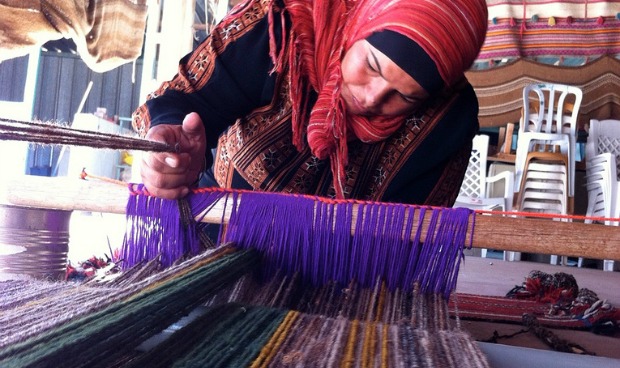
Sidreh Weaves Bedouin Tradition Into Their Future

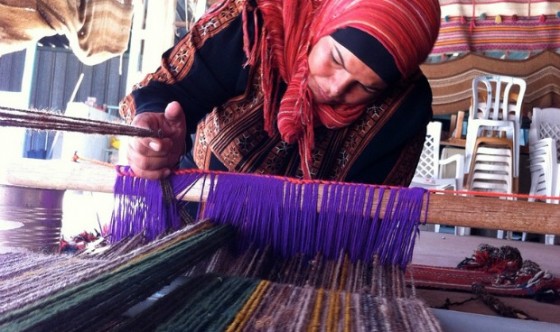
lakiya sidreh weaving workshop with bedouins
A few short decades ago, the ladies of Lakiya had a very different life. Their traditional Bedouin clans lived in encampments throughout the Israeli Negev Desert, herding animals. When their families were relocated to government-built towns, the women became aware of how their illiteracy, and their society’s rule against mingling with men who are not related to them, severely hampered their progress in the modern world.

Gradually over the past two decades, Lakiya sisters Khadra and Hanan Elsana organized Sidreh, named for a tough desert tree. Since 1991, the Sidreh center provides a safe, female-only environment where the women practice the traditional art of Bedouin weaving. While at the center, they can learn how to read and write in Arabic and Hebrew, and how to earn a high school diploma. Some of the enterprising ones have gone on to start businesses or pursue higher education.
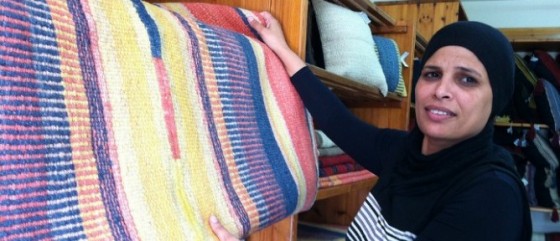
lakiya sidreh weaving workshop with bedouins handmade carpets
Khadra Elsana with a hand woven carpet

The Elsana sisters go on speaking tours regularly. Earlier this year, Hanan was at the United Nations headquarters in New York discussing the plight of Bedouin women. Khadra recently accepted a social advocacy prize in the United States.

Because of the Sidreh center, many Bedouin women in the region of Lakiya now feel comfortable leaving the house. Over time, their fathers and husbands grew to accept that the women could go outside the village for work, and even drive cars. Their daughters have started going to college, thanks to the small amounts of money the mothers make from the weaving initiative, and thanks to special programs created for them at Ben-Gurion University of the Negev.

“The men are surprised to see so many women driving today,” Khadra tells ISRAEL21c.
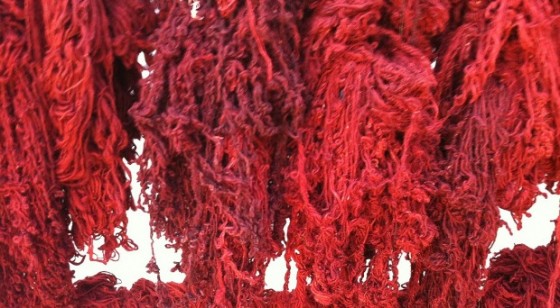
lakiya sidreh weaving workshop with bedouinsHand spun, hand dyed wool

It wasn’t easy, says the mother of four and now executive director of Sidreh. In the beginning, “women here weren’t even walking on the streets,” she says. She had to fight her community to accept her leaving the home, and she had to persuade her own husband to agree. Yet in less than one generation, she points out, the women have come a long way.

In years past, the size of a Bedouin tent was determined by how many goat, camel or sheep’s wool carpets could be made for the dwelling. But without the need for tents anymore, the women of Sidreh have found a new way to weave ancient skills into the newly developing culture.

The handmade carpets start with the collection of the pure wool from Awasi sheep, or raw goat or camel wool discarded by shearers. The women of Sidreh gather it and bring it to the center for cleaning. At the center or at home, they wind it onto spools, dye and dry it, and then use it for weaving on traditional floor looms.
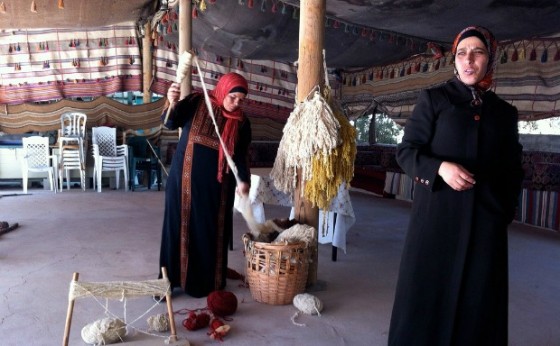
lakiya sidreh weaving workshop with bedouins

A four-meter-long strip of carpet can take about a week to weave. It’s a labor of love, with not a lot of profits, but the income from the onsite store and other fair-trade stores in cities such as Jaffa give the women enough money to buy self-confidence.

For a small fee, the women will demonstrate the entire process, with some hands-on opportunities for groups. They are open to having a dialogue with visitors, sharing details about their lives, dreams and ambitions.

“The women of Sidreh have done this to show that they can be honorable people,” says Yeela Ranaan, who runs the Bedouin Experience travel agency. A trip to the Sidreh center can be combined with other women-only Bedouin enterprises such as the embroidery center at the Association for the Improvement of Women’s Status in Lakiya, or Desert Daughter, founded by a Bedouin medicine woman’s granddaughter.
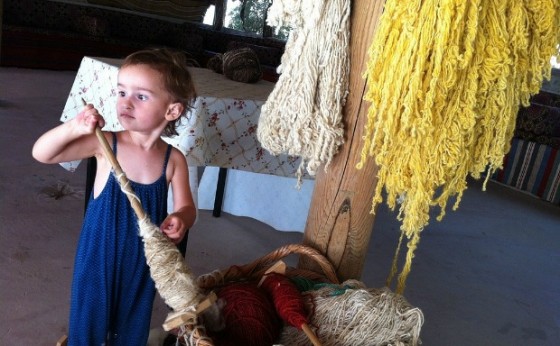
lakiya sidreh weaving workshop with bedouinsMy daughter tries her hand at spinning wool by hand.

Ranaan says the situation still needs further improvement. “About half the women in this town still don’t get out. And their daughters don’t complete high school,” says Raanan.

But for the other half, the story’s been changed.

This story was first printed on ISRAEL21c – www.israel21c.org

Karin Kloosterman
Karin Kloostermanhttp://www.greenprophet.com
Karin Kloosterman is an award-winning journalist, innovation strategist, and founder of Green Prophet, one of the Middle East’s pioneering sustainability platforms. She has ranked in the Top 10 of Verizon innovation competitions, participated in NASA-linked challenges, and spoken worldwide on climate, food security, and future resilience. With an IoT technology patent, features in Canada’s National Post, and leadership inside teams building next-generation agricultural and planetary systems — including Mars-farming concepts — Karin operates at the intersection of storytelling, science, and systems change. She doesn’t report on the future – she helps design it. Reach out directly to [email protected]

LEAVE A REPLY

Please enter your comment!
Please enter your name here

TRENDING

Earth building with Dead Sea salt bricks

Researchers develop a brick made largely from recycled Dead Sea salt—offering a potential alternative to carbon-intensive cement.

Farm To Table Israel Connects People To The Land

Farm To Table Israel is transforming the traditional dining experience into a hands-on journey.

Remilk makes cloned milk so cows don’t need to suffer and it’s hormone-free

This week, Israel’s precision-fermentation milk from Remilk is finally appearing on supermarket shelves. Staff members have been posting photos in Hebrew, smiling, tasting, and clearly enjoying the moment — not because it’s science fiction, but because it tastes like the real thing.

An Army of Healers Wins the 2025 IIE Goldberg Prize for Peace in the Middle East

In a region more accustomed to headlines of loss than of listening, the Institute of International Education (IIE) has chosen to honor something quietly radical: healing. The 2025 Victor J. Goldberg Prize for Peace in the Middle East has been awarded to Nitsan Joy Gordon and Jawdat Lajon Kasab, the co-founders of the Army of Healers, for building spaces where Israelis and Palestinians — Jews, Muslims, Christians, Druze, and Bedouins — can grieve, speak, and rebuild trust together.

Peace hospital opens between Jordan and Israel

The proposed medical centre, described by Emek HaMaayanot Regional Council head Itamar Matiash as “a centre for cancer treatment, so that people from Jordan or further away could come and receive treatment,” would become the flagship of a wider cluster of medical, academic and innovation-based services planned for the Israeli half of the zone.

Qatar’s climate hypocrisy rides the London Underground

Qatar remains a master of doublethink—burning gas by the megaton while selling “sustainability” to a world desperate for clean air. Wake up from your slumber people.

How Quality of Hire Shapes Modern Recruitment

A 2024 survey by Deloitte found that 76% of talent leaders now consider long-term retention and workforce contribution among their most important hiring success metrics—far surpassing time-to-fill or cost-per-hire. As the expectations for new hires deepen, companies must also confront the inherent challenges in redefining and accurately measuring hiring quality.

8 Team-Building Exercises to Start the Week Off 

Team building to change the world! The best renewable energy companies are ones that function.

Thank you, LinkedIn — and what your Jobs on the Rise report means for sustainable careers

While “green jobs” aren’t always labeled as such, many of the fastest-growing roles are directly enabling the energy transition, climate resilience, and lower-carbon systems: Number one on their list is Artificial Intelligence engineers. But what does that mean? Vibe coding Claude? 

Somali pirates steal oil tankers

The pirates often stage their heists out of Somalia, a lawless country, with a weak central government that is grappling with a violent Islamist insurgency. Using speedboats that swarm the targets, the machine-gun-toting pirates take control of merchant ships and then hold the vessels, crew and cargo for ransom.

Leopoldo Alejandro Betancourt López Turned Ocean Plastic Into Profitable Sunglasses

Few fashion accessories carry the environmental burden of sunglasses. Most frames are constructed from petroleum-based plastics and acrylic polymers that linger in landfills for centuries, shedding microplastics into soil and waterways long after they've been discarded. Leopoldo Alejandro Betancourt López, president of the Spanish eyewear brand Hawkers, saw this problem differently than most industry executives.

Why Dr. Tony Jacob Sees Texas Business Egos as Warning Signs

Everything's bigger in Texas. Except business egos.  Dr. Tony Jacob figured...

Israel and America Sign Renewable Energy Cooperation Deal

Other announcements made at the conference include the Timna Renewable Energy Park, which will be a center for R&D, and the AORA Solar Thermal Module at Kibbutz Samar, the world's first commercial hybrid solar gas-turbine power plant that is already nearing completion. Solel Solar Systems announced it was beginning construction of a 50 MW solar field in Lebrija, Spain, and Brightsource Energy made a pre-conference announcement that it had inked the world's largest solar deal to date with Southern California Edison (SCE).

Related Articles

Popular Categories