
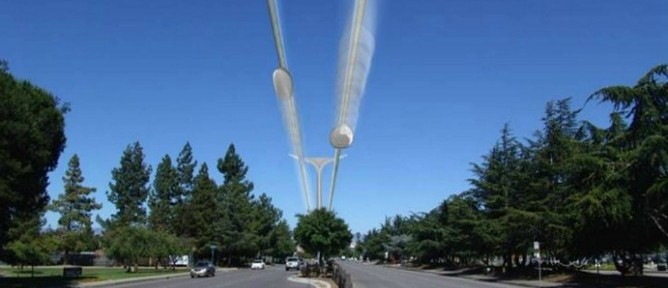

 Situated above the treeline, SkyTran commuter pods will not interfere with normal traffic: Photo illustration by NASA/SkyTran
Developing economical and green urban transit systems have not been easy. This includes such planned transit innovations as the commuter pod transit system being planned for Abu Dhabi’s carbon neutral Masdar City and a new commuter light rail line recently completed in Jerusalem and still planned for Tel Aviv.
Now a new type of ecologically clean urban transit system may soon become reality in Israel, with the completion of the SkyTran aerial pod transit system that is being developed by a company headed by Jerry Sanders, a NASA space agency technician and now Chairman and CEO of SkyTran Inc.
NASA’s AMES Research Center – Where space age technology is translated into projects on earth. Photo: NASA/SkyTran
The project is a ‘spin-off’ from space age technologies developed by NASA’s AMES Research Center, located about 15 minutes drive from San Jose California, in the heart of Silicon Valley. Sanders was recently interviewed by Israel’s Channel 2 News program, where he explained how the new system will operate.
Sanders, who hails originally from Israel and now lives both there and in the San Francisco area, says that the project involves a network of pod-like two-seater vehicles that are lifted into the air “on a pillow of air” by unique magnets and travel above ground at speeds reaching as much as 150 miles per hour (240 kph).
“The pods can even travel faster once people get used to their speed and do not require much energy expenditure,” says Sanders.
He added that the idea of this concept is to combine space age technology with the need for a reasonable cost rapid transit system.
“People will enter the pod much like they would an elevator,” he told Green Prophet.
Because the construction and operation costs of such a project are much lower than that of building a light train rail line with a projected cost of around $6 million per kilometer as compared to more than $180 million for the light train line, trip costs needn’t be high. Sanders expects that each trip will only cost around 6 NIS per person ($1.50).

A SkyTran two seat commuter pod: Photo -NASA/SkyTran
The initial route of the project will begin at the Kiryat Atidim Technology and Business Park, N.E. of Tel Aviv. It will continue past the Tel Aviv University train station and onwards to the former Tel Aviv Port, now a major entertainment and leisure area.
Another pilot route may also in in the eastern part of the coastal city of Netanya and will connect two large industrial and commercial areas with the newly completed soccer stadium.
“Both Tel Aviv Mayor Ron Huldig and Netanya Mayor Miriam Fireberg Ikar are very enthusiastic about this project,” says Sanders, who went on to say that if the initial projects are successful the system will eventually be erected in other parts of the country as well. The Tel Aviv route may also connect to the new Ariel Sharon Ecology Park, formerly the Hiriya Garbage Mountain.
From a technological standpoint, the SkyTran system, which lifts and operates the transit pod by means of magnetic air waves, is very easy to install and can be placed “in backyards and alleys” with very minimal obstruction to normal traffic.
“The amount of electricity needed to operate each pod is about a third as much as the energy required to run a Toyota Prius”, says Sanders, who also commented that this system is more economical than the total electric cars like those of Better Place.
“Better Place’s calculations do not mention the fact that the electricity used to power their cars comes from power plants that run on fossil fuels (including natural gas). There is also the matter of eventually having to recycle or dispose of the battery packs, which contain large amounts of pollutants,” he says.
How this new transportation project will compare to other innovative ones, such as the transport pods being developed for Abu Dhabi’s Masdar City and intercity rapid transit modes like the Dubai – AbuDhabi electric Superbus remains to be seen. We at Green Prophet will provide updates as the SkyTran project progresses.
More about unique regional transport systems and ecology projects:
Bio Powered Bus Fitted with Recycled Materials Cruises Dubai
Dubai to Abu Dhabi Superbus Now Road Legal
Masdar City’s Pod Car Makers Po Car Makers – The Interview
Tel Aviv’s Light Train System Still Chugs on – Slowly




This system is evidently a refreshing spirit in Israel. One of the important benefits of this kind of system is saving expensive land and more efficient land use.