Bureaucracy Slows Israel’s Solar Energy Progress

israel solar panel mirrors

Israel’s research labs such as National Solar Energy Center,  Grand Technion Energy Program (GTEP) and companies such as Zenith Solar and Arava Power Systems are developing advanced solar energy technology which is nearly cost-competitive with fossil fuels.  Israel’s solar technology has been used in places as far away as Australia and China.   Combine this with the fact that about 60 percent of Israel is a desert averaging more than 9 hours of sunshine per day and Israel’s solar energy industry should have a bright future.  But as of 2011 Israel had only installed 190 Megawatts of peak photovoltaic power generation capacity.  This is about 3 photovoltaic watts per person.  This places Israel at the top of the MENA countries, well ahead of Turkey which only has 0.1 peak photovoltaic watts installed per capita.  But outside of MENA, 19 countries exceed Israel’s photovoltaic generating capacity.  This surprising list includes such cloudy northern places as Canada with twice and Germany with 60 times Israel’s per capita photovoltaic capacity.

So what’s the problem?

Some solar power advocates claim that the reason for Israeli solar’s failure to thrive is that Israel’s government doesn’t do enough to encourage solar energy or that government bureaucracy actually discourages photovoltaic installations.  Israel’s Public Utility Authority (PUA) introduced feed-in tariffs in 2008 in an effort to encourage solar energy deployments.  Feed-in tariffs are intended to compensate for high start-up and KWh production costs so that solar can compete with legacy energy generation technologies.  Feed-in tariffs have allowed green alternative energy systems to compete with legacy technology in Israel and elsewhere.

But the tariffs introduce a level of bureaucratic complexity to solar installations.  Solar utilities can’t afford to ignore the tariffs that their competitors are benefiting from.  PUA’s scheme limits residential feed-in tariffs to 15KWp and commercial feed-in tariffs to 50KWp with a 50MW total installation limit for the first 7 years.  Residential and large scale commercial solar companies are competing for licenses which entitle them to a slice of this pie.

But now that photovoltaics have dropped as low as $1/Watt, PUE is considering  reducing feed-in tariffs by up to 34% from last year to 65 agorot per kilowatt hour.  This move is intended to save ratepayers NIS 2 billion which would otherwise become windfall profits for solar utilities.

In a Jerusalem Post article published early last month, Arava Power Company CEO Jon Cohen said that such low feed-in tariffs would cause Israel’s green energy possibilities to “slip between our fingers.”  He went on to say that  because of this policy, Eliat’s generators would continue to burn diesel during times of peak demand at a cost that exceeds the feed-in tariff.

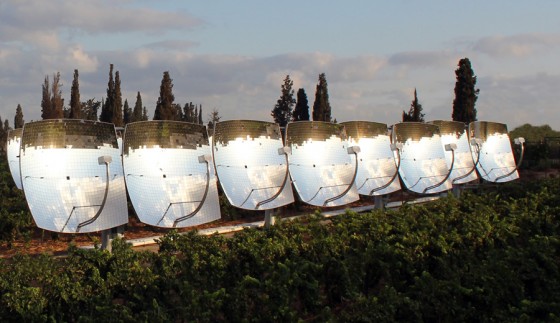
Photo of solar energy collectors from Zenith Solar

Brian Nitz
Brian Nitzhttp://www.greenprophet.com
Brian remembers when a single tear dredged up a nation's guilt. The tear belonged to an Italian-American actor known as Iron-Eyes Cody, the guilt was displaced from centuries of Native American mistreatment and redirected into a new environmental awareness. A 10-year-old Brian wondered, 'What are they... No, what are we doing to this country?' From a family of engineers, farmers and tinkerers Brian's father was a physics teacher. He remembers the day his father drove up to watch a coal power plant's new scrubbers turn smoke from dirty grey-back to steamy white. Surely technology would solve every problem. But then he noticed that breathing was difficult when the wind blew a certain way. While sailing, he often saw a yellow-brown line on the horizon. The stars were beginning to disappear. Gas mileage peaked when Reagan was still president. Solar panels installed in the 1970s were torn from roofs as they were no longer cost-effective to maintain. Racism, public policy and low oil prices transformed suburban life and cities began to sprawl out and absorb farmland. Brian only began to understand the root causes of "doughnut cities" when he moved to Ireland in 2001 and watched history repeat itself. Brian doesn't think environmentalism is 'rocket science', but understanding how to apply it within a society requires wisdom and education. In his travels through Europe, North America, Asia and the Middle East, Brian has learned that great ideas come from everywhere and that sharing mistakes is just as important as sharing ideas.

LEAVE A REPLY

Please enter your comment!
Please enter your name here

TRENDING

Earth building with Dead Sea salt bricks

Researchers develop a brick made largely from recycled Dead Sea salt—offering a potential alternative to carbon-intensive cement.

Farm To Table Israel Connects People To The Land

Farm To Table Israel is transforming the traditional dining experience into a hands-on journey.

Remilk makes cloned milk so cows don’t need to suffer and it’s hormone-free

This week, Israel’s precision-fermentation milk from Remilk is finally appearing on supermarket shelves. Staff members have been posting photos in Hebrew, smiling, tasting, and clearly enjoying the moment — not because it’s science fiction, but because it tastes like the real thing.

An Army of Healers Wins the 2025 IIE Goldberg Prize for Peace in the Middle East

In a region more accustomed to headlines of loss than of listening, the Institute of International Education (IIE) has chosen to honor something quietly radical: healing. The 2025 Victor J. Goldberg Prize for Peace in the Middle East has been awarded to Nitsan Joy Gordon and Jawdat Lajon Kasab, the co-founders of the Army of Healers, for building spaces where Israelis and Palestinians — Jews, Muslims, Christians, Druze, and Bedouins — can grieve, speak, and rebuild trust together.

Peace hospital opens between Jordan and Israel

The proposed medical centre, described by Emek HaMaayanot Regional Council head Itamar Matiash as “a centre for cancer treatment, so that people from Jordan or further away could come and receive treatment,” would become the flagship of a wider cluster of medical, academic and innovation-based services planned for the Israeli half of the zone.

Qatar’s climate hypocrisy rides the London Underground

Qatar remains a master of doublethink—burning gas by the megaton while selling “sustainability” to a world desperate for clean air. Wake up from your slumber people.

How Quality of Hire Shapes Modern Recruitment

A 2024 survey by Deloitte found that 76% of talent leaders now consider long-term retention and workforce contribution among their most important hiring success metrics—far surpassing time-to-fill or cost-per-hire. As the expectations for new hires deepen, companies must also confront the inherent challenges in redefining and accurately measuring hiring quality.

8 Team-Building Exercises to Start the Week Off 

Team building to change the world! The best renewable energy companies are ones that function.

Thank you, LinkedIn — and what your Jobs on the Rise report means for sustainable careers

While “green jobs” aren’t always labeled as such, many of the fastest-growing roles are directly enabling the energy transition, climate resilience, and lower-carbon systems: Number one on their list is Artificial Intelligence engineers. But what does that mean? Vibe coding Claude? 

Somali pirates steal oil tankers

The pirates often stage their heists out of Somalia, a lawless country, with a weak central government that is grappling with a violent Islamist insurgency. Using speedboats that swarm the targets, the machine-gun-toting pirates take control of merchant ships and then hold the vessels, crew and cargo for ransom.

Leopoldo Alejandro Betancourt López Turned Ocean Plastic Into Profitable Sunglasses

Few fashion accessories carry the environmental burden of sunglasses. Most frames are constructed from petroleum-based plastics and acrylic polymers that linger in landfills for centuries, shedding microplastics into soil and waterways long after they've been discarded. Leopoldo Alejandro Betancourt López, president of the Spanish eyewear brand Hawkers, saw this problem differently than most industry executives.

Why Dr. Tony Jacob Sees Texas Business Egos as Warning Signs

Everything's bigger in Texas. Except business egos.  Dr. Tony Jacob figured...

Israel and America Sign Renewable Energy Cooperation Deal

Other announcements made at the conference include the Timna Renewable Energy Park, which will be a center for R&D, and the AORA Solar Thermal Module at Kibbutz Samar, the world's first commercial hybrid solar gas-turbine power plant that is already nearing completion. Solel Solar Systems announced it was beginning construction of a 50 MW solar field in Lebrija, Spain, and Brightsource Energy made a pre-conference announcement that it had inked the world's largest solar deal to date with Southern California Edison (SCE).

Related Articles

Popular Categories