
New Israeli Cemeteries Focus on Dense Burial…and Adding Charm

dense burial niche israel flowersHigh-rise necropolises offer a greener way of dense burial and a dignified appearance to comfort mourners.

Having buried two loved ones in Israel myself, I know how wearisome field cemeteries are. Arriving on foot, I trudge along winding interior roads for long minutes, sweating and squinting against the glare in summer or huddling under a dripping umbrella in winter. No matter how often I’ve visited the graves, unfamiliar new roads built to accommodate fresh burial grounds disorientate me and I lose my way. According to Israel’s Central Bureau of Statistics, the current yearly death rate stands at 5.3 per 1000 people, so new roads and burial grounds must be expected.

Having located the section, I gingerly step between graves, careful not to disrespect any by walking on them. The grave behind me is decorated with a cactus garden, the family’s attempt to soften the harsh look of the place. Cemeteries in Israel don’t have the luxury of grassy spaces and flowering borders; there simply isn’t enough space, nor water to spare for maintaining tender greenery. Most mourners have nothing of comfort to rest their eyes on but a tombstone and the traditional pebble placed on the grave. People of means erect headstones of imported stone or marble.

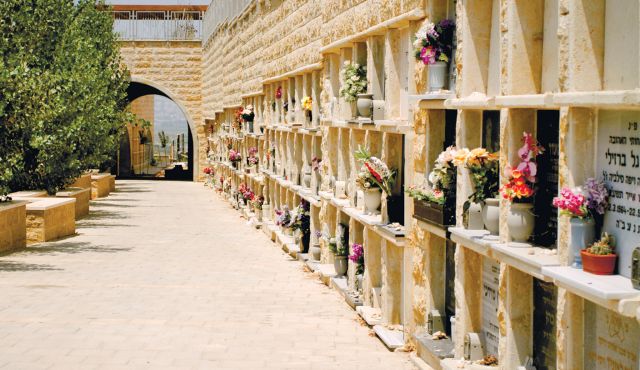
How much more green sense does dense burial make: buildings of local stone where the deceased rest in niches. (See our previous two posts on this old/new eco-burial style here and here.) Stately trees provide shade. Mediterranean landscaping, with benches for visitors to rest on, offer a measure of comfort. Forward-thinking Israeli architects are now working with local burial societies to construct such modern necropolises, which will accommodate tens of thousands of graves.

Architect Yechiel Komet’s projected dense burial site is a series of terraces connected by circular ramps. To be constructed on Jerusalem’s sprawling Har HaMenuchot cemetery, it will house 30,000 graves. Komet’s experience in planning major hotels serves when planning the esthetics of the place, which he envisions as a sort of garden.

“There is a lot of power in cemeteries, and as an architect I am trying to make the ritual of burial easy to accomplish, as well as dignified; to think about the individual person who goes there to unite with the memory of a loved one, but also to think about the family accompanying their loved one on his final journey, ” Komet told Haaretz.

The new vertical burial site at the Yarkon Cemetery, planned by architects Eytan Ronel and Dorit Levy, will contain 12,5000 graves. Here also there is a pleasant, dignified atmosphere and privacy.

“High-density burial is a hybrid of landscape development and construction,” says Ronel in the same interview.

The Yarkon cemetery has another team working on high-density sites. The Ponger-Sagiv architectural team plans two sites there that will contain  23,000 graves.

“Here you come to the entrance and the grave is closer,” says Tuvia Sagiv. “You are in a building made up of many spaces and it is possible to spend time in it. I think the method of burying in niches is more dignified.” He adds,  “At first people didn’t believe they were getting these graves for free.”

Indeed, some of the public has displayed an initial opposition to this system of burial. But the burial societies, who are investing NIS 250 million at Har Hamenuhot and NIS 190 million at the Yarkon cemetery, are confident that eventually all sectors of Israeli society will see the advantages of these cemeteries. The plans are backed by the Ministry of Religious Affairs and it’s expected that by 2040-2050, dense burial will be the way to go.
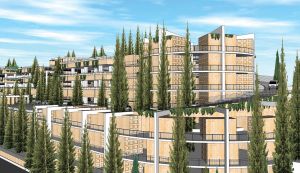

image-dense-burial-jerusalem

More cheerful news about death on Green Prophet:
Photo of Tel Regev cemetery near Haifa by Hagai Fried.
Drawing of the projected Har Hamenuchot vertical cemetery by Yechiel Komet.


Miriam Kresh
Miriam Kreshhttps://www.greenprophet.com/
Miriam Kresh is an American ex-pat living in Israel. Her love of Middle Eastern food evolved from close friendships with enthusiastic Moroccan, Tunisian and Turkish home cooks. She owns too many cookbooks and is always planning the next meal. Miriam can be reached at miriam (at) greenprophet (dot) com.
2 COMMENTS
  1. a very true problem in here.but there are more solutions; we buried my grandmother in a cemetery that belongs to a funeral home by the name “aley shalechet” (which means autumn leaves). They have private cemeteries in different areas in israel. All are spacious, with green tall grass, flowers,benches and trees. We buried nana under a small tree by a bench. Surrounded by her favorite flowers. I think private cemeteries are the only solution for people who care. Also it is more protected (we all heard about the burglers and violent acts in cemeteries). It is safe and easier to visit and to maintaine. And on this note I would also like to recommend on the company that dealt with grandma’s death and to command them, they set the whole funeral. Helped with everything while my parents couldn’t and were just such great souls. Thank u

Comments are closed.

TRENDING

Ancient mud buildings in the Muslim world are spectacular and sustainable

Other notable mud structures in the wider Muslim world include the Bob Dioulasso Grand Mosque in Burkina Faso, and the Khiva Wall in Uzbekistan, which is built around a collection of Islamic schools and mosques. The Siwa Oasis in Egypt (which we visited and posted about here) and the Eastern Castle in Syria have also employed mud bricks in their construction, and research shows that the famous walls of Jericho were built using sun-dried mud bricks.

The 2025 Aga Khan Architecture Winners: Building Resilience and Community

The 2025 Aga Khan Award for Architecture honors seven projects from Bangladesh to Iran that blend sustainability, cultural heritage, and community empowerment — from flood-resilient homes to the revival of Egypt’s historic Esna — showcasing how design can tackle climate, social, and urban challenges with beauty and purpose.

BIG Palliative Care: Denmark’s Nature and Spirituality in Dignified End-of-Life Care

Bjarke Ingels Group has won the competition to design the new Sankt Lukas Hospice and Lukashuset, a 8,500 m² palliative care center envisioned as a village nestled within nature. Building on the legacy of the Sankt Lukas Foundation, established in the 1930s, this project will significantly expand Denmark's palliative care capacity, tripling its current facilities to serve approximately 2,100 patients each year.

Binishell dome homes from sprayed concrete could cost $3500 a home

Binishells are a fast-made construction made by inflating a gigantic neoprene bladder then covering this balloon in a thin coat of reinforced spray-on concrete. The technique developed in the 60s by an Italian architect could be a great solution to urban and rural housing in southern United States and Mediterranean regions.

New Gourna and Egyptian Architect for Social Justice: Hassan Fathi

The ideas of Hassan Fathy, Egyptian architect whose views on sustainable architecture and social justice were scorned in his time, is inspiring modern opinions today.

Turning Your Energy Consultancy into an LLC: 4 Legal Steps for Founders in Texas

If you are starting a renewable energy business in Texas, learn how to start an LLC by the books.

Tracking the Impacts of a Hydroelectric Dam Along the Tigris River

For the next two months, I'll be taking a break from my usual Green Prophet posts to report on a transnational environmental issue: the Ilısu Dam currently under construction in Turkey, and the ways it will transform life along the Tigris River.

6 Payment Processors With the Fastest Onboarding for SMBs

Get your SMB up and running fast with these 6 payment processors. Compare the quickest onboarding options to start accepting customer payments without delay.

Qatar’s climate hypocrisy rides the London Underground

Qatar remains a master of doublethink—burning gas by the megaton while selling “sustainability” to a world desperate for clean air. Wake up from your slumber people.

How Quality of Hire Shapes Modern Recruitment

A 2024 survey by Deloitte found that 76% of talent leaders now consider long-term retention and workforce contribution among their most important hiring success metrics—far surpassing time-to-fill or cost-per-hire. As the expectations for new hires deepen, companies must also confront the inherent challenges in redefining and accurately measuring hiring quality.

8 Team-Building Exercises to Start the Week Off 

Team building to change the world! The best renewable energy companies are ones that function.

Thank you, LinkedIn — and what your Jobs on the Rise report means for sustainable careers

While “green jobs” aren’t always labeled as such, many of the fastest-growing roles are directly enabling the energy transition, climate resilience, and lower-carbon systems: Number one on their list is Artificial Intelligence engineers. But what does that mean? Vibe coding Claude? 

Somali pirates steal oil tankers

The pirates often stage their heists out of Somalia, a lawless country, with a weak central government that is grappling with a violent Islamist insurgency. Using speedboats that swarm the targets, the machine-gun-toting pirates take control of merchant ships and then hold the vessels, crew and cargo for ransom.

Related Articles

Popular Categories