
A Desert Shrub That Outwits Mice

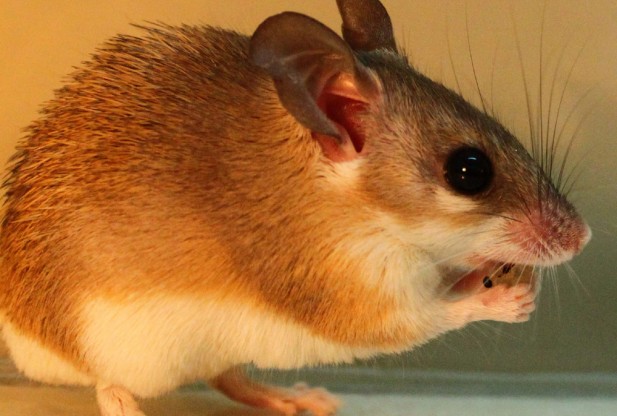
nature, evolution, wildlife, desert, IsraelWhile humans inch closer to their eventual demise by burning up the resources upon which they so richly depend, the earth’s “lower” species are making moves to ensure their longevity. US and Israeli researchers published a joint study in the journal Current Biology that unveils how a desert shrub called Ochradenus baccatus outwits the spiny mice by planting a “mustard bomb” in its seed. When a mouse chews the seed, which then turns to pulp, an embedded enzyme releases a toxic cocktail that causes the mouse to spit it out. This in turn ensures the seed’s survival.

Hot mustard

Researchers from the University of Utah and the Technion-Israel Institute of Technology discovered that enzymes present in mignotte berries release isothiocyanates – the flavor of hot mustard – in order to deter the mice from consuming them completely.

When scientists deactivated the mustard bomb enzyme in labs, the mice devoured up to 80% of the seeds, leaving none behind for dispersal.

However, when mice eat mignotte berries in their natural habitat, they tend to retreat to areas that are favorable for the desert bush, according to the study’s co-author and Professor of Biology at the Univeristy of Utah Denise Dearing.

Directed deterrence

As a result, once the hot mustard chemical prompts the mice to spit out the gnarled seeds, they are primed for successful germination.

“The mice are actually dispersing the seeds to a suitable habitat for germination,” Dearing told Red Orbit. “Under the parent plant is a bad spot. A rocky crevice would be a cool, suitable location because it’s not in direct sunlight.”

The process by which plants “outwit” their consumers is called “directed deterrence.”

The best known example before the new study, Dearing noted, involved chili peppers, which deter mammals from eating their seeds because mammals feel pain induced by their ingredient, capsaicin. Because birds “don’t feel the heat at all, they tend not to crush the seeds while they are feeding, so they are good dispersers of chili pepper seeds,” said Dearing.

Chewed seeds are stronger

Most remarkably, the researchers discovered that the chomped seeds were actually twice as likely to germinate as un-chomped seeds, revealing an exciting symbiosis between the spiny mouse and the “clever” bush. We have a lot to learn.

Although human beings have neglected nature’s genius in the last century or so, some enlightened individuals are not only beginning to discern its inherent wisdom, but are attempting to mimic it in design and other fields.

We previously talked to Melissa Sterry, one of the foremost experts on biomimicry, but Egypt has its proponents too. Dayma leads tours that teach young and old about the lessons that camels, scorpions and other species can teach us, and how we can mimic their adaptations to improve life for us as well.

:: Red Orbit

Photo Credit: Michal Samuni-Blank, Technion-Israel Institute of Technology

More on Nature’s Genius:

Israeli Military Uses Biomimicry to Design Butterfly Drone

Inspired by Nature, Water Tips for the Middle East

What Camels and Scorpions Teach Dayma Tourists in Egypt 

Curvy Desert Home Designed by Iranian Students Mimics the Snail

 

Tafline Laylin
Tafline Laylinhttp://www.greenprophet.com
As a tour leader who led “eco-friendly” camping trips throughout North America, Tafline soon realized that she was instead leaving behind a trail of gas fumes, plastic bottles and Pringles. In fact, wherever she traveled – whether it was Viet Nam or South Africa or England – it became clear how inefficiently the mandate to re-think our consumer culture is reaching the general public. Born in Iran, raised in South Africa and the United States, she currently splits her time between Africa and the Middle East. Tafline can be reached at tafline (at) greenprophet (dot) com.

TRENDING

Everything is better when you spend 5 days in a cave

She spent 5 days in a cave in the dark. See what it did to her body.

What is the Jewish Climate Trust?

Jewish Climate Trust has quickly attracted the attention and support of some of the most influential voices in Jewish philanthropy, drawing backing from prominent family foundations and business leaders connected to the Bronfman and Schusterman philanthropic networks, alongside climate-focused investors and community builders aligned with founding leader Nigel Savage. Together, these donors have committed many millions of dollars to build a serious, long-term climate platform for the Jewish world — not as a symbolic gesture, but as a strategic intervention in one of the defining challenges of this generation.

Who gave the first kiss?

When you experience your first kiss you might feel like you are the first in the world to feel that way. Kissing, scientists say, occurs in a variety of animals (even if today it's not in every culture), and it presents an evolutionary puzzle: kissing, a learned behavior, carries high risks, such as disease transmission like herpes and hepititis, while offering no obvious reproductive or survival advantage.

Lizard tail stew, dhub mansaf, is a favored folk dish in Saudi Arabia

By exploring forgotten folk dishes like lizard stew, Green Prophet continues to connect the dots between culture, ecology, and the future of sustainable living in the Middle East.

Afghan Taxis Get Ancient Persian A/C Hack—And It Works Better Than Yours

The Afghan windcatcher car cooler isn’t just clever. It’s low-cost climate adaptation. With rising global temperatures and millions of cars still without functioning air con, it’s a design-for-the-rest-of-us moment. A punk rock move in a world of overdesigned heat tech. Plus, it’s deeply sustainable: no refrigerants, no increased fuel use, no carbon guilt. Just water, airflow, and a little DIY spirit.

Turning Your Energy Consultancy into an LLC: 4 Legal Steps for Founders in Texas

If you are starting a renewable energy business in Texas, learn how to start an LLC by the books.

Tracking the Impacts of a Hydroelectric Dam Along the Tigris River

For the next two months, I'll be taking a break from my usual Green Prophet posts to report on a transnational environmental issue: the Ilısu Dam currently under construction in Turkey, and the ways it will transform life along the Tigris River.

6 Payment Processors With the Fastest Onboarding for SMBs

Get your SMB up and running fast with these 6 payment processors. Compare the quickest onboarding options to start accepting customer payments without delay.

Qatar’s climate hypocrisy rides the London Underground

Qatar remains a master of doublethink—burning gas by the megaton while selling “sustainability” to a world desperate for clean air. Wake up from your slumber people.

How Quality of Hire Shapes Modern Recruitment

A 2024 survey by Deloitte found that 76% of talent leaders now consider long-term retention and workforce contribution among their most important hiring success metrics—far surpassing time-to-fill or cost-per-hire. As the expectations for new hires deepen, companies must also confront the inherent challenges in redefining and accurately measuring hiring quality.

8 Team-Building Exercises to Start the Week Off 

Team building to change the world! The best renewable energy companies are ones that function.

Thank you, LinkedIn — and what your Jobs on the Rise report means for sustainable careers

While “green jobs” aren’t always labeled as such, many of the fastest-growing roles are directly enabling the energy transition, climate resilience, and lower-carbon systems: Number one on their list is Artificial Intelligence engineers. But what does that mean? Vibe coding Claude? 

Somali pirates steal oil tankers

The pirates often stage their heists out of Somalia, a lawless country, with a weak central government that is grappling with a violent Islamist insurgency. Using speedboats that swarm the targets, the machine-gun-toting pirates take control of merchant ships and then hold the vessels, crew and cargo for ransom.

Related Articles

Popular Categories