
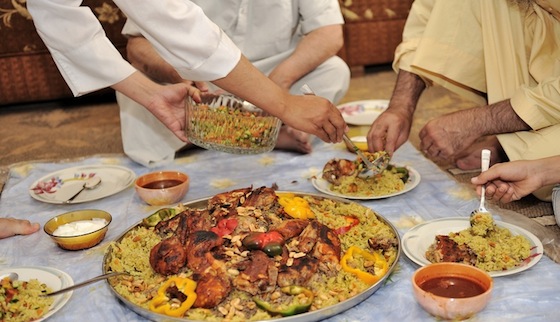
Fasting Jordanians Eat $700 Million Worth of Food During Ramadan

syria, jordan, ramadan meal, iftar
It’s counter-intuitive, but food consumption soars during the month of Ramadan fasting.

Jordanian households spent nearly $150 million on food during the first three days of Ramadan this year, according to the Jordan Chamber of Commerce (JCC). Khalil Haj Tawfiq, from the JCC food sector, told The Jordan Times that over the past few years Ramadan food consumption has been averaging over $700 million.

Iftar, the evening meal when Muslims break their day-long fast (read our Green Iftar Guide here), is best likened to America’s Thanksgiving: a splendid multi-course feast that combines religious observance with family celebration. It’s most commonly held within the home, but businesses and social organizations hold special formal iftars too, lengthy dining events offering a fabulous display of traditional foods. Whereas Thanksgiving is a one-day occurrence, Jordan’s one million households are very likely participating in an iftar celebration every night of the holy month.

Haj Tawfiq, formerly president of the Foodstuff Traders Association (FTA), points out that tens of thousands of Arab tourists who travel during Ramadan to visit family living in Kingdom add to the food demand. In addition, charitable donations of food to the poor increases this month.

This all adds up to tons of food.  Really, tons.

According to Haj Tawfiq, during the holy month, Jordanians munch through approximately 15,000 tons of sugar,  12,000 tons of rice,  and 20,000 tons of chicken (the birds alone are valued at $74 million).

No one’s skimping on the beef and fish: consumers stock up on over 2,000 tons of red meat and 2,000 tons of fish. Individual stats on breads, teas, juices and sweets were not detailed, but do factor into the national cash register receipt exceeding half a billion dollars.

“This year we (merchants) expect consumption to be lower than last year because the purchasing power of Jordanians is weaker,” he noted, adding that rising electricity tariffs and fuel prices have increased living costs for the majority of Jordanians. Decrease in 2012 demand is attributed to weaker purchasing power, as consumers also wrestle with high levels of unemployment.

Market demand for food products usually picks up a week ahead of Ramadan and rolls into the first few days of the fasting month, according to FTA president Samer Jawabreh.  He calculated this trend as a 50% increase over non-Ramadan consumption patterns, and he agreed that the demand for food in Ramadan appears to be lower this year than last.

Despite complaints by consumers of rising food prices, the FTA insists that food prices are stable and that prices of certain commodities now cost less then last year.

It’s reported that the Kingdom’s food distributors have enough goods in store to cover the local market needs for over 120 days.  I hope the clothing distributors are equally well stocked in clothing with elastic waistbands.

Image of Ramadan meal from Shutterstock

LEAVE A REPLY

Please enter your comment!
Please enter your name here

TRENDING

Earth building with Dead Sea salt bricks

Researchers develop a brick made largely from recycled Dead Sea salt—offering a potential alternative to carbon-intensive cement.

Peace hospital opens between Jordan and Israel

The proposed medical centre, described by Emek HaMaayanot Regional Council head Itamar Matiash as “a centre for cancer treatment, so that people from Jordan or further away could come and receive treatment,” would become the flagship of a wider cluster of medical, academic and innovation-based services planned for the Israeli half of the zone.

Vegetarian Ramadan Recipes From the Middle East

From Ma'amoul to Couscous, why not try a new...

How EcoPeace Uses Environmental Education to Bridge Borders in the Jordan Valley

In a region long marked by political divides, armed conflict, and environmental degradation, EcoPeace Middle East is quietly advancing the power of peacebuilding. Peace through education. Through its cross-border teacher tours in the Jordan Valley, EcoPeace is bringing together educators from Israel, Jordan, and the Palestinian territories to address critical environmental issues.

Jordan turns to ancient fire and mines volcanic soil to solve water crisis

In the volcanic highlands of northern Jordan, north of Amman engineers are mining a natural resource not for energy, but for agriculture. The material: crushed volcanic rock, now processed into a mineral-rich soil that may hold the key to reducing water and fertilizer demand in arid regions.

Qatar’s climate hypocrisy rides the London Underground

Qatar remains a master of doublethink—burning gas by the megaton while selling “sustainability” to a world desperate for clean air. Wake up from your slumber people.

How Quality of Hire Shapes Modern Recruitment

A 2024 survey by Deloitte found that 76% of talent leaders now consider long-term retention and workforce contribution among their most important hiring success metrics—far surpassing time-to-fill or cost-per-hire. As the expectations for new hires deepen, companies must also confront the inherent challenges in redefining and accurately measuring hiring quality.

8 Team-Building Exercises to Start the Week Off 

Team building to change the world! The best renewable energy companies are ones that function.

Thank you, LinkedIn — and what your Jobs on the Rise report means for sustainable careers

While “green jobs” aren’t always labeled as such, many of the fastest-growing roles are directly enabling the energy transition, climate resilience, and lower-carbon systems: Number one on their list is Artificial Intelligence engineers. But what does that mean? Vibe coding Claude? 

Somali pirates steal oil tankers

The pirates often stage their heists out of Somalia, a lawless country, with a weak central government that is grappling with a violent Islamist insurgency. Using speedboats that swarm the targets, the machine-gun-toting pirates take control of merchant ships and then hold the vessels, crew and cargo for ransom.

Leopoldo Alejandro Betancourt López Turned Ocean Plastic Into Profitable Sunglasses

Few fashion accessories carry the environmental burden of sunglasses. Most frames are constructed from petroleum-based plastics and acrylic polymers that linger in landfills for centuries, shedding microplastics into soil and waterways long after they've been discarded. Leopoldo Alejandro Betancourt López, president of the Spanish eyewear brand Hawkers, saw this problem differently than most industry executives.

Why Dr. Tony Jacob Sees Texas Business Egos as Warning Signs

Everything's bigger in Texas. Except business egos.  Dr. Tony Jacob figured...

Israel and America Sign Renewable Energy Cooperation Deal

Other announcements made at the conference include the Timna Renewable Energy Park, which will be a center for R&D, and the AORA Solar Thermal Module at Kibbutz Samar, the world's first commercial hybrid solar gas-turbine power plant that is already nearing completion. Solel Solar Systems announced it was beginning construction of a 50 MW solar field in Lebrija, Spain, and Brightsource Energy made a pre-conference announcement that it had inked the world's largest solar deal to date with Southern California Edison (SCE).

Related Articles

Popular Categories