
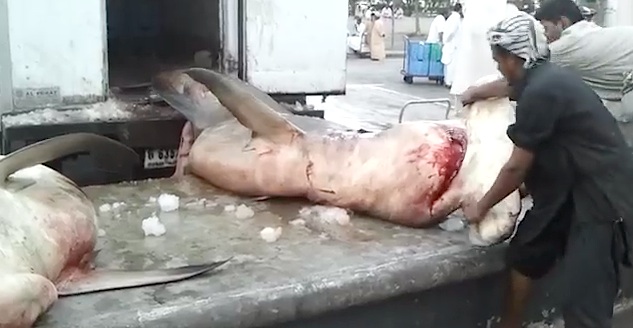


A disturbing video of an enormous Great hammerhead shark (Sphyma mokarran) being hauled out of a truck in a Dubai fish market reveals once again the failure of authorities to monitor shark fishing in the United Arab Emirates. We had used an image of it here, but it was so violent and ugly Google banned the page! So we removed it for the tamer pic you see above.
In the UAE, it is officially illegal to kill sharks with the sole purpose of harvesting their fins, but Dubai has a record of supplying shark fins to Hong Kong, where they are highly coveted as the main ingredient in shark fin soup. They are never captured for their meat, which the International Union of Conservation (IUCN) claims is considered unpalatable. Hit the jump to see the video.
[youtube]http://www.youtube.com/watch?v=LermuNgmwpQ[/youtube]
Reproductive prime
This video was uploaded onto the Shark Year website by Alexmoz76, who we were unable to reach for comment.
But Jonathan Ali, Managing Director of Wild Animal Productions and a renowned shark activist based in the UAE, posted the video on his Facebook page with strong exclamations of disapproval.
“Another massive great Hammerhead in Dubai fish market brought in from Oman!” he wrote. “They can barely get it out of the truck!! This is a magnificent specimen and reproductively in its prime! What a sad waste!”
Great hammerhead sharks are particularly vulnerable since they only reach sexual maturity when they are five years old, according to a 2011 story published in The National. And then they only reproduce once every two years.
Last year we posted a ghastly image of a female hammerhead that was killed along with a belly full of pups, a devastating loss to the species that prompted a massive outcry.
Shoddy enforcement
Shark conservation in the UAE is hampered in great measure because of gaps in crucial data, which Rima Jabado from Lebanon – a doctoral student at UAE University – is striving daily to fill. In an interview with Arwa, Rima describes the challenges associated with shark conservation and overfishing.
She explains that shark finning is a major threat to this apex species, but it is not the only one. Habitat degradation and by-catch in places where the hammerhead is not specifically targeted are other key factors contributing to diminishing populations.
Although Article 5 of the UAE’s Ministry of Environment and Water’s Decree No. 216 makes it clear that “capture of sharks for fins is prohibited,” the law in Dubai is poorly enforced. Notice that the men handling the enormous shark were completely unphased by the cameraman, which probably means that they have little fear of retribution.
Great hammerheads are listed as globally endangered on the IUCN red list but as long as their fins remain so profitable, it will be very difficult to slow their journey towards extinction.
More on Shark Fishing and Finning in the UAE:
Dubai Marine Life at Risk After Devastating Shark Catch
25 Shark Species in the Persian Gulf Need Urgent Protection
Shark Fin Soup Can Give You Brain Damage



Thank you, Jonathan, for this lengthy and informative response. We appreciate your inside perspective and are naturally eager for updates. Is finning legal in Oman?
Thank you for posting this article and bringing the shark plight to the attention once again of your readers. I would, however, like to ask you to state that there are some important errors in your report.
Please note that this shark was brought into the UAE from Oman with import permits that are enforced by the Ministry of Environment. Since there is currently no CITES ban on hammerhead sharks (only 3 species of sharks are currently on Appendix II), then there is technically and legally no reason to prevent the movement of non-listed sharks from Oman to UAE markets.
Therefore, it is incorrect to place the blame for shark overfishing of sharks on the shoulders of UAE fishermen. In fact, UAE fisheries is not the main concern. Oman has a far more significant shark fisheries and the real issue facing UAE authorities is how to determine ways to control the fin trade.
Most fins reaching the UAE’s fin export trade are reaching the UAE from other parts of the region (namely Oman, Somalia, Eritrea, Yemen, Iran and some GCC countries). The role the authorities need to tackle is that of being a major distribution hub that transports upto 8% of the fins reaching Hong Kong alone (according to FAO statistics).
If we keep things in perspective, the UAE is not a major shark fisher and does not deserve to be condemned as such. In fact, they are trying to prevent overfishing in general and have implemented legislation to ban shark fishing during the most important breeding season when sharks are closer inshore and easier to catch. The Ministry of Environment is also preparing a media based shark awareness program and a major regional shark workshop in order to discuss the status of sharks with other GCC and Arab region ministries this coming October.
So I would please be very grateful if you would not get Oman and the UAE’s issues mixed up. On the one hand, the main shark fishing issues relating to hammerhead sharks and a number of other extremely important species needs to be tackled by Omani authorities. On the other hand, the issue of the fin trade and so called ‘import & re-export’ of fins needs to be tackled by the UAE authorities.
It is hoped that next year’s CITES COP 16 meeting in Thailand will see once again proposals to add hammerheads to the Appendix II list for trade controls. If they do get added, then this region needs to assume full responsibility towards protecting what are clearly very important pupping grounds for at least two of the hammerhead species. With that in place, scenes like these will soon be a thing of the past. Lets only hope it isn’t too late!
Thank you,
Jonathan Ali Khan
Wild Planet Productions