Turkey’s Early Hydroelectric Dams Featured in Exhibit

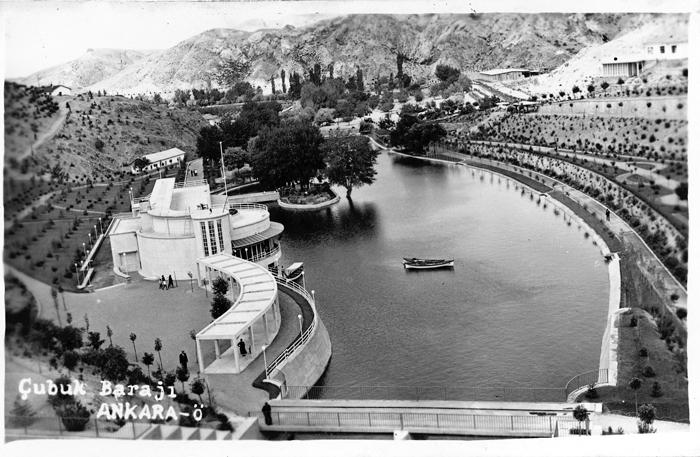
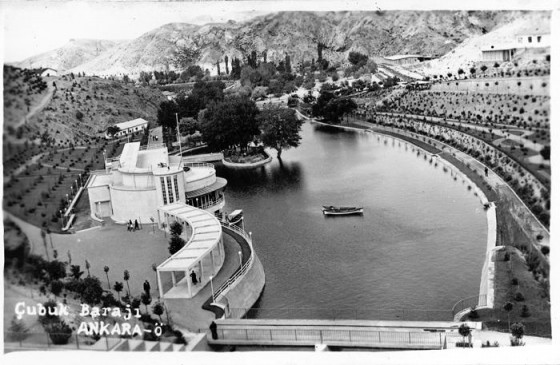
ankara dam turkeyThe first hydroelectric dam built in Ankara, Turkey’s capital city, the Çubuk Dam was promoted as “Ankara’s Bosphorus”.

A new exhibit at Istanbul’s avant-garde SALT Galata gallery, Graft, throws open the archive of material about Turkey’s first major hydroelectric projects in the 1930s. The display critically analyzes the motives behind these early endeavors — and the effects of the extensive hydroelectric industry they spawned in Turkey.

Marmara reservoir, Atatürk Model Farm, Ankara<br ></a>Aslıhan Demirtaş archive<br />

The “Marmara Basin” was an irrigation reservoir on a model farm in Ankara constructed by Atatürk, the founder of the Turkish Republic. It refers to the Marmara Sea, which lies south of Istanbul. The farm featured another reservoir named after the Black Sea.

Based on a Turkish architect’s PhD dissertation at the Massachusetts Institute of Technology, Graft traces the construction  and administration of dams during Turkey’s Republican Period, the first two decades after the founding of the republic in 1923.

In an effort to generate more energy and emulate more industrialized nations, many of Turkey’s river basins and lakes were turned into dams in the 1930s, especially in the dry, barren land around the new capital city of Ankara.

Aslıhan Demirtaş, the architect behind the SALT exhibit, locates these developments in a broader historical context: humankind’s ongoing quest to shape nature to its purposes.

“As well as being a necessity in the post-industrial world, it was also a reflection of man’s desire to dominate nature,” she told reporters at the exhibit’s recent opening, according to the Hürriyet Daily News.

Çubuk Dam, Ankara<br ></a>Aslıhan Demirtaş archive<br />

Another view of the Çubuk Dam, showing the height of its walls.

Demirtaş sees these projects as efforts to “graft” a modern, expansion-focused infrastructure onto the rural Anatolian plain of old — hence the exhibit’s name.

“These modern projects of a ‘modern’ geography are cultivars, propagated by grafting an Ottoman scion onto an Anatolian root: Istanbul’s waterfront geography, onto Ankara’s barren land,” reads the description of the exhibit on SALT’s website.

The website further explains how these early projects of the 1930s became the prototypes for the 700 hydroelectric dams all over modern Turkey:

The singular Directorate of Public Works of the 1930s, which propagated the cultivars of Ankara, proliferated into a complex machine of multiple ministries and government organizations to develop regional development plans through the 1950s. As a result, the cultivar of Ankara was re-grafted all over the country. Multiplied in a massive scale on the riverbeds of Anatolia and Eastern Thrace, the cultivars, consequently, transformed and mutated into a wild species of aggressive and invasive nature.

Opening of Çubuk Dam, 1936, Ankara<br ></a>Necati Kazancı archive

Each of Turkey’s current 26 regions, which were delineated after the 1950s, was located around a corresponding river basin so that each would have a steady supply of energy and irrigation water.

The exhibit also includes two 1/50,000 size models of Turkey’s major dams on the Tigris and Euphrates Rivers.

“This is to concretize, at least partly, the physical aspect of Turkey’s modernization process,” Demirtaş told the Hürriyet Daily News.

That modernization process has come a long way since the early, hopeful days of the Republic. Turkey’s dams are now notorious for hogging water supplies and degrading their surrounding environments.

The hydroelectric dams on the Tigris and Euphrates are now violating the human rights of communities downstream of Turkey, according to a report by the United Nations last year. They are the biggest source of contention between Turkey and Iraq. And a planned hydroelectric project in northeastern Turkey could similarly poison relations with another neighbor, Georgia.

Turkey’s hydroelectric industry is long overdue for internal inspection and reform. This exhibit about its origins is an excellent place for the country to start.

:: Hürriyet Daily News

Read more about hydroelectric dams in Turkey:
Hydroelectric Dam In Turkey May Cause Environmental Catastrophe In Georgia
Turkish Water Projects Stirring Resentment Around The Region
Turkey’s Dams Are Violating Human Rights, UN Report Says

Images via SALTonline

Julia Harte
Julia Hartehttp://www.greenprophet.com
Julia spent her childhood summers in a remote research station in the Rocky Mountains of Colorado, helping her father with a 25-year-old experiment in which he simulated global warming over a patch of alpine meadow. When not measuring plant species diversity or carbon flux in the soil, she could be found scampering around the forests and finding snowbanks to slide down. Now she is a freelance journalist living in Istanbul, where her passion for the environment intersects with her interest in Turkish politics and grassroots culture. She also writes about Turkish climate and energy policy for Solve Climate News.
1 COMMENT

Comments are closed.

TRENDING

Sink holes from over-watering farmers’ fields

Sinkholes are rapidly appearing in Turkey’s central Anatolian farming region, particularly around Konya and Karapınar. These giant gaping holes in the ground in areas of farmland, known locally as obruk, are not random geological events. They are linked to prolonged drought, climate-driven heat stress, and heavy groundwater extraction for agriculture in one of the country’s most important breadbaskets.

Arap Koftesi burgul balls in a garlicky yogurt sauce

This bit of Turkish home cuisine is called Arap Koftesi, and I discovered it in Özlem's Turkish Table. We can call them burgul balls.

Americans probe the alleged biblical ark on Mount Ararat in new study

The Durupınar formation's dimensions strikingly mirror the biblical description of Noah's Ark, as detailed in Genesis 6:15. Ground-penetrating radar (GPR) surveys have revealed internal features, including rectangular shapes and what appears to be a central chamber, located approximately 22 feet beneath the surface. These findings suggest the possibility of man-made structures within the formation.

Make Lahmacun, crispy Turkish flatbreads with meat

Lahmacun, or lahmajoun are fun to eat folded over and out of hand, as a snack or finger food. If you prefer to make bigger pastries, they also make a satisfying meal.

Earthquake data can predict war

Seismic meters used to detect upcoming earthquakes may be used in the Art of War

Turning Your Energy Consultancy into an LLC: 4 Legal Steps for Founders in Texas

If you are starting a renewable energy business in Texas, learn how to start an LLC by the books.

Tracking the Impacts of a Hydroelectric Dam Along the Tigris River

For the next two months, I'll be taking a break from my usual Green Prophet posts to report on a transnational environmental issue: the Ilısu Dam currently under construction in Turkey, and the ways it will transform life along the Tigris River.

6 Payment Processors With the Fastest Onboarding for SMBs

Get your SMB up and running fast with these 6 payment processors. Compare the quickest onboarding options to start accepting customer payments without delay.

Qatar’s climate hypocrisy rides the London Underground

Qatar remains a master of doublethink—burning gas by the megaton while selling “sustainability” to a world desperate for clean air. Wake up from your slumber people.

How Quality of Hire Shapes Modern Recruitment

A 2024 survey by Deloitte found that 76% of talent leaders now consider long-term retention and workforce contribution among their most important hiring success metrics—far surpassing time-to-fill or cost-per-hire. As the expectations for new hires deepen, companies must also confront the inherent challenges in redefining and accurately measuring hiring quality.

8 Team-Building Exercises to Start the Week Off 

Team building to change the world! The best renewable energy companies are ones that function.

Thank you, LinkedIn — and what your Jobs on the Rise report means for sustainable careers

While “green jobs” aren’t always labeled as such, many of the fastest-growing roles are directly enabling the energy transition, climate resilience, and lower-carbon systems: Number one on their list is Artificial Intelligence engineers. But what does that mean? Vibe coding Claude? 

Somali pirates steal oil tankers

The pirates often stage their heists out of Somalia, a lawless country, with a weak central government that is grappling with a violent Islamist insurgency. Using speedboats that swarm the targets, the machine-gun-toting pirates take control of merchant ships and then hold the vessels, crew and cargo for ransom.

Related Articles

Popular Categories