

Saudi’s Waste of Ice Age Water Depicted in 4 NASA Images

water waste, NASA, water conservation, pivot irrigation, saudi arabia, agriculture, land grabsWithin 50 years, water trapped hundreds of thousands of years ago will be depleted by Saudi desert farms using pivot irrigation.

Water is a non-renewable resource in the Saudi desert, which only receives one inch of rain a year, so it makes sense to use existing resources very, very carefully, right? For ancient desert dwellers, this concept was a no-brainer, but for modern society – not so much.

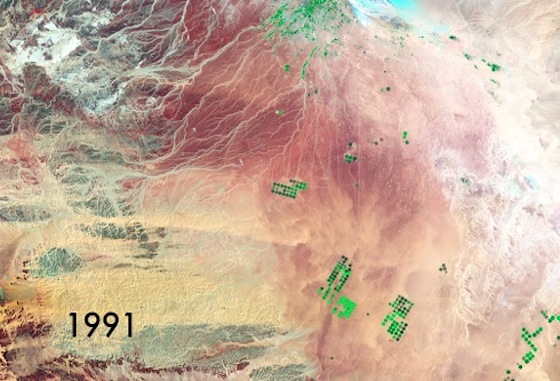
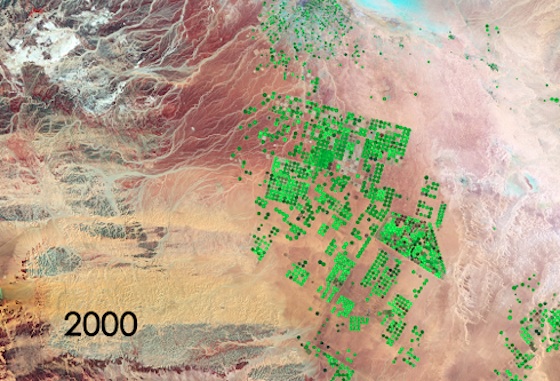
Concerns about creating food security for Saudi Arabia’s population has led to an insane agricultural program depicted in NASA satellite images collected between 1987 and 2012. These eye-opening pictures demonstrate how the fields have grown using finite water sources trapped during the last Ice Age that hydrologists estimate will be gone within 50 years! 
water waste, NASA, water conservation, agriculture, land grabs, saudi arabia

Each patch in these Landsat images represents a field of wheat (along with other crops) that is approximately 1 kilometer or 0.62 miles wide. A bright green block is healthy, according to NASA, while the orange-hued segments aren’t faring so well beneath the crippling desert sun.

The crops are irrigated using a technique called center-pivot irrigation. Saudis drill deep holes beneath the desert sands to tap into fossilized water captured hundreds of thousands of years ago.
water waste, NASA, water conservation, agriculture, land grabs, saudi arabia

The water is then pumped through a circular sprinkling system that sprays the crops.

NASA, which manages the Landsat imaging program with the U.S. Department of Interior, explains how the images were captured and what they represent:

The images were created using reflected light from the short wave-infrared, near-infrared, and green portions of the electromagnetic spectrum (bands 7, 4, and 2 from Landsat 4 and 5 TM and Landsat 7 ETM+ sensors). Using this combination of wavelengths, healthy vegetation appears bright green while dry vegetation appears orange. Barren soil is a dark pink, and urban areas, like the town of Tubarjal at the top of each image, have a purple hue.

water waste, NASA, water conservation, agriculture, land grabs, saudi arabia desert

Using their extraordinary fossil wealth, Saudi has also nabbed up land in other countries, including water and food scarce Ethiopia, in order to secure food supplies for their own population.

I guess it’s hard to give up the good life, but it won’t be good indefinitely.

:: Grist, NASA

More News from Saudi Arabia:
Saudi Star Among Firms Behind Thousands of Forced Relocations in Ethiopia
Aflaj: Ancient Channels Keep Water Flowing in the Desert
Morocco’s Berbers had Water Management Sorted
Tafline Laylin
Tafline Laylinhttp://www.greenprophet.com
As a tour leader who led “eco-friendly” camping trips throughout North America, Tafline soon realized that she was instead leaving behind a trail of gas fumes, plastic bottles and Pringles. In fact, wherever she traveled – whether it was Viet Nam or South Africa or England – it became clear how inefficiently the mandate to re-think our consumer culture is reaching the general public. Born in Iran, raised in South Africa and the United States, she currently splits her time between Africa and the Middle East. Tafline can be reached at tafline (at) greenprophet (dot) com.
3 COMMENTS

Comments are closed.

TRENDING

Jujube, the sidr tree of medicine and magic

A magic holy sidr bath to deflect the evil eye? It needs 7 powdered sidr leaves stirred into a bucket of warm water. The hadith of the Prophet Muhammad allows to repeat healing prayers and verses from the Koran to increase the water’s potency. 5 grams, or 1 tablespoon of sidr powder equals 7 leaves.

Farm To Table Israel Connects People To The Land

Farm To Table Israel is transforming the traditional dining experience into a hands-on journey.

What a martian ice age left behind tells us about our future

We have heard that peak climate change might be...

Iran’s holiest city about to run dry as terror chosen over water management

Iran’s second-largest city, Mashhad, is facing an acute water emergency after dam reservoirs feeding the city fell below three percent capacity, according to Iranian state and local media. Officials warn that without rainfall or improved inflows from neighboring Afghanistan, the city’s supply could soon collapse.

Lizard tail stew, dhub mansaf, is a favored folk dish in Saudi Arabia

By exploring forgotten folk dishes like lizard stew, Green Prophet continues to connect the dots between culture, ecology, and the future of sustainable living in the Middle East.

Should You Invest in the Private Market?

startustartup Unlike public stock exchanges, which offer daily trading, strict...

How to build a 100-year-company

Kongō Gumi is a Japanese construction company, purportedly founded in 578 A.D., making it the world's oldest documented company. What can we learn about building sustainable businesses from them?

From Pilot Plant to Global Stage: How Aduro Clean Technologies’ 2026 Expansion Signals a Turning Point for Chemical Recycling Investors Like Yazan Al Homsi

The company's Next Generation Process (NGP) Pilot Plant in London, Ontario, has officially moved into initial operating campaigns, generating the kind of structured, repeatable data that separates laboratory promise from commercial viability.

How AI Helps SaaS Companies Reduce Repetitive Customer Support Work

SaaS products are designed for large numbers of users with different levels of experience, and also in renewable energy.

Pulling Water from the Air

Faced with water shortage in Amman, Laurie digs up...

Turning Your Energy Consultancy into an LLC: 4 Legal Steps for Founders in Texas

If you are starting a renewable energy business in Texas, learn how to start an LLC by the books.

Tracking the Impacts of a Hydroelectric Dam Along the Tigris River

For the next two months, I'll be taking a break from my usual Green Prophet posts to report on a transnational environmental issue: the Ilısu Dam currently under construction in Turkey, and the ways it will transform life along the Tigris River.

6 Payment Processors With the Fastest Onboarding for SMBs

Get your SMB up and running fast with these 6 payment processors. Compare the quickest onboarding options to start accepting customer payments without delay.

Related Articles

Popular Categories