
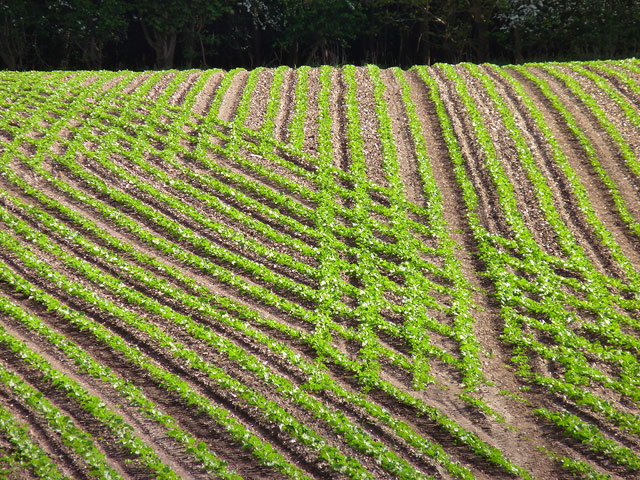

 Egyptians researchers believe that sugar beets like those pictured above can help to clear the country’s stockpile of land mines.
20% of the world’s land mines are planted in Egypt, where they have killed or maimed a total of more than 7,000 people in the last 25 years. They are scattered in the western desert and Sinai and pose an enormous impediment to development as well as considerable risks to animal and human safety.
Researchers from the Academy of Scientific Research and Technology (ASRT), the government body responsible for funding research in Egypt, believe they have found a three-tiered solution to this problem that involves plants and bacteria, but critics doubt whether their laboratory tests will prove effective in the field.
Disarming landmines safely
Many of the land mines left by German forces in the 1940s throughout the Western Desert were laid in such a way that if one in a cluster is detonated, others will be as well. This makes it virtually impossible for human beings to crawl around the land mine field in order to disarm these weapons.
So ASRT researchers sought a method of clearing the land mines that doesn’t cause danger to humans.
Their biological solution involves three stages, according to SciDev.Net: detecting the mines, corroding its iron case, and then neutralizing its explosive power.
Biological weapons of peace
Aresa Biodetection from Norway designed the first phase in March, 2004 by creating a strain of mustard plant (Arabidopsis Thaliana) that turns red in the presence of nitrogen oxide that leaks from land mines. Researchers hoped to spray seeds from an airplane with help from the air force.
But Richard Butler, program Managing of Halo Trust which specializes in disarming hazardous war debris told the paper that birds will eat the seeds. Researchers countered by claiming that the area of northern Egypt where they plan to test the technology does not have a lot of birds.
The next phase involves spreading bacteria that will eat away at the iron casings so that the trinitrotoluene (TNT) gas will be released, but Laurel Anne Hill, moderator of the Minds Clearing Landmines, questions whether Egypt’s land mines have iron casings.
The final stage entails planting plants such as tobacco or sugar beet that absorbs nitrogen, which the Egyptians claim will finally deactivate the mines.
The viability of bio anti-warfare
“We investigated the technique for almost a year before approving large-scale experiments,” Abdelsalam Gomaa, a member of the ASRT committee responsible for approving funds for agricultural research, told SciDev.Net.
They are now waiting for permission from the armed forces to put their ideas to the test near the Mediterranean Sea in northern Egypt.
Sean Sutton, a spokesperson for the UK-based Mines Advisory Group doesn’t want to discount the idea, but he does think it sounds a bit far-fetched.
Regardless of the outcome, we think this is an excellent step in the right direction for Egyptian agriculture and clean tech and we’re eagerly awaiting further news. In the meantime, check out this bamboo minesweeper designed by Afghan designer Massoud Hassani.
:: SciDev.Net
image via Geograph
More on Agriculture, Science, and Technology:
eZra3 Remote Farming is Like Farmville but Real



Dear All,
Thank you very much for this interesting topic. Please update us with any details, I have a promising idea that may positively impact the efficiency of the detection method.
Best Regards,
Mohamed Sallam
Very interesting topic!
Do you think there will be a positive development?
Do we have any updated information?
The situation is complex. There are many types of landmines. Basically, however, they fall into two main categories: Anti-personnel (AP) and Anti-vehicle (AV) mines.
AP landmines are the most common. The weight of a dog or a child is enough to set them off. These days, their casings are generally plastic.
AV landmines contain more explosives than AP landmines do and also require a greater weight to trigger them. AV landmine casings can be made of metal or plastic. However, metal AV landmine removal becomes complicated if plastic AP landmines are planted nearby.
But then there are explosive remnants of war (ERW) which consist of items such as artillery shells, grenades and cluster munitions that have not exploded. These are not landmines but they can remain dangerous, function as AP landmines do, and even be called landmines in error. Most such explosive ordnance tends to be made primarily of metal and explosives.
I checked the “Explosive Remnants of War and Mines Other Than Anti-Personnel Mines” global survey 2003-2004, issued by Mines Action Canada. According to that report, only 20 – 25% of the estimated 23 million landmines in Egypt at that time were actually AP or AV landmines. The rest were ERW, which are not technically landmines (even if they produce the same result) and would mainly be comprised of metal and explosives.
I suspect that at least some of Egypt’s planned action is to destroy ERW.
Thanks Laurel. That’s good to know. What are newer land mines made of?
I would like to clarify a point. When I first heard about the Egyptian plan, I asked how many of the landmines in that country had iron bodies that the bacteria could attack. Many modern landmines contain little metal. However, if the Egyptian mines are older, the metal content would be much, much higher.