

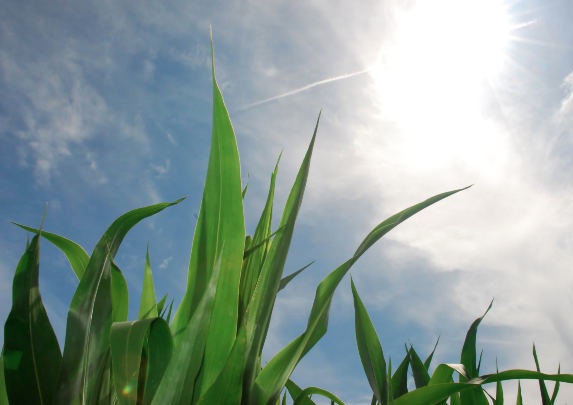
 MIT researchers say that soon all we’ll need to harvest our vast solar resource is grass and stabilizing powder.
While Masdar and Suntech and other solar energy projects are laboring under expensive, high-tech materials in order to improve their energy-absorbing capability, MIT researchers in the United States are taking a different approach: using grass. (No, not that grass. Our articles on cannabis can be found here.)
They realized that nothing in nature absorbs energy as well as plants, so they have developed a solar technology that combines a small amount of grass (or other agricultural waste), a stabilizing powder made of zinc oxide and titanium oxide, and a glass or metal substrate which mimics the photosynthesis process. Eventually their technology will be so simple that anybody will be able to make their own solar panels for next to nothing. See our DIY solar panels pros and cons to know if setting up solar on your own is for you.
Photosynthesis packed for DIY home solar kits
According to the folks at Fastco Design, the MIT researchers have discovered how to “chemically stabilize plant-derived photosystem-I (PS-I), the structures inside plant cells that perform photosynthesis, on a substrate that creates electric current when exposed to light–all using readily-available materials.”
This solar cell then isolates PS-1 molecules and eventually carries an electrical current with the stabilizing powder.
So, instead of massive solar-panel producing factories that require a lot of natural materials, MIT’s technology could literally be packed in a small plastic bag and shipped off to anyone who wants to make their own solar panels at home.
DIY panels for anyone
If DIY enthusiasts can get their hands on a few grass clippings or other greenery and the substrate, then MIT only needs to ship out the zinc and titanium oxide and instructions for creating energy from this unlikely mix and a solar panel has been made.
Eventually, according to Andreas Mershin, people will be able to mix everything together and create a paint that can be applied to their roof. But there is a catch. At the moment, this technology doesn’t even have a 2% efficiency rate yet. But it will, and even that is plenty efficient given the small amount of resources necessary to create it.
This is what we call putting the sun’s power into the hands of the people. One day we won’t have to rely on the big money folks in order to have a little light in our homes.
More on Solar Panels in the Middle East:
DIY solar panels – pros and cons
Nanosolar’s Ultra Thin Solar Panels Could Go East
Abu Dhabi Prince Shames White House by Crowning Court Roof With Solar Panels
6 Hot Solar Projects From the Middle East and North Africa
image via Penywise, Morguefile

I don’t know who: (‘rich servatius’) is, But judging by ‘its’ comment, it would seem to be a dis-info plant from a solar panel production company. If it isn’t, we can all quite efficiently judge its IQ level which in this case appears to be even less efficient than a grass solar panel!
If Bill Gates would have said that about his friends new Windows program back in 1986, He wouldn’t have 78 Billion dollars in his personal Bank account!
Be Well,
Please keep sharing new technology.
Most welcome & we are trying to do something that can change the whole world.:)
Congrats and keep up the good work!
I am a 4th year B.Sc. student working on Renewable Energy in different kind of projects as well as R&D department as a student researcher in Bangladesh Atomic Energy Research Establishment, Savar, Bangladesh.
Md. Zakaria Mahbub, where are you working?
Definitely it is a good idea. We are also working with Dye Sensitized solar cell. Titanium di oxide already has been used with Indium Tin Oxide (ITO) glass. But the it has very low efficiency.
Now we are trying to do it with Carboxy Methyle Celluloise (CMC) in stead of Titanium di oxide. I hope, It will have a greater efficiency.
Hopelly this project keeps improving becuase we are running out of resources in many areas. Once this new tech is out in the market, it will be a great help for people and the environment
But Rich, this project isn’t taking up any space? That’s the whole point.
When the efficiency goes up to 14%, please report again. Otherwise it’s a waste of solar space.