Saudis Again Refute BBCs Claims of Arsenic-Contaminated Zamzam Water

zam zam water saudi arabiaMore questions than answers in new Saudi refutation of BBCs slam on its holy waters

In May, we covered the BBC claim that imported Zamzam holy waters from a sacred well at Mecca being sold in some Muslim bookshops in London was  contaminated with dangerous levels of arsenic.

Association of Public Analysts President Dr Duncan Campbell was quoted as saying “The water is poisonous, particularly because of the high levels of arsenic, which is carcinogen. [sic] I would not recommend drinking this water.”

But is the Saudi government getting a bum rap on the safety of its holy water? 

Although Ridiculously Simple Technology Can Save Millions from Arsenic Poisoning – arsenic can harm the liver and kidney and cause cancer at higher levels than the 10 micrograms per litre permitted by the WHO.

Fahd Turkistani, adviser to the Presidency for Meteorology and Environment, said the BBC Report focused on bottled water supplied not by the Presidency of the Two Holy Mosques Affairs, but by unscrupulous individuals.

“Zamzam water contamination could have been caused by illegal workers who sell it from unsterlised containers at Makkah Gates. The Saudi Government has banned the sale of such water,” Mr Turkistani said.

Perhaps even more definitively, Saudi Arabia simply does not export its Zamzam water. So what is in the London muslim bookstores cannot be the officially sanctioned Zamzam.

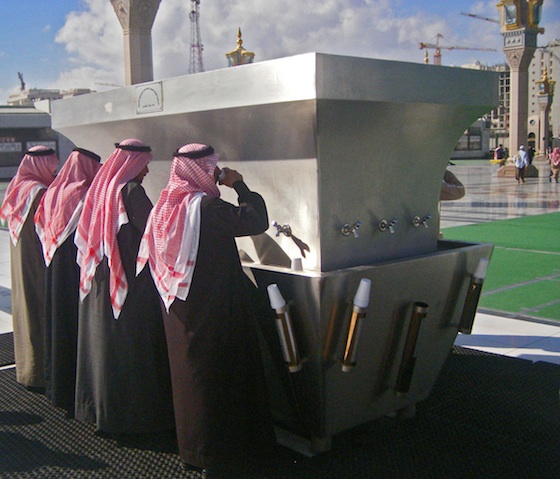
The King Abdullah Zamzam Water Complex was built just last year in Mecca. It supplies 200,000 bottles a day from the Zamzam well, within the Masjid Al Haram, about 20 metres East of the Kaaba. But it does not export its water.

In a document refuting the claim by the BBC, Saudi Arabia undertook an independent study to find definitive results on different water samples, including Zamzam water. King Fahd University for Petroleum and Mineral Resources (KFUPM) conducted tests on Zamzam water using the latest laser spectrum disintegration technology, and gauged part-per-million levels of harmful materials.

They found that it contains “no harmful substances, including arsenic”. But the refutation goes on to claim that the amount of arsenic in Zamzam water is “much lower” than the 10 micrograms per litre permitted by the WHO.

And then, even more disconcertingly, the paper quotes Fahd Turkistani, adviser to the Presidency for Meteorology and Environment as saying “ultraviolet rays are applied to kill harmful bacteria.”

But this raises more questions than it answers. The most cursory google search for approved treatment methodologies for arsenic in water does not include the use of ultra-violet rays. Nor is arsenic “bacteria.”

Of course, it is possible that these are translation errors in the document in English, not exactly what Turkistani was saying. But for these reasons, the refutation is not entirely reassuring.

:: BBC Report

::Saudi Refutation

Read more on Zam Zam Water
Zam Zam Holy Water in Mecca is Contaminated
Plastic Removes Arsenic
Saudi Options Narrow With Peak Water

1 COMMENT

LEAVE A REPLY

Please enter your comment!
Please enter your name here

TRENDING

Astro uses AI to help procure land for renewable energy

For oil-rich, environmentally vigilant Gulf states, Astro isn’t just another startup story. It is a blueprint for accelerating an energy transition that is now existential, not optional.

Farm To Table Israel Connects People To The Land

Farm To Table Israel is transforming the traditional dining experience into a hands-on journey.

Sink holes from over-watering farmers’ fields

Sinkholes are rapidly appearing in Turkey’s central Anatolian farming region, particularly around Konya and Karapınar. These giant gaping holes in the ground in areas of farmland, known locally as obruk, are not random geological events. They are linked to prolonged drought, climate-driven heat stress, and heavy groundwater extraction for agriculture in one of the country’s most important breadbaskets.

Oil pollution in Basrah’s soil is 1,200% higher than it should be

Soil pollution levels in parts of Basra are 1,200% to 3,300% higher than those typically measured in cities like Toronto or New York, according to new comparative soil data. It's getting into water.

Explore Balat in Istanbul for a perfect day of coffee, cats, and second-hand clothing shops

Balat is not a neighborhood you would visit in the standard tour to Istanbul. If you want a real taste of Istanbul and the people who live there, wander around a smaller craftsman, artisan, coffee shops and second hand clothing shops on cobblestone streets in the neighborhood of Balat.

Qatar’s climate hypocrisy rides the London Underground

Qatar remains a master of doublethink—burning gas by the megaton while selling “sustainability” to a world desperate for clean air. Wake up from your slumber people.

How Quality of Hire Shapes Modern Recruitment

A 2024 survey by Deloitte found that 76% of talent leaders now consider long-term retention and workforce contribution among their most important hiring success metrics—far surpassing time-to-fill or cost-per-hire. As the expectations for new hires deepen, companies must also confront the inherent challenges in redefining and accurately measuring hiring quality.

8 Team-Building Exercises to Start the Week Off 

Team building to change the world! The best renewable energy companies are ones that function.

Thank you, LinkedIn — and what your Jobs on the Rise report means for sustainable careers

While “green jobs” aren’t always labeled as such, many of the fastest-growing roles are directly enabling the energy transition, climate resilience, and lower-carbon systems: Number one on their list is Artificial Intelligence engineers. But what does that mean? Vibe coding Claude? 

Somali pirates steal oil tankers

The pirates often stage their heists out of Somalia, a lawless country, with a weak central government that is grappling with a violent Islamist insurgency. Using speedboats that swarm the targets, the machine-gun-toting pirates take control of merchant ships and then hold the vessels, crew and cargo for ransom.

Leopoldo Alejandro Betancourt López Turned Ocean Plastic Into Profitable Sunglasses

Few fashion accessories carry the environmental burden of sunglasses. Most frames are constructed from petroleum-based plastics and acrylic polymers that linger in landfills for centuries, shedding microplastics into soil and waterways long after they've been discarded. Leopoldo Alejandro Betancourt López, president of the Spanish eyewear brand Hawkers, saw this problem differently than most industry executives.

Why Dr. Tony Jacob Sees Texas Business Egos as Warning Signs

Everything's bigger in Texas. Except business egos.  Dr. Tony Jacob figured...

Israel and America Sign Renewable Energy Cooperation Deal

Other announcements made at the conference include the Timna Renewable Energy Park, which will be a center for R&D, and the AORA Solar Thermal Module at Kibbutz Samar, the world's first commercial hybrid solar gas-turbine power plant that is already nearing completion. Solel Solar Systems announced it was beginning construction of a 50 MW solar field in Lebrija, Spain, and Brightsource Energy made a pre-conference announcement that it had inked the world's largest solar deal to date with Southern California Edison (SCE).

Related Articles

Popular Categories