
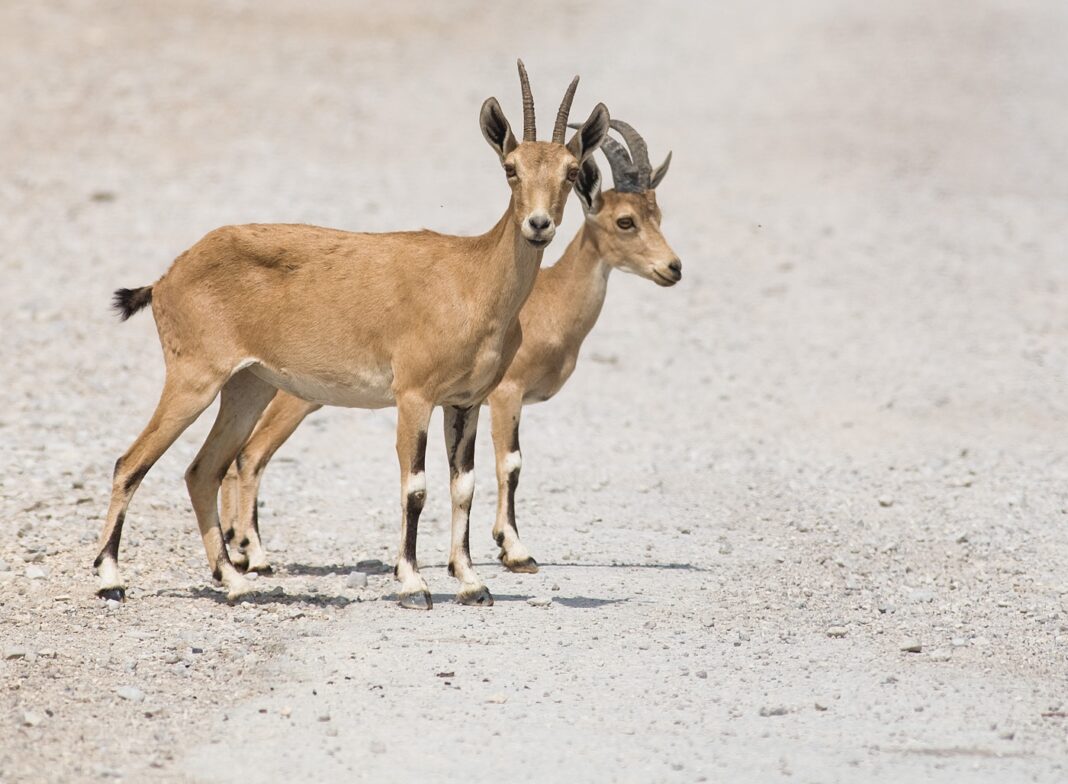

 Could large solar array farms put these desert animals at risk?
Builders of large solar array farms in Israel’s Negev region and in places like California’s Mojave Desert have had ongoing problems with nature lovers , environmentalists, and Native American Tribes .
It now appears that the environmentalists in Israel may be winning out on efforts to build giant solar array farms in the Negev and Arava regions. A recent study conducted by Israel’s Nature and Parks Authority (NPA) indicates that building such projects could be fatal to thousands of wild animals that live in the fragile ecosystem of these desert regions.
 Will solar mirrors blind animals?
The idea of constructing large solar energy array farms has been in the works for several years now.
They will be similar to projects in the USA, where companies like Brightsource have been trying to build huge solar energy farms on supposedly vacant land in California’s Mojave Desert and on “coyote land” in neighboring Nevada .
In the case of the Negev, the NPA now claims that constructing such solar farms will destroy the area’s already endangered eco-system which is home to wildlife species such as desert gazelles , Nubian Ibexes, spotted hyenas, desert cats; and several species of desert dwelling birds, including sand partridges, Huobara Bustards (large desert birds resembling turkeys), and several species of raptors.
Similar battles between solar energy advocates and environmentalists in California have caused problems for Brightsouce and other companies like Solar Millennium, which have also been accused of wanting to build these large solar farms on sacred Native American burial sites .
In California, indigenous desert tortoises will be “relocated” to make room for the solar energy farms. You might wonder how many of these slow moving desert dwellers we’re talking about, and how the solar energy companies expect to round them up in order to move them elsewhere.
Israel’s Negev region, despite composing a large part of the county’s total land area, is still small in comparison to California’s desert regions. NPA’s Doron Rotem, the author of the report, says that constructing the solar farms “will without question harm the area’s wildlife, especially birds that could become blinded by large solar mirrors, and bats which could fly into either mirrors or solar panels during nighttime foraging flights. The study concludes that these projects are better suited to areas where infrastructures are already present.
 Viablealternative:rooftop solar energy plants
A viable alternative is the construction of numerous “roof top” solar energy plants atop commercial buildings and even private homes.
Projects of this kind are in progress throughout Israel. Solar Power claims it can construct its plants to create solar energy “virtually anywhere” .
Ibex Photo via NPA
More solar energy issue article:
Solar Energy’s Not so Sunny Side
Solar Energy for Small Portable Solar Grids Virtually Anywhere
Brightsource and Solar Millennium Accused of Building on Sacred Indian Sites
Solar Developers Find Themselves in Green vs Green Debate over Coyote Land



@ Alison Tottenham,
With respect, your comment shows a stunning lack of understanding of (a) the technology, (b) desert flora and fauna and (c) how ecosystems, habitat and migration corridors work. I am not that familiar with the Negev, but we face the same level of mercenary destruction in the Mojave.
Curiously the media always neglects to mention that major partners in Bright Source are Chevron, BP, Morgan Stanley and StatOil (tar sands), which might give a more accurate picture of how ethically these projects are being developed and with how much concern for the environment.
As other posters have stated, CSP is a thermal technology using mirrors (not PV) that completely bulldozes and compacts the entire multi-thousand-acre site, permanently killing everything on it, including thousands of juvenile tortoises in burrows. They are, in essence, gigantic bug-zappers generating heat well over 700 degrees F that will FRY anything that flies through their paths, creating enormous risks for birds, bats and pollinators. I have no idea how you imagine that foliage will “cool” the panels, but it won’t. Cooling is anathema to the purpose, which is heating.
There is literally zero hope of any tortoises frolicking in shade or surviving the industrialization process, so the large ones they find are forced to leave their territory where they have carefully mapped out food, water, shade and burrows into hostile territory, where they then spend the rest of their life trying to return to where they used to live, making them targets for predation. At least 50% of adult tortoises can expect to die in this “relocation” process, on top of the majority of juveniles and eggs. And this is only ONE of thousands of harmed species, and one that is supposed to be heavily protected! They fence the area because their “green” power plant will kill anything living there, and they spray it with herbicide to ensure that nothing will survive.
No plant or animal life is left, nor can it grow back. Ephemeral washes, soil crust and migration corridors are permanently and irrevocably destroyed, and major dust and flooding problems are created, all of which has very negative impacts on all surrounding areas as well. New roads bring nonnative invasive species to add insult to injury. On and on and on.
I assume that just this simple collection of facts might influence your opinion in the same direction as the qualified biologists who performed the study and determined that rooftop was the solution, which it is.
If anyone is interested in signing a petition objecting to wholesale destruction of our open spaces while rooftops are left to bake and sprawl, please go to:
http://www.change.org/petitions/solar-done-right-call-to-action-for-energy-democracy-2
Let your voice be heard!
I would really like to view the report. Does anyone have the link or knows if it is for sale online perhaps?
I just spent quite a bit of time googling for this info with zero results.
I live in southern California and have been fighting the good fight against BrightSource and the other large solar firms, trying to save the Mojave, if anyone has the link to the report or orderig info please let me know.
Great job here on this site.
I don’t think the NP:A is as much concerned with solar panels, which absorb sunlight, as they are with the “Brightsource” type of technology of using mirrors to reflect the sunlight towards a central collector that will power a generator or steam powered generator to create electricity.
It’s the reflections from these mirrors – perhaps hundreds of them that they are concerned with.
Just a few thoughts on this report.
Firstly, if the panels are reflecting much light, then they are not functioning at peak efficiency, and should not have been used in the first place. Modern panels, both mono and poly crystaline, are coated in such a way that light is reflected internally. Therefore, the problem of dazzling birds and animals should not occur.
Secondly, it is certain that initially all animals will avoid this patch of dessert; although the tortoises will probably like the shade and patches of bright sun in which to bask. Plus eventually they may very well benefit from my third point.
Thirdly, the array shown in the photo above seems to be considerably less than 100ha. True it is likely to change the surface of the dessert underneath it, for the simple reason that the panels will increase the dew dripping onto the sands and their shade should mean that much of this moisture is retained. It will be very interesting to see which plants colonise the paneled area.
Forthly, I suspect that in time, ca 12 months, all the species mentioned will be using the area around and under the panels, for lying up. Whereas the dessert cats may change their hunting techniques in the area, I suspect that they will use the cover to sneak up on their prey; but I also suspect that the Nubian Ibexes will use the panels to their advantage in dodging their pursuers. Of all the animal species mentioned, I suspect that the sand partridges and raptors will choose to avoid the patch, as will the Huobara Bustards. But this might well change as some vegetation developes in the shade of the panels, unless the Nubian Ibex keep it trimmed too fiercely.
Fifthly, if the whole area is fenced off, then yes of course the mammals and bustards will not be able to use it. But there is no reason why a ground level vegetation should not be allowed to develop, if only to keep the panels cooler and working more efficiently. Besides, it should be possible to select several 100ha sites in the dessert without having much effect on the total carrying capacity (animal numbers) of the whole dessert area.
I hope that Israel’s NPA has done a study of the animal species that were actually living on or using the area now covered by panels. Because, without this baseline study, they will not be able to make any justifiable comments on the post installation effects on wildlife or vegetation whether it is beneficial or not. I would love to see such a study and will follow developments with interest.
Dear “Name”
I would say that Israel’s Nature and Parks Authority (NPA) is definitely an environmental organization as its responsibility deals with caring for all of the country’s national parks and nature reserves, and not just wildlife.
So what’s the big deal?
Why is this “solar energy advocates” versus “environmentalists”? Wouldn’t it be more accurate to say “wildlife advocates”? I mean, generally “environmentalists” are advocating for both wildlife AND solar energy.
Personally, I find the term “environmentalist” silly. It is so general as to be meaningless. Like the term ‘sustainability’ or ‘green’.