

 Lack of space in urban environments often means that farming opportunities are limited, but a technique of farming indoors and upwards may resolve this problem
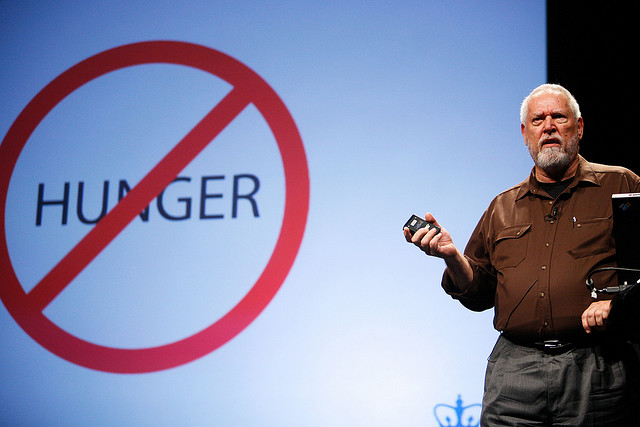
Over a week ago, I had the opportunity to attend an event featuring Dickson Despommier, the grandfather of vertical farming. As Green Prophet editor Karin explains in an interview with a vertical farming expert, vertical farming is where crops are grown in buildings and on various levels to save not only space but water. Despommier explains that in today’s world, 80% of the earth’s available land is already farmed and so we need to come up with better ways to grow food for our increasingly urban and populated world.

Here at Green Prophet, we have already looked the potential of green roofs in the Middle East, growing food without soil as well as sprouting urban agriculture groups. Or companies like flux leading the sensor tech revolution. Now I take another look at one development in urban food growing – vertical farming – and the potential it has to solve food problems in the Middle East.
Uses 70% Less Water Than Traditional Farming
Some of the advantages of vertical farming, which incorporates growing techniques such as hydroponics (growing without soil), is that there is no crop loss from severe weather events and you can grow crops all year. However, the big advantage for places such as the Middle East, is that vertical farming uses around 70% less water than traditional farming. As the growing conditions are a lot more controlled, water isn’t lost due to inefficiencies such as leaks and evaporation.
This is a huge advantage for those considering adopting the technique in the water-scare Middle East as it means that it could potentially make growing a lot more commercially viable. Indeed, Despommier revealed that countries such Saudi Arabia, Jordan and Qatar have already show interest in the technique. According to Despommier, there was a meeting in 2009 with the Jordan mayor office to discuss the farming technique and there were also a pyramid-shaped vertical farm designed for Dubai.
[youtube]http://www.youtube.com/watch?v=1clRcxZS52s&feature=player_embedded[/youtube]
End The African Land Grab
Whilst in its tentative stages, vertical farming in the Middle East could be a great solution to the regions current water problems and its huge reliance on food imports. This novel way of farming could also end the African land grab by countries such as Egypt, Saudi Arabia and the United Arab Emirates to secure food supplies.
Since the Arab Spring riots, which were in part sparked by food shortages and rising prices, food security has climbed up the agenda of many Middle Eastern governments. Let’s hope that they consider improving their own food self-sufficiency through green techniques such as vertical farming and not just buying up tracts of fertile land from drought-stricken and troubled nations in Africa such as Ethiopia, Sudan and Somalia.
:: Image via kris krug/flickr.
For more information on urban agriculture in the Middle East see:
What Urban Rooftop Gardening Could Do For The Middle East



One thing to remember when growing food using hydroponics is that pure water will not have the minerals that soil has, which plants convert to a bioavailable form. Food grown this way will be depleted of trace minerals needed in your diet unless the minerals are added to your water supply.
This is one of the challenges in growing food hydroponically: understanding the chemistry of it all. Once you get it down pat the rest is much easier than soil farming.
The idea that crops can be grown with “70% less water” is based on a confusion between water APPLIED and water CONSUMED by the crop. Evaporation is a genuine non-productive loss, but leaks and seepage do not disappear, they return to the local hydrological system. Science tells us that crop biomass is a near linear function of water transpired by the crop; the law of conservation of mass tells us that water does not disappear, and we need to trace exactly where it goes before making these sorts of misleading and dangerous claims.
Hi, we just installed a solar powered pump for a water & energy kiosk in really rural Ethiopia. We like to extent this project with highly productive garden for local food production now that we have sufficient decentralised and renewable powered water supply. I would be interested in the technology for vertical farming for self supply and extra sales on local markets and specific next steps, budget requirement, local training etc. Thanks Oliver