
Semi-Sustainable Berber Agriculture

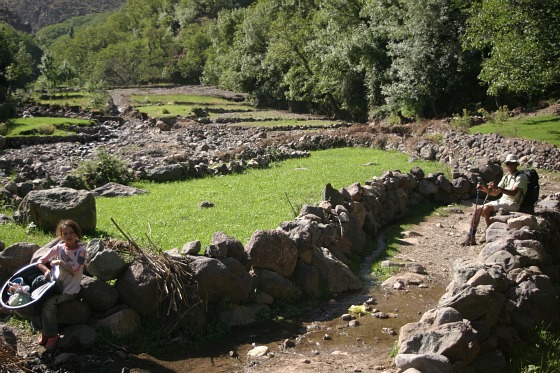
sustainable agriculture, Morocco, eco-tourismThe verdant valleys in the Toubkal National Park stand in stark contrast to the dry, red mountain sides.

After my last visit to Toubkal National Park in Morocco’s high Atlas Mountains, where I ungracefully scrambled to the summit of its namesake in order to prove to myself and the world that I am cool enough to climb to the highest point in North Africa, I couldn’t walk properly for days after.

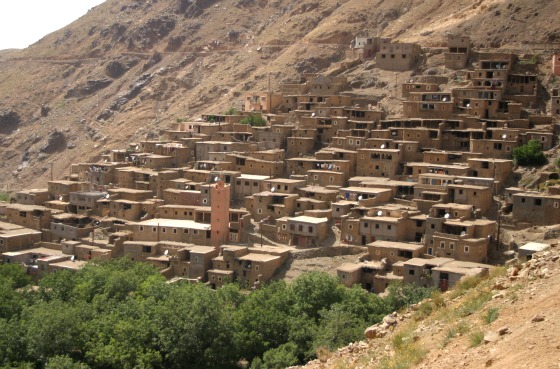
Over the weekend, I went back via the Ourika Valley. But this time, while there were moments of challenging hiking, my focus was on understanding the Berber people who live in small iron-red homes tucked into the side of steep slopes. With my talented mountain guide leading the way, I trekked across a handful of loose scree peaks and verdant valleys, occassionally stopping to drink mint tea with the locals, and admire their terraced agriculture plots. Naturally, what seems “so sustainable” has a more complicated background.
Not the gringo way

I’m guilty of assuming that anything ethnic is more sustainable than the marauding gringo way. And often, by virtue of its scale, it is. But ethnic people whose survival depends more on knowledge of the land than on an ability to name the parts of a sentence also make mistakes.

Terraced agriculture is very labor intensive. It is first necessary to dig ledges into the side of slopes, which are typically steep, and then a sophisticated irrigation system has to be put in place.

It is also recognized as a sustainable form of agriculture practiced in the Andes for hundreds of years, as well as in Viet Nam, Bali, and other hilly countries, since it conserves water, reduces soil erosion, maximizes arable land, and decreases surface runoff.

Verdant valleys

Each of the villages we encountered while looping from Oukamidene, a high altitude winter ski resort, west, south, east, and then back again, manages a lush grove of walnut, apple, and fig trees, along with potatoes, wheat, olives, and a host of other produce.

These fields are carefully irrigated with a system reportedly installed by the Spanish. Melted snow and river water is channeled into targas. These are long concrete troughs, of sort, that have numbered metal trap doors. Each of the men in the village take turns irrigating the crops by lifting the trap doors and allowing water to flow in steps down each successive ledge.

This according to my guide, who has worked for several European tour operators and spends part of his life in the United Kingdom. Born and raised in Aremd, one of the villages that seem to cluster around Mt. Toubkal, he has seen the villages change. And they are not all equal.

The risks

It is a carefully-planned system that ensures each crop is placed at its ideal elevation. It is the system that has been in place for hundreds of years. But it is endangered.

In a paper presented to the 12th Biennial Conference of the International Association for the Study of Commons, Bernadette Montanari – then an Ethnobiology PhD student – and consultant Lars Soeftehard warned that Atlas mountain natural resources are declining because of over-harvesting and population pressure.

They added that the situation is made worse by lack of secure land tenure, political representation, or empowerment.
sustainable agriculture, Morocco, eco-tourismNoble suffering?

One old man, who is bowlegged now and less able to trek up and down the mountain passes, works at the ski resort a couple of hours walk away from his village. This year, he says, times are hard because his village did not vote for the man in charge and are therefore not privy to his favors.

Much of the food grown is used at home, particularly wheat, which is processed in a pre-industrial style (with mules trained to stomp the wheat on a concrete slab in order to facilitate the easy separation of the edible part of the plant from the remaining hay) and used to make bread. The remaining produce is sold at the market. On Mondays, especially, locals far and wide flock to a town on the edge of the Ourika Valley well-known for its market.

This life is hard, endangered, but more honest somehow. While many of the locals live in filthy dirty clothing and are missing their teeth, and while they toil hard in the high sun, they are a quiet and humble people whose way of life is prey to tourist traffic, resource degradation, and climate change. But they are always ready to offer a lovely cup of hot tea to the curious, weary traveler.

More travel, nature, and food stories from Morocco:

A Side of Sewage with Dinner in Morocco

Making Cobras Swoon is not so Charming

Rocking the Eco-Toubkal in Morocco

all images via Tafline Laylin
Tafline Laylin
Tafline Laylinhttp://www.greenprophet.com
As a tour leader who led “eco-friendly” camping trips throughout North America, Tafline soon realized that she was instead leaving behind a trail of gas fumes, plastic bottles and Pringles. In fact, wherever she traveled – whether it was Viet Nam or South Africa or England – it became clear how inefficiently the mandate to re-think our consumer culture is reaching the general public. Born in Iran, raised in South Africa and the United States, she currently splits her time between Africa and the Middle East. Tafline can be reached at tafline (at) greenprophet (dot) com.
1 COMMENT

LEAVE A REPLY

Please enter your comment!
Please enter your name here

TRENDING

1,600-Year-Old Samaritan Farm Estate Found in Kafr Qasim Shows How Ancient Communities Lived Sustainably

Archaeologists in Kafr Qasim have uncovered a 1,600-year-old Samaritan agricultural estate with colorful mosaics, an olive oil press, and a ritual bath. This rare discovery reveals how ancient communities lived sustainably—growing food locally, reusing materials, and balancing faith with farming—offering lessons for modern climate resilience in the Middle East.

The UN builds an AI coalition to save the planet

Over 100 partners, including 37 tech companies, 11 countries and 5 international organizations, have joined forces with the UN under the Coalition for Environmentally Sustainable Artificial Intelligence, aiming to ramp up global momentum to place AI on a more environmentally sustainable path. 

How Satellite Technologies Reduce Costs for Agrochemicals and Fertilizers

Discover how satellite technology is revolutionizing agriculture by optimizing fertilizer use, cutting agrochemical costs, and boosting crop yields. Learn how precision farming, remote sensing, and AI-driven analytics enhance soil health, improve nutrient efficiency, and promote sustainable agriculture. ? #PrecisionFarming #SatelliteTech

How to help Gaza fishermen

The destruction of Gaza's two main aquaculture farms, along with the hatchery facility, has also left the sector unable to produce alternative aquatic foods through aquaculture. 

Sustainable rubber and latex production

America and the world sees a rubber shortage. A new plan to grow it in America, sustainably.

Qatar’s climate hypocrisy rides the London Underground

Qatar remains a master of doublethink—burning gas by the megaton while selling “sustainability” to a world desperate for clean air. Wake up from your slumber people.

How Quality of Hire Shapes Modern Recruitment

A 2024 survey by Deloitte found that 76% of talent leaders now consider long-term retention and workforce contribution among their most important hiring success metrics—far surpassing time-to-fill or cost-per-hire. As the expectations for new hires deepen, companies must also confront the inherent challenges in redefining and accurately measuring hiring quality.

8 Team-Building Exercises to Start the Week Off 

Team building to change the world! The best renewable energy companies are ones that function.

Thank you, LinkedIn — and what your Jobs on the Rise report means for sustainable careers

While “green jobs” aren’t always labeled as such, many of the fastest-growing roles are directly enabling the energy transition, climate resilience, and lower-carbon systems: Number one on their list is Artificial Intelligence engineers. But what does that mean? Vibe coding Claude? 

Somali pirates steal oil tankers

The pirates often stage their heists out of Somalia, a lawless country, with a weak central government that is grappling with a violent Islamist insurgency. Using speedboats that swarm the targets, the machine-gun-toting pirates take control of merchant ships and then hold the vessels, crew and cargo for ransom.

Leopoldo Alejandro Betancourt López Turned Ocean Plastic Into Profitable Sunglasses

Few fashion accessories carry the environmental burden of sunglasses. Most frames are constructed from petroleum-based plastics and acrylic polymers that linger in landfills for centuries, shedding microplastics into soil and waterways long after they've been discarded. Leopoldo Alejandro Betancourt López, president of the Spanish eyewear brand Hawkers, saw this problem differently than most industry executives.

Why Dr. Tony Jacob Sees Texas Business Egos as Warning Signs

Everything's bigger in Texas. Except business egos.  Dr. Tony Jacob figured...

Israel and America Sign Renewable Energy Cooperation Deal

Other announcements made at the conference include the Timna Renewable Energy Park, which will be a center for R&D, and the AORA Solar Thermal Module at Kibbutz Samar, the world's first commercial hybrid solar gas-turbine power plant that is already nearing completion. Solel Solar Systems announced it was beginning construction of a 50 MW solar field in Lebrija, Spain, and Brightsource Energy made a pre-conference announcement that it had inked the world's largest solar deal to date with Southern California Edison (SCE).

Related Articles

Popular Categories