
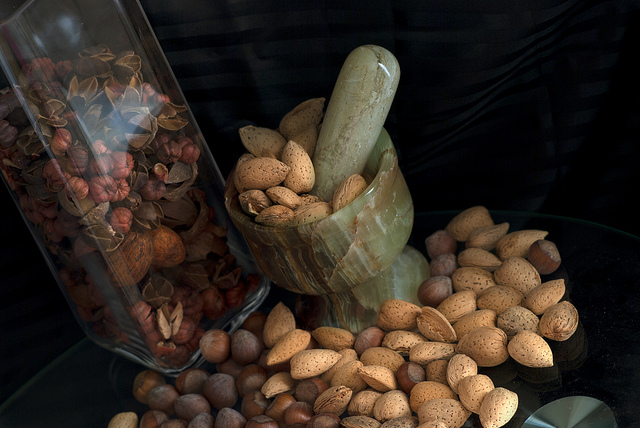

Climate Change Cracks Down On Middle East Nuts

nuts, climate change, reduced crop production, greenhouse gas emissionsClimate change will disrupt every aspect of life in the next few decades,  including the kernel of Middle Eastern culture.

A Middle East without nuts is like Belgium without chocolate: virtually impossible to imagine. But a recent report published in the peer-reviewed journal PLoS ONE (hat tip to Grist) shows that warm (and warming) countries that grow nuts and drupes such as dates and olives could see a major reduction in crop production over the next several decades. Greenhouse gas emissions are the culprit.

Rising temperatures are reducing the length of winter chill in warming countries, a period that is crucial to farming fruit and nut trees. Winter chill refers to the buffer zone that occurs between winter and spring.

Trees that stay dormant during winter months to protect themselves against frost need this time to wake up again, shake off the cold, and prepare for spring.

If this period is reduced or effectively canceled by climate change, then crop production will also decline.

Oman is among the countries that has already shown major losses in winter chill, which is expected to drop further still. Modeling shows that countries around the Mediterranean Sea could see losses of up to 40CP (chill portions), while Israel, and North African countries such as Morocco and Tunisia will be hardest hit.

Growing nuts and stone fruits in many countries throughout North Africa and the Middle East will no longer be economically unfeasible, although researchers note that northern regions could see an increase in winter chill.

Since we’re not about to arrest climate change any time soon, probably our best defense is to find more perky crops that don’t need so much time to “wake up.”

Climate change has the power to disrupt weather patterns and gut the kernel of deep-rooted cultures. Now that’s just nuts!

:: PLoS ONE

More on Crops and Climate Change in the Middle East:

Algeria to Boost Food Security

Organic Farms Growing in Abu Dhabi

Farming Caviar in Abu Dhabi’s Desert

image via DeusXFlorida
Tafline Laylin
Tafline Laylinhttp://www.greenprophet.com
As a tour leader who led “eco-friendly” camping trips throughout North America, Tafline soon realized that she was instead leaving behind a trail of gas fumes, plastic bottles and Pringles. In fact, wherever she traveled – whether it was Viet Nam or South Africa or England – it became clear how inefficiently the mandate to re-think our consumer culture is reaching the general public. Born in Iran, raised in South Africa and the United States, she currently splits her time between Africa and the Middle East. Tafline can be reached at tafline (at) greenprophet (dot) com.

LEAVE A REPLY

Please enter your comment!
Please enter your name here

TRENDING

Farm To Table Israel Connects People To The Land

Farm To Table Israel is transforming the traditional dining experience into a hands-on journey.

From Green Energy to Healthy Societies: Why old systems thinking is becoming relevant again

Across the Middle East and North Africa, large investments are being made in green hydrogen, renewable energy, water infrastructure and sustainability. Most of these efforts are discussed in the context of climate change, decarbonization and economic diversification. That framing is important, but it may not capture their full value.

Huge Fish Nursery Discovered Under Freezing Arctic Seas

In 2019, an underwater robot camera exploring the seabed...

Remilk makes cloned milk so cows don’t need to suffer and it’s hormone-free

This week, Israel’s precision-fermentation milk from Remilk is finally appearing on supermarket shelves. Staff members have been posting photos in Hebrew, smiling, tasting, and clearly enjoying the moment — not because it’s science fiction, but because it tastes like the real thing.

How you create green steel on a blockchain

The thing about raw materials is that once they are melted down, you can't prove the source of the material. Same is true with gold, cucumbers and even forged products that look the same as the real thing. When it comes to steel, and how we produce it, it has a massive carbon problem. What's happening in Japan right now could change how we think about heavy industry and climate action.

6 Payment Processors With the Fastest Onboarding for SMBs

Get your SMB up and running fast with these 6 payment processors. Compare the quickest onboarding options to start accepting customer payments without delay.

Qatar’s climate hypocrisy rides the London Underground

Qatar remains a master of doublethink—burning gas by the megaton while selling “sustainability” to a world desperate for clean air. Wake up from your slumber people.

How Quality of Hire Shapes Modern Recruitment

A 2024 survey by Deloitte found that 76% of talent leaders now consider long-term retention and workforce contribution among their most important hiring success metrics—far surpassing time-to-fill or cost-per-hire. As the expectations for new hires deepen, companies must also confront the inherent challenges in redefining and accurately measuring hiring quality.

8 Team-Building Exercises to Start the Week Off 

Team building to change the world! The best renewable energy companies are ones that function.

Thank you, LinkedIn — and what your Jobs on the Rise report means for sustainable careers

While “green jobs” aren’t always labeled as such, many of the fastest-growing roles are directly enabling the energy transition, climate resilience, and lower-carbon systems: Number one on their list is Artificial Intelligence engineers. But what does that mean? Vibe coding Claude? 

Somali pirates steal oil tankers

The pirates often stage their heists out of Somalia, a lawless country, with a weak central government that is grappling with a violent Islamist insurgency. Using speedboats that swarm the targets, the machine-gun-toting pirates take control of merchant ships and then hold the vessels, crew and cargo for ransom.

Leopoldo Alejandro Betancourt López Turned Ocean Plastic Into Profitable Sunglasses

Few fashion accessories carry the environmental burden of sunglasses. Most frames are constructed from petroleum-based plastics and acrylic polymers that linger in landfills for centuries, shedding microplastics into soil and waterways long after they've been discarded. Leopoldo Alejandro Betancourt López, president of the Spanish eyewear brand Hawkers, saw this problem differently than most industry executives.

Why Dr. Tony Jacob Sees Texas Business Egos as Warning Signs

Everything's bigger in Texas. Except business egos.  Dr. Tony Jacob figured...

Related Articles

Popular Categories