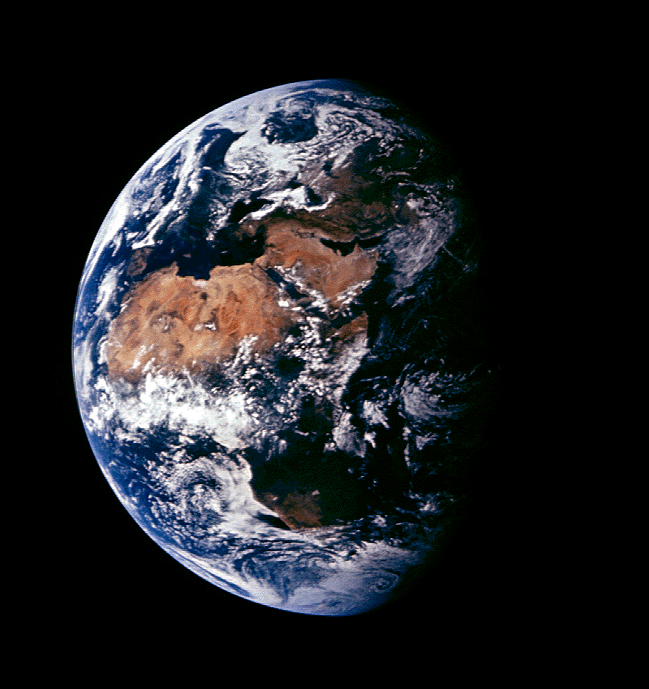
 Despite facing issues such as water scarcity and pollution at poisonous levels, the Middle East is still sending mixed message about climate change. Image of Mideast and earth Courtesy of NASA.
There is a constant debate in green circles over whether the Middle East is really taking climate change seriously. Some days the Arab world seems busy installing solar panels, planting trees, planning green cities and the next they are expanding airports, driving species to extinction and spending billions on the defense rather than the environment. So what is really going on?
Well, the only honest answer is that its complicated. For one, there is the whole issue of the difference in attitudes between the numerous governments, businesses and the average person who is just trying to make a living. To me, it seems that against a backdrop of ignorance and lack of interest, there is real progress being made by innovative groups, individuals and government plans. But like in many countries, there is a lot of people who just don’t get it.
In a recent article published in Qantara, Joseph Mayton stated that the idea of conservation and environmental activism was ‘unknown and almost nonexistent’ in the average person living in the Middle East despite urgent issues such as water shortages and environmental pollution. He explained that “the environmental movement is often ridiculed and shunned by local media. In many ways, it is seen as foreign or Western, and it has yet to make a solid impact on the ground.”
Whilst this may not be easy reading, it does ring true to many people working the field. Issues such as environmental pollution and water shortage may have an impact of the daily lives of Arabs but they are not making the connection between them and climate change. Well not yet, anyway.
 Air pollution is a huge problem facing Egyptians living in Cairo and yet many don’t make the link between pollution and protecting the environment. Image via ninahale.
Taking a quick look at businesses there is more to feel hopeful about but it’s far from great. According to the latest report by the Sustainability Advisory Group (SAG), an international alliance of sustainability strategists and specialists, businesses are still complacent about several critical issues affecting the region.
Whilst regional businesses increasingly view Corporate Social Responsibility (CSR) as something which can add value to their business reputation, sadly a relatively high number of business leaders continue to rate water conservation, climate change and waste as “un-important to their business.” Given the real threats that the region faces from climate change, these results are quite alarming.
Maria Sellanpaa, Founding Director of the Sustainability Advisor Group, told Green Prophet that she had witnessed fairly uneven progress on the issue of climate change in the Middle East. “It appears that in some countries there is considerable activity ‘on the ground’ to explore for instance alternative energy solutions but mostly at micro generation level. This is obviously encouraging but what we are not really witnessing yet is strong government support and action or regional collaborative efforts.”
Maria also added the link between desalinated water and carbon was not clear and new technologies urgently needed implemention to make water less carbon-intensive and cheaper. The CSR report is SAG’s second CSR report and the research covered UAE, Saudi Arabia, Bahrain, Oman, Qatar, Yemen, Egypt and Jordan.
This may all make for some depressing reading but it does illustrate my point that’s complicated. Because against the backdrop of limited interest, things are starting to change.
Green groups are forming all the time across the Middle East, the environment is climbing up governments and businesses’ agenda and there are some great projects already making a difference. Support is growing, so we just have to accept that change of the magnitude that climate change demands is going to take time.