
Syria’s drip irrigation water park

water security park syriaA new park in drought-hit Syria showcases water-saving techniques

Following five years of drought which has driven nearly half a million people away from drought-hit areas and put the country at risk of increasing desertification, Syria has inaugurated a water scarcity park to highlight the need to conserve dwindling water supplies.

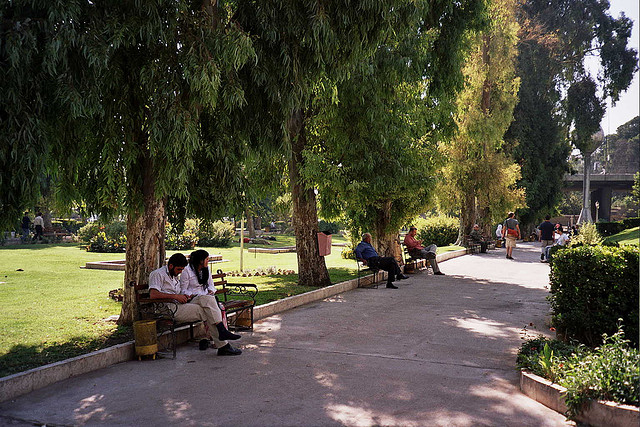
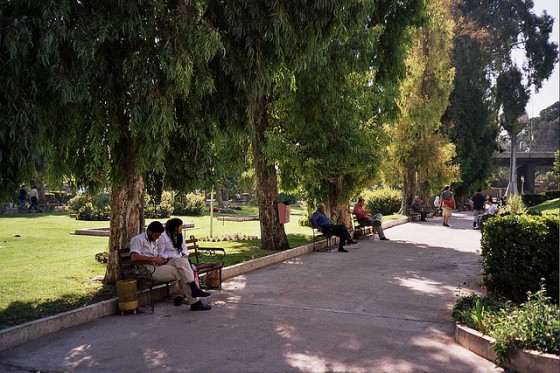
Using drip irrigation techniques, the 1,000 square metre ‘water scarcity park’ will harvest rainwater and also use solar power to generate electricity to pump water for irrigation. Drip irrigation is a technique used to conserve water as draws water directly from it sources and takes it the plants through a network of pipes with small holes so that water waste is minimal.

drip irrigation technology, stockholm international water institute, industry water award, agriculture, water scarcity, Middle East, Israel, Netafim
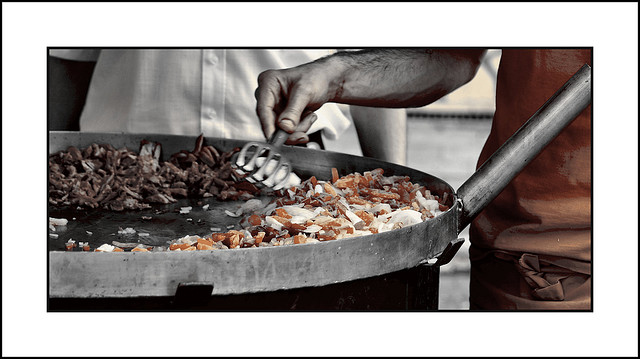
Netafim pipes snake through farmer’s fields and deliver water and nutrients right at the root base

The park which was opened by the country’s Vice-President Dr Najah Al-Attar, is located in Dummar, a suburb of Damascus and is planted with various drought-resistant flora. It is hoped that the park will be used as model for public and private parks and help rationalize the consumption of water and energy.

The water scarcity crisis in Syria has been blamed on a combination of poor water management, lack of rainfall and the over-extraction of water. In the past, Syria was comfortably supported by the Euphrates River in the top half of the country but the diversion of large amounts of water into agriculture and industrial sector means that the supplies are not sufficient to support the population. According to reports in The National, scientists reported that between 2002 and 2008, water availability dropped from 1200 cubic meters to 750 cubic meters per person in Syria.

Unlike the rich Gulf states which are able to afford expensive desalination plants, Syria is struggling with water scarcity and urban household face water cuts each evening. Severe drought in the rural east of the country has also drastically affected 1.3 million people with 800,000 of whom had had their livelihoods devastated and half a million forced to move into the cities just to eke out a living. According to a February report by the United Nations Office for the Coordination of Humanitarian Affairs, this has been the “largest internal displacements in the Middle East in recent years.”

Sadly, Syria is not an isolated case in the region as the entire Middle East is facing water shortages. A report by the Arab Forum for Environment and Development (AFED) remarked that Arab region is one of the driest in the world- 70% of the land is dry and rainfall is sparse- and the effects of climate change will only exacerbate the situation. After delays in the rainy season serious concerns were raised with regards to water availability in Lebanon and Jordanians were also urged to pray for rainwater.  The AFED report added: “Without fundamental changes in policies and practices, the situation will get worse, with drastic social, political and economic ramifications.”

For more on Syria and water issues see:

500,000 Syrians Flee Drought-Stricken Zone

Syria’s Dustbowl Attributed To Wasted Water

Syria Suffers Water Shortage – More News on Middle Eastern Drought
Arwa Aburawa
Arwa Aburawahttp://www.greenprophet.com
Arwa is a Muslim freelance writer who is interested in everything climate change related and how Islam can inspire more people to care for their planet and take active steps to save it while we can. She is endlessly suspicious of all politicians and their ceaseless meetings, especially as they make normal people believe that they are not part of the solution when they are the ONLY solution. Her Indian auntie is her model eco-warrier, and when Arwa is not busy helping out in the neighborhood alleyway garden, swap shopping or attempting fusion vegetarian dishes- with mixed success, she’d like to add- she can be found sipping on foraged nettle tea.
1 COMMENT
  1. Global Warming Apocalypse is Approaching! Over 50 years ago scientists warned us of what was coming.But we’ve refused to act very quickly.Now we’re getting closer and closer to the point of no return.It will began with began with the drought,fires,superstorms,oil spills,sea level rise,blackouts,floods,famine and plagues…And ends with the breakdown of societies,violence,economic collaspe and world war. A global heat wave will return in 2010 to 2014,there will be environmental disasters in the years to come…I’m Jerry Rivers,senior environmental Scientist from Roosevelt,New York, USA..please go to my websites at: http://www.stopglobalwarming.org, wwww.evaneco.com, http://www.suprememastertv.com.

LEAVE A REPLY

Please enter your comment!
Please enter your name here

TRENDING

10 Proven Israeli Technologies to Help Somaliland Build Food, Water, and Energy Security

Israel’s water and agricultural technologies didn’t emerge from ideal conditions. They were developed under pressure: low rainfall, saline water, political isolation, lack of energy resources, and the constant need to feed a growing population with limited land. Over the years, I’ve written about many of these companies not as miracle-makers, but as problem-solvers. That’s what makes them relevant to places like Somaliland. Israel was the first country in the world to recognize Somaliland as an independent state although Ethiopia has been treating the nation as such for decades.

Water conflicts in the Middle East region to watch in 2025

Rising temperatures, unpredictable rainfall, and more frequent droughts amplify existing disputes. Water scarcity can fuel unrest, as seen in Iran’s Khuzestan protests, and can undermine fragile peace deals in post-conflict states like Libya and Yemen.

The Satellite That Sees Earth Breathe: How NISAR Could Transform Sustainability From Space

Critically, NISAR’s data will be publicly available. That means not only scientists and governments, but also nonprofits, local planners, and startups can build tools and services using the data.

Arab agricultural land is on the brink

Across the Arab world, croplands face a perfect storm of stressors. Excessive fertilizers and pesticides erode soil ecology. Poor drainage and over-irrigation drive salinization, leaving fields crusted with salt. Rising temperatures, dwindling groundwater, and more frequent sand-and-dust storms—all amplified by climate change—compound the crisis.

Types of seed banks and how they work in hot climates

You may have heard about the doomsday Svalbard Global Seed Vault but there are smaller versions of seed banks all over the world. The seed banks in the Middle East protect ancient seeds like wheat, chick peas, fava beans, and sesame.

Qatar’s climate hypocrisy rides the London Underground

Qatar remains a master of doublethink—burning gas by the megaton while selling “sustainability” to a world desperate for clean air. Wake up from your slumber people.

How Quality of Hire Shapes Modern Recruitment

A 2024 survey by Deloitte found that 76% of talent leaders now consider long-term retention and workforce contribution among their most important hiring success metrics—far surpassing time-to-fill or cost-per-hire. As the expectations for new hires deepen, companies must also confront the inherent challenges in redefining and accurately measuring hiring quality.

8 Team-Building Exercises to Start the Week Off 

Team building to change the world! The best renewable energy companies are ones that function.

Thank you, LinkedIn — and what your Jobs on the Rise report means for sustainable careers

While “green jobs” aren’t always labeled as such, many of the fastest-growing roles are directly enabling the energy transition, climate resilience, and lower-carbon systems: Number one on their list is Artificial Intelligence engineers. But what does that mean? Vibe coding Claude? 

Somali pirates steal oil tankers

The pirates often stage their heists out of Somalia, a lawless country, with a weak central government that is grappling with a violent Islamist insurgency. Using speedboats that swarm the targets, the machine-gun-toting pirates take control of merchant ships and then hold the vessels, crew and cargo for ransom.

Leopoldo Alejandro Betancourt López Turned Ocean Plastic Into Profitable Sunglasses

Few fashion accessories carry the environmental burden of sunglasses. Most frames are constructed from petroleum-based plastics and acrylic polymers that linger in landfills for centuries, shedding microplastics into soil and waterways long after they've been discarded. Leopoldo Alejandro Betancourt López, president of the Spanish eyewear brand Hawkers, saw this problem differently than most industry executives.

Why Dr. Tony Jacob Sees Texas Business Egos as Warning Signs

Everything's bigger in Texas. Except business egos.  Dr. Tony Jacob figured...

Israel and America Sign Renewable Energy Cooperation Deal

Other announcements made at the conference include the Timna Renewable Energy Park, which will be a center for R&D, and the AORA Solar Thermal Module at Kibbutz Samar, the world's first commercial hybrid solar gas-turbine power plant that is already nearing completion. Solel Solar Systems announced it was beginning construction of a 50 MW solar field in Lebrija, Spain, and Brightsource Energy made a pre-conference announcement that it had inked the world's largest solar deal to date with Southern California Edison (SCE).

Related Articles

Popular Categories