


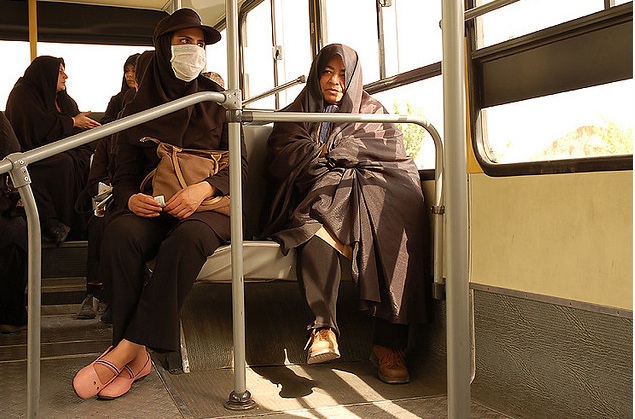
 Lack of urban planning around its natural landscape keeps air pollution locked into the city of Tehran, Iran – one of the most polluted cities in the world.
Tehran is one of the most polluted cities of the world –– with higher levels of sulfur dioxide than India and Bangladesh. Air pollution in the Iranian city of Tehran is not new. In the 50s, 60s and 70s, along with a rapid population growth of Tehran, automobile ownership raised dramatically. Establishment of Iranian car production factories like Iran Khodro and Pars Khodro, and also foreign car import caused massive inflow of cars into the streets of Tehran.
On the other hand, many industrial factories were established in the same period of time around Tehran, especially in south, south west, and west of the city. Cars and factories have a major role in the dangerous pollution in Tehran. However, some other factors like land-use planning, urban form and weak public transit encourage residents to use personal automobiles.In addition to the mentioned factors, the geographical characteristics of the location of Tehran make the air pollution problem of the city harder to solve.
During the recent years academic researchers have stressed the geographical impacts on Tehran’s pollution. Both studies were published in Geographical Research journal in Iran. The first one was authored by Dr. Pour Ahmad from the University of Tehran in 1998, and the second one was conducted by Dr. Safavi from Imam Hossein University and Dr. Alijani from Tarbiat Moallem University in Tehran in 2006.
 Cars don’t help. In a city of about 13.5 million people, an estimated 3 million cars vie for the road. Image via hamed
The studies show how geographical specifications of Tehran like direction of wind, rainfall, inversion, topography, and so on, affect the quality of air. Among these factors, it seems that the wind direction and topography, which work together, have the most influential role in the in the air pollution of Tehran. A BBC report (in Persian) says that 27 people a day die in Tehran from air pollution-related diseases. The north of the city is blocked by Alborz Mountain and the eastern and south eastern parts of the city are captured by some shorter heights like Bibi Shahrbanoo Mount in the south-east.
The dominant wind of Tehran blows from west to east. And most of the industries of Tehran are placed in west and south west. So the wind brings the pollutants to the city and there is no escape way through the eastern heights. In the meantime, if there were a way out in the eastern mounts, the western winds could clean a part of the emissions of the automobiles.
Shortage of rainfall of Tehran is another factor that could have reduced the pollution. In Tehran, in every 3 days of fall and winter, there is a probability of a rainfall greater than 5 mm. It is believed that rainfall of more than 5mm is effective in washing the air. The rain is less important in cleaning the air in comparison with wind, because the rain washes the air pollutions to the soil. But the wind directs the pollutant to the outer limits of the city.
The number of inversion (read more here on inversions) and smog days of Tehran seems to increase every year and this is an alarming sign for the city and governmental authorities. Some strategies have been implemented but the number of dangerous or polluted days have not dropped during the recent years.
Tips to improve air quality in Iran? Fewer cars, and newer ones that meet today’s emissions standards, and better urban planning.
Read more on green Iran:
Iran Looks to Create Biofuel
Iran Inaugurates Its First Solar CSP Plant
Celebrate Spring and Iranian New Year
Image via kamshots


Hi, thanks for the great article.
I have been living in Tehran for the passed year. A war has been going on in Iraq and Syria, as we all know, and the western winds seem to be bringing more and more dust, and more and more unseen toxins from the warzone that seem to be making everyone sick, the symptoms are the same across the city.
I wonder if anyone has done research? I really need to know more about what is coming with those western winds and how it may be affecting us, what symptoms can be attributed to those particular toxins in the air.
Thanks!!
Hristina,
Please write about your questions here. I will try to give you some explanations or links of online resources. Or you can email me at mehrdad(at) greenprophet (dot) com
Mehrdad.
Dear Mr Parsipour,
I am doing kind of a research on the bicycle usage in Iran and the ways to promote it. I would really appreciate it,if you can answer some of my questions or give me some more information. Your articles have helped me a lot so far. Since i couldn’t find any other way to contact you, i am writing you here. Here is my email [email protected]
Thank you in advance!
The only solution is to having a better management witch is absolutely is needed in Iran.
more walking, more biking, more public transit
is the solution.
thanks Arwa
Thanks for this really interesting article, Mehrdad.
Less cars has to be the future!
Arwa