
Human Fertilization Starts at the Bottom

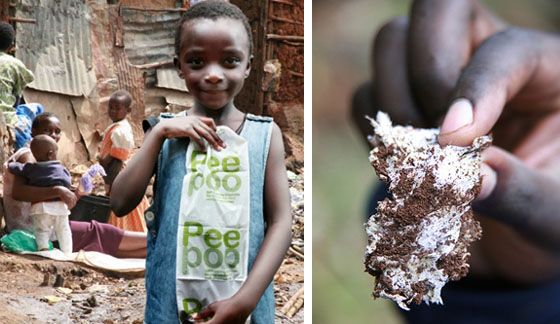
pee poo africa peepoo image childA banal for-profit product for the Third World may revolutionize the treatment of human waste

In the Middle East and other regions with increasing water stress, using clean water to whisk excreta out of sight is increasingly wasteful. For the more than 40% of the world’s population that don’t have private toilets with running water, it is not even a choice. For the rest of us, who are the heirs of European water-based treatment of human waste, developed back when there was plenty of water, and only a few million of us, we may soon need to consider a dry treatment alternative, courtesy of a Swedish architect: the Peepoo bag.

Stockholm architect and Professor Anders Wilhelmson developed the bag as a real solution for the lack of sanitary facilities in slums, emergencies and refugee camps without access to water treatment toilets. But it may have wider ramifications.

Slum dwellers themselves gave him the idea. As an architect, he was concerned with the rise of megacities, and particularly exploding slums. But on one of his visits, the women in a Bombay slum pointed out to him that their problems were hardly architectural, but much more fundamental: hygienic. People virtually do their business right on their doorsteps, so this is an environment in which diseases thrive and epidemics spread unchecked.

His radical, simple, and even somewhat banal solution required him to think outside the architectural field, which seemed inadequate or irrelevant to the world’s biggest problems. The earth’s biggest market exists in the countries of the Third World, home to 76 percent of the world’s population.

Working with Swedish giant BASF, he developed the Peepoople bag. It can be placed over a can to defecate in, and the biodegradable plastic bag picked up, and simply tied closed – where it converts the human waste into valuable fertilizer with an actual market value.

The bag is lined with urea, a substance that reliably deactivates the bacteria in excrement. The casing is made of Ecovio – a fully compost-able material manufactured by BASF. Once buried, it needs only 2-3 weeks to turn the excrement into highly effective, and completely safe fertilizer.

For the world’s poorest, the deactivation of bacteria in fecal matter is essential to hygiene. They are currently faced with no choice but to use city streets, doorways, or open fields as latrines, near food production like rice paddies, and bacterial contamination is a problem.

Rather than operate as a non-profit, the bags are designed to be a source of income, in that they can be sold by women micro-entrepreneurs in these nations. Peepoo is starting small field trials to see whether Third World consumers will even accept the bag, how to price it, and which business model will develop the greatest impact. The cost of the bags, and the cost of collecting them would be prohibitive for the world’s poorest, but he was determined to make it affordable.

So the idea of also selling the valuable fertilizer was considered, to subsidize the cost of the bag with the revenues generated by fertilizer production. Selling the fertilizer subsidizes the consumers expense, in buying the bag, to make the net effect cost-neutral, an essential aspect of the idea.

Tests of consumer acceptance have been conducted in Haiti after the earthquake, and several other regions.

In a new test in Muslim Bangladesh (PDF), 92% of the slum dwellers surveyed liked the fact that the system was producing fertilizer, 85% were open to selling the bags for this purpose, and 92% were comfortable with eating food produced using fertilizer from human excreta.

Currently rice paddies are the de facto toilets, so this would be an improvement because the bags ensure that the excreta is fully composted before mixing with soil.

The Bangladesh test revealed an additional reason for acceptance of the idea, by women especially. There, open fields are the public toilets and offer no privacy. So for privacy reasons, women restrict going to the toilet until night time, under cover of darkness. Being able to use the bag solves this restriction, as it can be used inside the home when needed, rather than having to wait till nightfall.

::Peepoople

Related stories on dry composting toilets:
Haitians Test the Pee-Poo Bag: A Sanitary Solution for Crises in Middle East?
I Pee, You Poo, We All Need Peepoo (Emergency Sanitation Bags That Grow Crops)
Compost Toilets and 4 Good Reasons for the Middle East

LEAVE A REPLY

Please enter your comment!
Please enter your name here

TRENDING

Astro uses AI to help procure land for renewable energy

For oil-rich, environmentally vigilant Gulf states, Astro isn’t just another startup story. It is a blueprint for accelerating an energy transition that is now existential, not optional.

Farm To Table Israel Connects People To The Land

Farm To Table Israel is transforming the traditional dining experience into a hands-on journey.

Luxury tower in Jerusalem ruins its sacred heritage and eco-architects are worried

Critics of a new set of luxury towers including Israeli-Greek architect Elias Mesinas, warn that the scale of the towers, loss of public green space, and creeping luxury-led gentrification risk undermining Jerusalem’s historic skyline, community fabric, and long-standing planning principles — raising a fundamental question: not whether Jerusalem should densify, but how it can do so responsibly while preserving what makes the city unique.

Iran’s holiest city about to run dry as terror chosen over water management

Iran’s second-largest city, Mashhad, is facing an acute water emergency after dam reservoirs feeding the city fell below three percent capacity, according to Iranian state and local media. Officials warn that without rainfall or improved inflows from neighboring Afghanistan, the city’s supply could soon collapse.

Ancient mud buildings in the Muslim world are spectacular and sustainable

Other notable mud structures in the wider Muslim world include the Bob Dioulasso Grand Mosque in Burkina Faso, and the Khiva Wall in Uzbekistan, which is built around a collection of Islamic schools and mosques. The Siwa Oasis in Egypt (which we visited and posted about here) and the Eastern Castle in Syria have also employed mud bricks in their construction, and research shows that the famous walls of Jericho were built using sun-dried mud bricks.

Qatar’s climate hypocrisy rides the London Underground

Qatar remains a master of doublethink—burning gas by the megaton while selling “sustainability” to a world desperate for clean air. Wake up from your slumber people.

How Quality of Hire Shapes Modern Recruitment

A 2024 survey by Deloitte found that 76% of talent leaders now consider long-term retention and workforce contribution among their most important hiring success metrics—far surpassing time-to-fill or cost-per-hire. As the expectations for new hires deepen, companies must also confront the inherent challenges in redefining and accurately measuring hiring quality.

8 Team-Building Exercises to Start the Week Off 

Team building to change the world! The best renewable energy companies are ones that function.

Thank you, LinkedIn — and what your Jobs on the Rise report means for sustainable careers

While “green jobs” aren’t always labeled as such, many of the fastest-growing roles are directly enabling the energy transition, climate resilience, and lower-carbon systems: Number one on their list is Artificial Intelligence engineers. But what does that mean? Vibe coding Claude? 

Somali pirates steal oil tankers

The pirates often stage their heists out of Somalia, a lawless country, with a weak central government that is grappling with a violent Islamist insurgency. Using speedboats that swarm the targets, the machine-gun-toting pirates take control of merchant ships and then hold the vessels, crew and cargo for ransom.

Leopoldo Alejandro Betancourt López Turned Ocean Plastic Into Profitable Sunglasses

Few fashion accessories carry the environmental burden of sunglasses. Most frames are constructed from petroleum-based plastics and acrylic polymers that linger in landfills for centuries, shedding microplastics into soil and waterways long after they've been discarded. Leopoldo Alejandro Betancourt López, president of the Spanish eyewear brand Hawkers, saw this problem differently than most industry executives.

Why Dr. Tony Jacob Sees Texas Business Egos as Warning Signs

Everything's bigger in Texas. Except business egos.  Dr. Tony Jacob figured...

Israel and America Sign Renewable Energy Cooperation Deal

Other announcements made at the conference include the Timna Renewable Energy Park, which will be a center for R&D, and the AORA Solar Thermal Module at Kibbutz Samar, the world's first commercial hybrid solar gas-turbine power plant that is already nearing completion. Solel Solar Systems announced it was beginning construction of a 50 MW solar field in Lebrija, Spain, and Brightsource Energy made a pre-conference announcement that it had inked the world's largest solar deal to date with Southern California Edison (SCE).

Related Articles

Popular Categories