
ELTE Weaves New Life Into Aging Persian Rugs

elte second life rugWhat’s almost as good as a Persian or Turkish Rug? An old one given new life with special dye.

In addition to oil, Iran has a commodity that no one needs to fight about: carpets. According to the Financial Times, in 2008, that country’s exports accounted for 30% of the world market. A staggering number of people rely on carpet-making for their livelihood: 1.2 million weavers craft 5 million square miles of carpet each year. (Learn how to green clean your carpet.) Unlike is some places, where a Persian or Turkish rug is merely a fancy decoration that hardly gets used, carpets in the Middle East are functional. (The Solaris carpet can even generate energy!) As such, they get worn to the bone, so to speak. Instead of letting them go, a Canadian company, ELTE, gives them a second life.

Treehugger saw the rugs at Toronto’s interior design show, where it is said designers are tripping over one another trying to produce the greenest products. ELTE especially caught the blogger’s attention with their SECOND LIFE rugs.
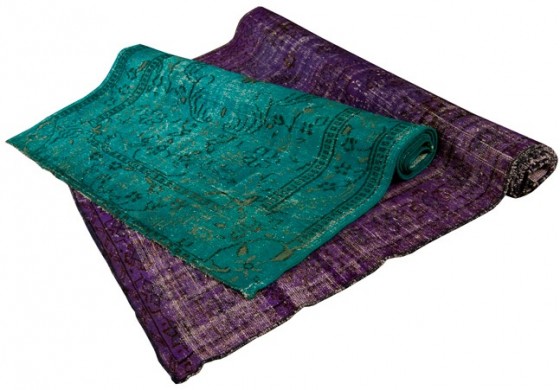
The family-run business scoops up rugs otherwise headed for the landfill. They then “scrape them down” or sand-washed and reinvigorate their former color with oil-based dyes. Many are up to 100 years old and range in price from $500 to $2500, depending on the size.

Not all of the rugs can be fully salvaged. Those that are beyond help are instead cut up into blocks and re-purposed as patchwork rugs. No one could argue that the rugs will ever achieve their former glory, but it’s a fine way to pay their respects to the artists who originally crafted them.

ELTE has made other strides to lower the carbon footprint. Their “Nature’s Carpets” are made from 100% wool – a renewable resource according to their website (this could probably be debated, but we’ll let it go for now), with jute backing.

They also sell what are called “Organic” Persian Rugs. This word has morphed so much since “organic food” came into being, we’re not sure what it means anymore. As applied to the rugs, however, they are all hand-knotted in Persian villages with hand-spun wool and use only natural dyes. Products used to create the dyes include walnuts, pomegranate skins, and vine leaves, and madder roots.

All in-store transactions are paperless, only degradable bags are used, and even the business cards are printed on Forest Stewardship Council (FSC) paper. And everything is recycled.

:: Treehugger

More Fashion and Design ideas from the Middle East:
Eco-Hijabs On The Rise: What Muslim Fashion Bloggers Have To Contribute
Israel, Iran Take Top 2 Endangered Species Design Prizes
TreeShirt Brings Graphic Tees And Planted Trees To Lebanon

Tafline Laylin
Tafline Laylinhttp://www.greenprophet.com
As a tour leader who led “eco-friendly” camping trips throughout North America, Tafline soon realized that she was instead leaving behind a trail of gas fumes, plastic bottles and Pringles. In fact, wherever she traveled – whether it was Viet Nam or South Africa or England – it became clear how inefficiently the mandate to re-think our consumer culture is reaching the general public. Born in Iran, raised in South Africa and the United States, she currently splits her time between Africa and the Middle East. Tafline can be reached at tafline (at) greenprophet (dot) com.

LEAVE A REPLY

Please enter your comment!
Please enter your name here

TRENDING

Zoroastrianism from Iran is the world’s first eco-religion

When Zarathustra started preaching around 1200 BCE in ancient Persia, which is known today as Iran, he wasn't just founding a religion—he was creating the world's first environmental protection movement. Good thoughts, good words, good deeds. But there was a mantra and words to live by: don't pollute the earth, water, or fire. Ever.

Sink holes from over-watering farmers’ fields

Sinkholes are rapidly appearing in Turkey’s central Anatolian farming region, particularly around Konya and Karapınar. These giant gaping holes in the ground in areas of farmland, known locally as obruk, are not random geological events. They are linked to prolonged drought, climate-driven heat stress, and heavy groundwater extraction for agriculture in one of the country’s most important breadbaskets.

UNESCO forest being developed in Iran

Environmental activists in Iran often face significant personal risk when speaking out about illegal land grabs, deforestation, or the destruction of protected areas. In recent years, several high-profile environmentalists have been detained, interrogated, or imprisoned on broad national-security charges, sometimes without transparent legal proceedings.

Iran’s rarest forest is on fire

It's full of rare and endemic species, and it's a UNESCO heritage site. Iran's natural treasure, a 1000-kilometer forest, the Hyrcanian forest has been on fire for several days. It stretches from the Caspian Sea and into neighboring Azerbaijan and is home to more than 3,200 kinds of plants. 

Sustainable Architect Ronak Roshan on the Politics Behind the Houston Ismaili Center

Roshan’s reflection situates the Houston Ismaili Center within a broader discussion about architecture as diplomacy — where aesthetics, faith, and geopolitics intersect. Her words challenge readers to question whether “green” design and grand symbolism can coexist without transparency and accountability.

Qatar’s climate hypocrisy rides the London Underground

Qatar remains a master of doublethink—burning gas by the megaton while selling “sustainability” to a world desperate for clean air. Wake up from your slumber people.

How Quality of Hire Shapes Modern Recruitment

A 2024 survey by Deloitte found that 76% of talent leaders now consider long-term retention and workforce contribution among their most important hiring success metrics—far surpassing time-to-fill or cost-per-hire. As the expectations for new hires deepen, companies must also confront the inherent challenges in redefining and accurately measuring hiring quality.

8 Team-Building Exercises to Start the Week Off 

Team building to change the world! The best renewable energy companies are ones that function.

Thank you, LinkedIn — and what your Jobs on the Rise report means for sustainable careers

While “green jobs” aren’t always labeled as such, many of the fastest-growing roles are directly enabling the energy transition, climate resilience, and lower-carbon systems: Number one on their list is Artificial Intelligence engineers. But what does that mean? Vibe coding Claude? 

Somali pirates steal oil tankers

The pirates often stage their heists out of Somalia, a lawless country, with a weak central government that is grappling with a violent Islamist insurgency. Using speedboats that swarm the targets, the machine-gun-toting pirates take control of merchant ships and then hold the vessels, crew and cargo for ransom.

Leopoldo Alejandro Betancourt López Turned Ocean Plastic Into Profitable Sunglasses

Few fashion accessories carry the environmental burden of sunglasses. Most frames are constructed from petroleum-based plastics and acrylic polymers that linger in landfills for centuries, shedding microplastics into soil and waterways long after they've been discarded. Leopoldo Alejandro Betancourt López, president of the Spanish eyewear brand Hawkers, saw this problem differently than most industry executives.

Why Dr. Tony Jacob Sees Texas Business Egos as Warning Signs

Everything's bigger in Texas. Except business egos.  Dr. Tony Jacob figured...

Israel and America Sign Renewable Energy Cooperation Deal

Other announcements made at the conference include the Timna Renewable Energy Park, which will be a center for R&D, and the AORA Solar Thermal Module at Kibbutz Samar, the world's first commercial hybrid solar gas-turbine power plant that is already nearing completion. Solel Solar Systems announced it was beginning construction of a 50 MW solar field in Lebrija, Spain, and Brightsource Energy made a pre-conference announcement that it had inked the world's largest solar deal to date with Southern California Edison (SCE).

Related Articles

Popular Categories