Esfahan Is Almost As Polluted As Tehran

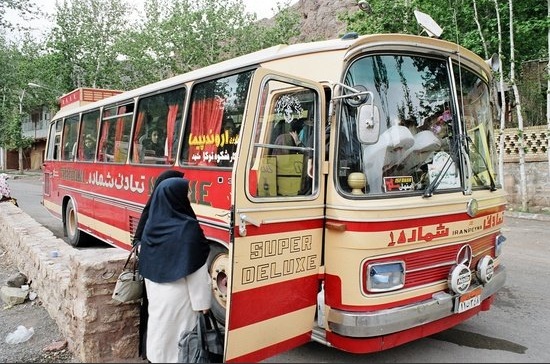
esfahan bus iranA look at the air pollution in Esfahan, Iran. Cars and the clay brick industry are some of the biggest problems. The solution? Take the bus.

In 2005 it was announced for the first time that the air pollution of Esfahan, the third big city of Iran, was in an emergency situation. Since then Esfahan has experienced a quick increase in air pollution. Today this city is the most polluted Iranian city after Tehran. The number of the “clean air” days in Esfahan was only 11 days last year. 

Where is the pollution coming from? Seventy to 75 percent of this pollution is caused by automobiles. So this has caused more strict control over emissions of the vehicle motors. Yearly checking of the car engines are done by special centers. This has recently been compulsory for car owners.

Apart from the automobiles, another reason of the air pollution of the city is the industry. While the industrial centers should be located outside a 50-kilometers radius of the city, still many centers are active inside the illegal zone.

According to Elaheh Mousavi, an environmental journalist in Iran, 70 percent of the clay bricks that are used in construction of the country are produced in Esfahan. These bricks are produced in kilns that use surface mud and lime as raw materials. Baking these materials in a 25 kilometers distance from the city, sends a daily amount of 1.5 to 2 tons of pollutant to the air of the city.

Elaheh also mentions the high percentage of sulfur in the automobile fuels as a main source of pollution. This amount of sulfur is 50 times more than the world standards.

It is likely that a traffic plan like Tehran’s be carried out in Esfahan in the near future. Such ideas can be heard from time to time from the transportation authorities. One of them is the Mostafa Nourian from the Municipality of Esfahan who believes that the central streets of Esfahan should be closed to the personal cars, and the only automobiles that can pass through them should be the public ones like buses and taxis.

This is similar to the traffic plan of Tehran, which has been executed in different levels since 1979 over the city center of Tehran. One of the reasons for executing such a plan in Tehran was the air pollution of the city less extreme then than now.

The difficulty in such problems is that usually the people have low levels of participation. The citizens of Iranian cities have seen inactivity from the governmental sections so they are discouraged and often do not take the first steps in using public transport facilities or by walking more.

However we should know that by using less cars and more sustainable ways of transportation like taking public transit is one of the most effective strategies for reducing air pollution in Iran or anywhere.

The people of Esfahan have traditionally been bicycle riders. This is what normally the elder people can remember. Of course the old monuments of Esfahan will be more tourist-friendly with cleaner air. We can hope.

More green articles on Esfahan and Tehran:

Problems With Rehabilitating the Historical Grand Bazaar of Tehran

The Difficulties of Developing Cycling Routes in Iranian Cities

Traffic Accident Fatalities in Iran: the Statistics and Causes

Image via travelpod

Mehrdad Parsipour
Mehrdad Parsipourhttp://www.greenprophet.com
Mehrdad Parsipour is an urban researcher who is based in Germany. He is originally from Iran and is interested in the traditional urbanism and architecture of Iran and Middle East. Mehrdad’s other research interests are western traditional urban development trends, Islamic cities, and sustainable urban forms, and finally the environment. Since 1997 he has been working in the field of civil engineering, and also urban and regional planning.
4 COMMENTS
  1. Today there are many companies which claim to offer the
    reliable background check services but their authenticity can be judged through background
    on myself check. With the aid of the internet you can easily come to know how to get the background check
    quite efficiently. Most individuals now gather this
    type of account for employment purposes.

Comments are closed.

Hot this week

How Renewable Energy is Revolutionizing the Way We Power Our World

Solar has become the star of the transition thanks to modular hardware and straightforward installation. It fits dense cities and remote towns alike. Many companies are turning to rooftop arrays and carport systems - and exploring commercial solar installation as a practical way to lock in future savings.

How does one start prepping?

Faced with an extreme winter storm this year, Americans wonder how to be prepared for catastrophe. Miriam has lived through wars in the Middle East - so she's prepared on giving you a guide to prepping.

Fishermen sue tire manufacturers on behalf of the salmon

A federal trial in San Francisco has brought US tire manufacturers, fishing groups, and environmental scientists into court over a chemical most drivers have never heard of — but which scientists say may be silently reshaping aquatic ecosystems.

Listening to Water: Tarek Atoui’s Next Work for Tate Modern

Born in Beirut, Lebanon in 1980 and now living in Paris, Atoui has spent years building instruments that don’t sit comfortably in concert halls. Many of them involve water, glass, and ceramics — materials that react to sound instead of simply producing it.

Leading Through a Dual-Energy Transition: Balancing Decarbonisation with Energy Security

Experience in one area of the energy industry isn't enough to guarantee readiness across all the others. That's where a structured program like an MBA in energy can come in. Today's advanced curricula explore energy economics, finance, policy, and strategic management alongside the technical subjects. And when pursuing an energy MBA online, professionals can skill up and retrain without having to step out of the labor market -- an important perk at a time when skilled professionals are already in short supply.

Topics

How Renewable Energy is Revolutionizing the Way We Power Our World

Solar has become the star of the transition thanks to modular hardware and straightforward installation. It fits dense cities and remote towns alike. Many companies are turning to rooftop arrays and carport systems - and exploring commercial solar installation as a practical way to lock in future savings.

How does one start prepping?

Faced with an extreme winter storm this year, Americans wonder how to be prepared for catastrophe. Miriam has lived through wars in the Middle East - so she's prepared on giving you a guide to prepping.

Fishermen sue tire manufacturers on behalf of the salmon

A federal trial in San Francisco has brought US tire manufacturers, fishing groups, and environmental scientists into court over a chemical most drivers have never heard of — but which scientists say may be silently reshaping aquatic ecosystems.

Listening to Water: Tarek Atoui’s Next Work for Tate Modern

Born in Beirut, Lebanon in 1980 and now living in Paris, Atoui has spent years building instruments that don’t sit comfortably in concert halls. Many of them involve water, glass, and ceramics — materials that react to sound instead of simply producing it.

Leading Through a Dual-Energy Transition: Balancing Decarbonisation with Energy Security

Experience in one area of the energy industry isn't enough to guarantee readiness across all the others. That's where a structured program like an MBA in energy can come in. Today's advanced curricula explore energy economics, finance, policy, and strategic management alongside the technical subjects. And when pursuing an energy MBA online, professionals can skill up and retrain without having to step out of the labor market -- an important perk at a time when skilled professionals are already in short supply.

From Green Energy to Healthy Societies: Why old systems thinking is becoming relevant again

Across the Middle East and North Africa, large investments are being made in green hydrogen, renewable energy, water infrastructure and sustainability. Most of these efforts are discussed in the context of climate change, decarbonization and economic diversification. That framing is important, but it may not capture their full value.

We saw peace – an interreligious encounter deep in our eyes

They came from Israel, Palestine, Jordan, Iraq, Yemen, Morocco, Tunisia, Lebanon, Egypt… There are Sunni Muslims, Shiite Muslims, Jews (Orthodox and Reform), Orthodox Christians, Coptic Christians, Protestant Christians, Druze, Baha'is, a Scientologist.

Can biochar reduce ‘Forever Chemicals’ in food if it’s used in farms?

Biochar is produced by heating organic material in a low-oxygen environment so it does not burn. This process, known as pyrolysis, transforms plant matter into a stable, carbon-rich material.

Related Articles

Popular Categories