American Vertical Farm Concepts Good for the Middle East

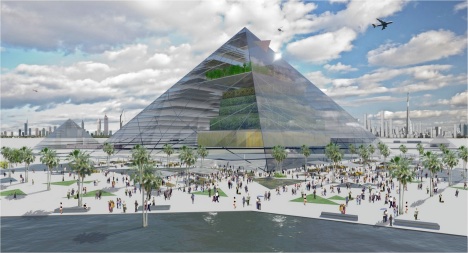
Inspired by Babylon’s Hanging Gardens? Weber Thompson’s Vertical Farm pyramid concept can be used in  Abu Dhabi or Dubai as well.

American cities like Newark New Jersey are a long way from Abu Dhabi or Cairo; but vertical farming concepts now being planned for American cities, are also being considered for locations in the Middle East as well. In a recent published article in Treehugger, giant pyramid shaped structures, as well as specially designed skyscrapers will produce large amounts of vegetables and other agricultural produce by means of soil-less hydroponics. Hydroponics has been in use for years, especially in green or hot house agriculture. But the idea of conserving space by integrating this concept into tall, vertical structures to save space is still relatively new.

The innovative vertical farm plans stem from two visionary vertical farming innovators, Dr. Dickson Despommier and Weber Thompson; and the Weber Thompson Architectural Firm is designing these structures. The main idea of architectural building concepts by Weber Thompson is to enable the use of vertical farming in densely populated urban areas. The concepts allow the maximum use of solar energy:

“to grow food in a climate-controlled multistory building free of pollutants, pesticides and seasons while producing the highest-quality produce in an urban environment.”

The climate (and rainfall) of areas like Newark New Jersey is a bit different from the climate in the Persian Gulf region, and other desert locations in the Middle East;  but in regions like the UAE, where Dr. Despommier’s vertical farming concepts are being studied with great interest, it may not be long before futuristic looking vertical farms will be common place in Dubai, Abu Dhabi, Saudi Arabia, and elsewhere in the Middle East.

Abu Dhabi’s Masdar City, now being built, is already hailed as the world’s first completely non-carbon residential and commercial project. In this much heralded “carbon free” project, futuristic designed vertical farming towers are part of the project’s unique planning models.
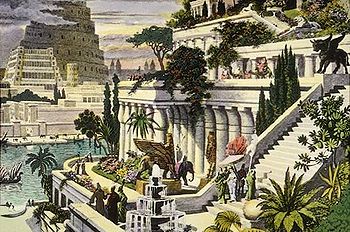
The Hanging Gardens: Alexander The Great loved the place

The idea of vertical farming concepts is actually very ancient, and goes all the way back to the 5th Century BCE, when Babylonia’s “Hanging Gardens of  Babylon” were hailed as one of the 7 Wonders of the Ancient World.

Constructed during the reign of  King Nebuchadnezzar II, who reigned for 43 years, beginning in 605 BCE, the gardens, some of which reached a height of as much as 320 feet high, were described by Greek Historian Diodorus as constructed with:

“A covering with sheets of lead, that the wet which drenched through the earth might not rot the foundation. Upon all these was laid earth of a convenient depth, sufficient for the growth of the greatest trees. When the soil was laid even and smooth, it was planted with all sorts of trees, which both for greatness and beauty might delight the spectators.”

While these beautiful gardens were not actually suspended, they were called the “hanging gardens” due to the greenery of the many plants and trees hanging over walls; thus giving the gardens its name.  Bringing water from the Euphrates River to the top of the gardens was an engineering feat still marveled to this day, and was described by the green geographer Strabo as done by “water engines (large buckets connected to chains and pulleys), by means of which persons, appointed expressly for the purpose, are continually employed in raising water from the Euphrates into the garden.”

The “Hanging Gardens of Babylon” have long since faded into history; but the vertical farming concept they created is now being sought after as a means of not only growing food crops, but for the creation of urban beauty as well, And no better place for such projects than the part of the world where the idea began, more than 2,500 years ago.

Read more on vertical farming:
Hanging Gardens of Babylon Prove Vertical Farming Concepts are not New
Vertical Farms May be Only Crop Solution in Middle East
Vertical Farms in Masdar City are Soil-less Crop Solution

Images: VerticalFarm.comWikipedia

Maurice Picow
Maurice Picowhttps://www.greenprophet.com/
Maurice Picow grew up in Oklahoma City, U.S.A., where he received a B.S. Degree in Business Administration. Following graduation, Maurice embarked on a career as a real estate broker before making the decision to move to Israel. After arriving in Israel, he came involved in the insurance agency business and later in the moving and international relocation fields. Maurice became interested in writing news and commentary articles in the late 1990’s, and now writes feature articles for the The Jerusalem Post as well as being a regular contributor to Green Prophet. He has also written a non-fiction study on Islam, a two volume adventure novel, and is completing a romance novel about a forbidden love affair. Writing topics of particular interest for Green Prophet are those dealing with global warming and climate change, as well as clean technology - particularly electric cars.

LEAVE A REPLY

Please enter your comment!
Please enter your name here

TRENDING

UAE Green Finance Report 2025

Masdar is the the UAE’s flagship renewable energy company. Compare it to Neom in Saudi Arabia. Masdar has become one of the world’s most active clean energy investors, with projects in more than 40 countries across six continents. Established in 2006 and jointly owned by ADNOC, Mubadala, and TAQA, Masdar operates and develops solar, wind, and green hydrogen projects with a current portfolio exceeding 50 gigawatts of capacity. Masdar also buys companies, and paid $50 million for this US business Terra-Gen last year. 

Iran’s water mafia and thirst for war leaves the country on brink of being dry

Iran’s Lake Urmia, once the Middle East’s largest saltwater lake, has shrunk by 90 percent due to mismanagement, dams, and drought. As Tehran pours billions into foreign conflicts, water activists face repression at home. The crisis mirrors Syria’s drought-driven unrest, showing how water scarcity can destabilize entire regions.

A Sustainable Path to Rebuilding Gaza: Opportunity for Collaboration and Peace

Given the likelihood of a buffer zone along Gaza’s border, an innovative approach could be to transform this space into a greenbelt. Many cities worldwide have successfully implemented green zones that serve as ecological buffers while also benefiting urban populations. A well-planned greenbelt could provide environmental benefits, support agriculture, and even serve as a shared space between Gazans and Israelis—turning a divisive border into an area of mutual sustainability.

Creamy Eggplant Soup Recipe

Eggplant seems an unlikely soup ingredient. But blended with vegetable stock, herbs, and cream, the shiny purple vegetable makes a creamy soup full of Middle-Eastern flavors.

Six “Green” Reasons To Drink Camel’s Milk

With 5 times the amount of Vitamin C in camel's milk, and full of iron, camel's milk needs no nutritional help. It has a shelf life of 5 days before pasteurization, after which it will survive for up to 3 weeks. Camel's milk is just as versatile as other milk, used as it is to produce low-fat varieties of cheese, chocolate, and a fermented delicacy that is used in areas that lack refrigeration.

Qatar’s climate hypocrisy rides the London Underground

Qatar remains a master of doublethink—burning gas by the megaton while selling “sustainability” to a world desperate for clean air. Wake up from your slumber people.

How Quality of Hire Shapes Modern Recruitment

A 2024 survey by Deloitte found that 76% of talent leaders now consider long-term retention and workforce contribution among their most important hiring success metrics—far surpassing time-to-fill or cost-per-hire. As the expectations for new hires deepen, companies must also confront the inherent challenges in redefining and accurately measuring hiring quality.

8 Team-Building Exercises to Start the Week Off 

Team building to change the world! The best renewable energy companies are ones that function.

Thank you, LinkedIn — and what your Jobs on the Rise report means for sustainable careers

While “green jobs” aren’t always labeled as such, many of the fastest-growing roles are directly enabling the energy transition, climate resilience, and lower-carbon systems: Number one on their list is Artificial Intelligence engineers. But what does that mean? Vibe coding Claude? 

Somali pirates steal oil tankers

The pirates often stage their heists out of Somalia, a lawless country, with a weak central government that is grappling with a violent Islamist insurgency. Using speedboats that swarm the targets, the machine-gun-toting pirates take control of merchant ships and then hold the vessels, crew and cargo for ransom.

Leopoldo Alejandro Betancourt López Turned Ocean Plastic Into Profitable Sunglasses

Few fashion accessories carry the environmental burden of sunglasses. Most frames are constructed from petroleum-based plastics and acrylic polymers that linger in landfills for centuries, shedding microplastics into soil and waterways long after they've been discarded. Leopoldo Alejandro Betancourt López, president of the Spanish eyewear brand Hawkers, saw this problem differently than most industry executives.

Why Dr. Tony Jacob Sees Texas Business Egos as Warning Signs

Everything's bigger in Texas. Except business egos.  Dr. Tony Jacob figured...

Israel and America Sign Renewable Energy Cooperation Deal

Other announcements made at the conference include the Timna Renewable Energy Park, which will be a center for R&D, and the AORA Solar Thermal Module at Kibbutz Samar, the world's first commercial hybrid solar gas-turbine power plant that is already nearing completion. Solel Solar Systems announced it was beginning construction of a 50 MW solar field in Lebrija, Spain, and Brightsource Energy made a pre-conference announcement that it had inked the world's largest solar deal to date with Southern California Edison (SCE).

Related Articles

Popular Categories