
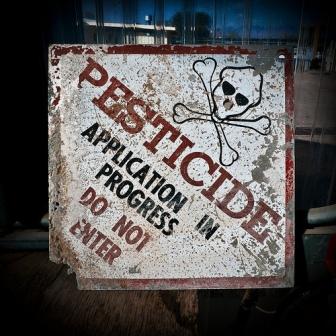
Israeli Company Makhteshim-Agan Industries Invests $1 Billion in Pesticides

Makhteshim-Agan Industries pesticidesAgrochemicals might be big business, but they are a bad deal for the environment and human health.

Israeli firm, Makhteshim-Agan Industries, believes that there is a bright future for chemical pesticides. It has just bet $1 billion dollars on this hope, buying out the Albough chemical manufacturer in a move which, according to Ha’aretz, will transform the Israeli company into the “biggest generic player” in North America’s pesticides industry.

There’s big money to be made from agrochemicals, although whether Makhteshim-Agan’s investment was wise financially remains a moot point since since Albough’s businesses focuses on a single product – the broad-spectrum herbicide, glyphosate:

“Glyphosate prices fluctuate tremendously, and there are clear signs of surplus production capacity around the world. Also, experts suspect that North American weeds are developing resistance to the chemical.”

But whichever way you add up the figures, investing in pesticides makes no ecological sense.  Glyphosate shot to (in)fame when Mosanto genetically modified crops to become resistant to the herbicide, sold under the brand name “Roundup.”

The biotech firm’s GM “Roundup Ready” crops can be sprayed with glyphosate to their heart’s content, killing all weeds and other plants, but leaving the corn or soya unscathed.

We don’t need chemicals to produce good quality food. Organic farming forsakes dependence on artificial pesticides and fertilisers (which, by the way, are increasingly expensive as oil prices rise) – and it can produce good yields, especially in developing countries, whilst conserving soil fertility and biodiversity.

Modern organic methods, first developed after World War Two, are now used by millions of farmers around the world. But investment in organic farming research and production methods is woefully underfunded. Imagine the difference $1 billion could make it if was spent more wisely.

Postscript: As glyphosate’s efficacy falls due to increased weed resistance, its price is expected to drop and Monsanto estimates that the contribution that Roundup makes to its gross profits will be slashed from $300 to £250. Perhaps it’s time to rethink their strategy.

::Betting a billion dollars on one weed killer, Ha’aretz

Photo via ken mccown

Michael Green
Michael Greenhttps://www.greenprophet.com/
Born into a family of auto mechanics and engineers in east London’s urban sprawl, Michael bucked the trend and chose a bicycle instead of a car. A relative newcomer to Jerusalem, he works as a freelance journalist writing for the Jerusalem Post and other publications. Before moving to Israel, he worked for an environmental NGO in England where he developed a healthy obsession with organic vegetables and an aversion to pesticides and GMOs. Michael’s surname is pure coincidence. Michael can be reached at michael (at) greenprophet (dot) com.
3 COMMENTS

Comments are closed.

TRENDING

Eco organization offices destroyed by Iran missile

Tel Aviv's eco organization, the Heschel Center, was impacted by an Iranian missile.

What are AWG air-water generators, and why they aren’t a golden-bullet solution (yet)

Atmospheric water generators (AWGs) sound like magic: machines that can pull drinking water out of air. The idea is mentioned in the Bible, where the elders would pray for water collected as dew on plants and the catch on turning this into a machine is in the physics. To turn invisible vapor into liquid, you must remove heat, especially the latent heat of condensation.

Jordan’s $6 Billion Aqaba–Amman Desalination Project from the Red Sea Moves Forward

In 2025, the Jordanian government signed agreements with a consortium led by Meridiam and SUEZ, alongside VINCI Construction and Orascom Construction. Under a 30-year concession agreement, the consortium will design, build, finance, operate, and maintain the system before transferring it back to the Jordanian government. The total investment is estimated at approximately $6 billion USD.

The Saudi Startup Turning Desalination’s Toxic Waste Into Its Own Disinfectant

For millennia, the Middle East's water crisis seemed an immutable fact of geography — a region defined as much by what it lacked as by what lay beneath its sands. Today, a convergence of plummeting solar costs, advancing membrane technology, and hard-won engineering expertise is rewriting that story.

Jujube, the sidr tree of medicine and magic

A magic holy sidr bath to deflect the evil eye? It needs 7 powdered sidr leaves stirred into a bucket of warm water. The hadith of the Prophet Muhammad allows to repeat healing prayers and verses from the Koran to increase the water’s potency. 5 grams, or 1 tablespoon of sidr powder equals 7 leaves.

How AI Helps SaaS Companies Reduce Repetitive Customer Support Work

SaaS products are designed for large numbers of users with different levels of experience, and also in renewable energy.

Pulling Water from the Air

Faced with water shortage in Amman, Laurie digs up...

Turning Your Energy Consultancy into an LLC: 4 Legal Steps for Founders in Texas

If you are starting a renewable energy business in Texas, learn how to start an LLC by the books.

Tracking the Impacts of a Hydroelectric Dam Along the Tigris River

For the next two months, I'll be taking a break from my usual Green Prophet posts to report on a transnational environmental issue: the Ilısu Dam currently under construction in Turkey, and the ways it will transform life along the Tigris River.

6 Payment Processors With the Fastest Onboarding for SMBs

Get your SMB up and running fast with these 6 payment processors. Compare the quickest onboarding options to start accepting customer payments without delay.

Qatar’s climate hypocrisy rides the London Underground

Qatar remains a master of doublethink—burning gas by the megaton while selling “sustainability” to a world desperate for clean air. Wake up from your slumber people.

How Quality of Hire Shapes Modern Recruitment

A 2024 survey by Deloitte found that 76% of talent leaders now consider long-term retention and workforce contribution among their most important hiring success metrics—far surpassing time-to-fill or cost-per-hire. As the expectations for new hires deepen, companies must also confront the inherent challenges in redefining and accurately measuring hiring quality.

8 Team-Building Exercises to Start the Week Off 

Team building to change the world! The best renewable energy companies are ones that function.

Related Articles

Popular Categories