

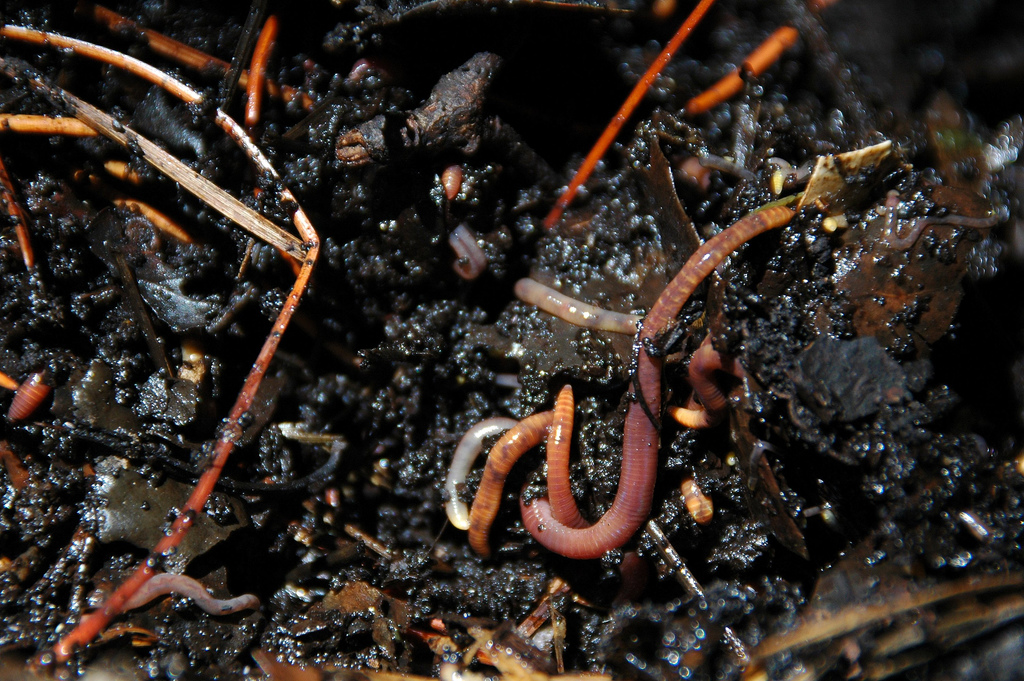
 An ode to the earthworm: An earthworm farmer in Israel praises the beauty of the earthworm. Time to grow your own?
The earthworm is one of mankind’s best friends. Hard at work 24/7, this lowly creature makes it possible for human and plant life to exist. Without the earthworm over here in the Middle East, we would have little to eat, our world would be flooded by snow and rain, and environmental pollution would be greater than it is today.
The earthworm is a natural tiller and a prodigious earth mover. Making its way through the soil it churns the earth, loosening the subsoil and creating microscopic tunnels that allow water and oxygen to reach the root systems of plant life. As they burrow, the earthworm mixes and sifts the soil, breaking up clods of dirt and burying stones.
The earthworm uses the tunnels it constructs to bring healthy organic matter deep into the ground and healthy minerals to the surface where they are most needed. These tunnels also help in water absorption. With earthworms the ground can absorb rain and snow four to ten times faster than areas without these passage ways. This reduces flooding, restores groundwater, and helps to retain moisture for dry seasons.
In the course of the earthworm’s movements, it eats close to one hundred percent of its body weight in decaying organic matter and soil daily. Passing through the length of the earthworm’s body, chemical reactions convert this matter into a super nutritious dark earthy substance full of nutrients and soil-enriching compounds known as “castings.” They are chock full of phosphorous, potash, magnesium, and calcium. Earthworm castings are no less than five times more beneficial than the finest top soil found anywhere in the world.
They contain microorganisms that fight harmful bacteria, pests, and disease in the soil.
Plants and trees grown in an environment with large numbers of earthworms tilling the soil produce healthier, tastier, and more bountiful harvests of food. More can be grown in a smaller space. Land considered unsuitable for growth can be converted into productive soil. The time required for the produce and fruit to ripen is shortened. The need for harmful chemical fertilizers and pesticides is dramatically diminished. Less water is needed for the growing food.
From the moment it is hatched the earthworm begins its life long task of turning organic matter into castings. No one knows for sure how long an earthworm lives, but in one study a group of earthworms were observed for fifteen years. At the end of this time the earthworms were found to be young, healthy, and vigorous as ever.
Clean cast-aways
The earthworms do not carry or transmit diseases. All they ever produce are castings and more earthworms. An earthworm can easily produce more than one thousand offspring annually. One thousand mature breeders can produce a million earthworms.
The earthworm has no eyes. Light sensitive cells on the skin enable it to maintain its course and avoid danger. These cells are also sensitive to touch. The earthworm has no lungs, taking in oxygen and releasing carbon dioxide through its highly permeable skin. It has five hearts that pump blood through its body and works similar to the heart of a human. The earthworm has a mouth but does not chew its food.
The earthworm swallows any piece of organic matter that enters its mouth where it passes into the gizzard, similar to that of a bird. There it is ground up with the help of tiny pebbles or grains of sand that serve as a millstone. The earthworm absorbs the nutrients it needs for survival and passes the castings out of its anterior.
The earthworm is an invertebrate, meaning it has no backbone. The absence of protruding appendages increases mobility. Lubricating mucus on its skin further allows the earthworm to pass through the roughest ground and escape the grasp of predators. An earthworm has the power to easily move stones that are fifty times its body weight.
Eating our leftovers
Earthworms live off of our leftovers. They devour food wastes, many types of animal manure, corrugated cardboard, and the leaves and grass clippings from our gardens. Fallen leaves in an orchard or forest that might need years to decompose are easily consumed by the earthworm. More than fifty percent of the contents that fill our garbage heaps are food for the earthworm. So much of the trash that packs our landfills, dirties our oceans and lakes, and makes the air less pleasant to breathe can be converted into castings.
In earlier times the importance of earthworms was recognized. The fertility of the Nile Valley can be attributed to the earthworm. Today, there is a growing appreciation of the work that the earthworm performs, both as a means of growing food and for recycling waste material. Many countries throughout the world are reducing their use of chemical fertilizers and pesticides by converting animal wastes and organic matter into castings. Local governments are using earthworms to alleviate the problems of overcrowded landfills. Earthworms can produce more compost, in a shorter amount of time, with less effort, than any other recycling method.
If every person in Israel and the Middle East fed one kilogram of food wastes to earthworms, 7 million kilograms less garbage would blight the beauty of our land. Five million kilos of castings would fertilize our fields, orchards, and gardens.
Raise your own
Earthworms can be raised in your home. Even if all you have is a small porch, you too can have your own earthworm farm, converting your fruit and vegetable wastes into beautiful castings that will enrich your plants, lawns, and gardens. It is a wonderful hobby and an excellent educational tool.
Have you ever considered how much garbage you dispose of each day? How many pounds of carrot and potato peels did you throw away during last week’s food preparations? What have you been doing with your apple cores, melon rinds, and cucumber peels? These items did not just disappear from the face of the earth.
In Hebrew we say, “Ain lanu Eretz acheret” (We have no other country). Therefor, we have a responsibility to care for our environment. We have the ability to combine ancient knowledge with modern know how to protect and enhance the beauty of our Land.
Let’s put the earthworm to work for us!
Nachum Hirschel lives in Beit Shemesh where he operates Eretz HaKodesh Earthworm Farm. He sells earthworms, castings, and bins. He gives classroom workshops and lectures extensively on earthworms throughout Israel. Nachum can be contacted at [email protected] or at 052-7-143-154.
Read more on composting and gardening:
NatureMills’s Urban Compost Device
Composting With Tiger Worms
Mulch, Rot and Invigorate Your Compost Heap


glad to have spoken with nochum. I will try to get to him shortly. I want earthworms to compost my current pile that is getting nowhere.
Hello, I would like to buy worms in Israel, do you sell them? thank you very much.
maria
We don’t sell worms. Sorry. Try Nachum, through here:
http://www.greenprophet.com/2010/05/earthworms-garden/
Cool sounds like fun. would be interested in knowing more about setting up a small bin in my backyard.