Bahrain Aims to Increase its Water Production by 33% – Within One Year

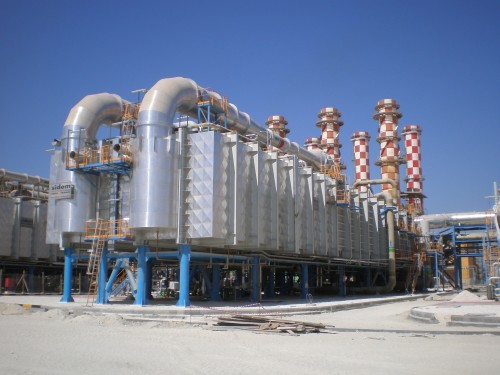
This desalination plant in Al-Hidd will be joined by additional facilities as Bahrain seeks to boost its water production. (Image via sidem-desalination.com)

Aiming to meet its growing water needs, Bahrain is pursuing an ambitious plan to increase its production of desalinated water. The kingdom currently produces 142 million gallons of water a day.

The first stage of the plan will cost some $400 million and has a particularly ambitious timetable:  The aim is to already produce an additional 48 million gallons of water a day by mid-2011. The second stage will phase in production of another 52 million gallons per day over the next two decades, bringing total daily capacity to 242 million gallons.

“Bahrain consumes 140 million gallons of water per day, so we need to have 420 million gallons to be enough for three days if an emergency strikes,” Dr Abdulmajid Al-Awadhi, chief executive of Bahrain’s Electricity and Water Authority (EWA), told the Gulf Daily News. And this is before taking into account future growth in water consumption.

Al-Awadhi acknowledged that it is also necessary to address Bahrain’s high rate of water consumption, noting that per capita consumption of water is about 125 gallons in the kingdom, compared to about 60 gallons in Japan.

The plan to increase water production includes building new desalination stations and water networks. “Bahrain is planning to secure water in all five governorates and connect water pipes to new houses, malls, shops and other buildings,” Al-Awadhi said.

:: ArabianBusiness.com
:: Gulf Daily News

Read more about Bahrain on Green Prophet:

Durrat Al Bahrain Artificial Islands – “A Place Like No Other”

Made-At-Home Cottage Industry Booming in Island Kingdom of Bahrain

Ira Moskowitz
Ira Moskowitzhttps://www.greenprophet.com/
When his kids were small, Ira would point to litter on the ground and tell them: “That makes me angry!” He still gets angry about pollution, waste and abusive treatment of our world, but is encouraged by the growing awareness of environmental issues and has been following the latest developments in cleantech with great interest. Ira grew up in the green hills of western Massachusetts and moved to Israel in the early 1980s after completing an MA in Middle Eastern Studies. He has worked as a software developer and journalist, and translates works of Hebrew fiction and non-fiction to English. Ira is trying to age gracefully, but refuses to surrender his youthful belief in the potential for change, including a collaborative future for the peoples of the Middle East. To contact Ira, email ira (at) greenprophet (dot) com.

TRENDING

Forever chemicals banned from Europe’s drinking water

The EU is taking a bold step in making sure all European Union member states worked to monitor and reduce PFAS levels in drinking water.

Elon Musk to create Mars base station on the Moon

For those unaware, SpaceX has already shifted focus to building a self-growing city on the Moon, as we can potentially achieve that in less than 10 years, whereas Mars would take 20+ years.

Astro uses AI to help procure land for renewable energy

For oil-rich, environmentally vigilant Gulf states, Astro isn’t just another startup story. It is a blueprint for accelerating an energy transition that is now existential, not optional.

10 Proven Israeli Technologies to Help Somaliland Build Food, Water, and Energy Security

Israel’s water and agricultural technologies didn’t emerge from ideal conditions. They were developed under pressure: low rainfall, saline water, political isolation, lack of energy resources, and the constant need to feed a growing population with limited land. Over the years, I’ve written about many of these companies not as miracle-makers, but as problem-solvers. That’s what makes them relevant to places like Somaliland. Israel was the first country in the world to recognize Somaliland as an independent state although Ethiopia has been treating the nation as such for decades.

Sink holes from over-watering farmers’ fields

Sinkholes are rapidly appearing in Turkey’s central Anatolian farming region, particularly around Konya and Karapınar. These giant gaping holes in the ground in areas of farmland, known locally as obruk, are not random geological events. They are linked to prolonged drought, climate-driven heat stress, and heavy groundwater extraction for agriculture in one of the country’s most important breadbaskets.

Turning Your Energy Consultancy into an LLC: 4 Legal Steps for Founders in Texas

If you are starting a renewable energy business in Texas, learn how to start an LLC by the books.

Tracking the Impacts of a Hydroelectric Dam Along the Tigris River

For the next two months, I'll be taking a break from my usual Green Prophet posts to report on a transnational environmental issue: the Ilısu Dam currently under construction in Turkey, and the ways it will transform life along the Tigris River.

6 Payment Processors With the Fastest Onboarding for SMBs

Get your SMB up and running fast with these 6 payment processors. Compare the quickest onboarding options to start accepting customer payments without delay.

Qatar’s climate hypocrisy rides the London Underground

Qatar remains a master of doublethink—burning gas by the megaton while selling “sustainability” to a world desperate for clean air. Wake up from your slumber people.

How Quality of Hire Shapes Modern Recruitment

A 2024 survey by Deloitte found that 76% of talent leaders now consider long-term retention and workforce contribution among their most important hiring success metrics—far surpassing time-to-fill or cost-per-hire. As the expectations for new hires deepen, companies must also confront the inherent challenges in redefining and accurately measuring hiring quality.

8 Team-Building Exercises to Start the Week Off 

Team building to change the world! The best renewable energy companies are ones that function.

Thank you, LinkedIn — and what your Jobs on the Rise report means for sustainable careers

While “green jobs” aren’t always labeled as such, many of the fastest-growing roles are directly enabling the energy transition, climate resilience, and lower-carbon systems: Number one on their list is Artificial Intelligence engineers. But what does that mean? Vibe coding Claude? 

Somali pirates steal oil tankers

The pirates often stage their heists out of Somalia, a lawless country, with a weak central government that is grappling with a violent Islamist insurgency. Using speedboats that swarm the targets, the machine-gun-toting pirates take control of merchant ships and then hold the vessels, crew and cargo for ransom.

Related Articles

Popular Categories