

This book is unusual. Firstly, by virtue of covering the topic of forest gardening at all, but also unusual in another respect.
Many gardening books either concentrate on being packed with practical How-To information, or on offering glossy fantasies for gardeners. In Creating a Forest Garden Martin Crawford has expertly covered both bases. There are lots of mouth-watering pictures and great ideas to fire the inspiration as well as detailed, knowledgeable advice on how to achieve the reality.
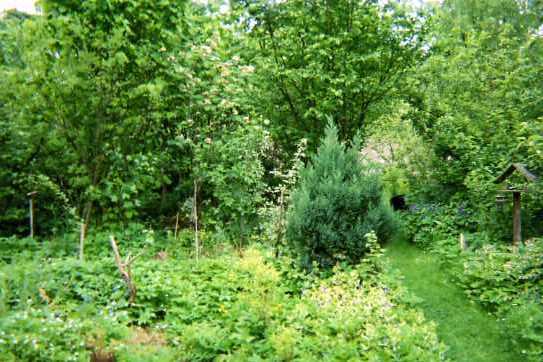
He begins by describing what he means by the concept of a ‘forest garden’, namely “a garden modelled on the structure of young natural woodland, utilising plants of direct and indirect benefit to people – often edible plants. It may contain large trees, small trees, shrubs, herbaceous perennials, annuals and root crops, all planted in such a way as to maximise positive interactions and minimise negative interactions, with fertility maintained largely or wholly by the plants themselves.”
Hence, some of the principles underlying this book are allied to those of permaculture, although Crawford also includes annuals and biennials and short-lived climbers within his plantings.
He explains how a forest garden can be low maintenance, highly efficient for food production and even contribute to ‘food security’. If successfully planned, with the soil covered most of the time, there should be little weeding required. A forest garden can be diverse, sustainable, resilient to climate extremes and also beautiful, but it’s certainly not quick-fix makeover gardening.
This book is definitely about gardening and not simply food production agriculture, but it does concentrate on plants which are both useful and edible. Nor are the possibilities limited to those with large areas of land. A forest garden can be a small back garden and the book highlights which subset of plants would be most suitable for this.
Crawford established his own forest garden fifteen years ago in the South West of the United Kingdom. Due to the mild climate of that region of the country, and somewhat international approach of the author, he is by no means only writing about traditional English woodland plants. He discusses the aesthetics, philosophy and practicalities of native and non-native planting and comes down in favour of a distinctly pragmatic approach.
Many of the plants described within this book, such as mulberry, almond, myrtle, grape vine and strawberry tree would not be out of place in the Middle East.
The luscious plant directories contained within the book give information about hardiness of plants and their sun and shade preferences and tolerances, which is a useful distinction to make. He also writes about water requirements and irrigation, although perhaps not in the detail required by a reader in the Middle East wishing to establish a forest garden from scratch. (we’ve written recently about using forests as carbon sinks – that post is here.)
Somewhat counter-intuitively, Crawford explains that if you want a forest garden it is easier to start with a field rather than a forest. Converting existing woodland will require extensive thinning and replanting. He describes the processes and cycles required to plant your own trees and begin to establish the layers of planting beneath this, with an upper canopy of trees, a middle layer of shrubs and lower, perennial ground cover, to create something between a natural woodland and an orchard garden in character.
He also addresses how prevailing levels of light affect planting. For example, the depth of shade beneath tree cover in a Middle Eastern forest garden will be less than for the same density of planting in a UK garden.
This wealth of knowledge on how to create a forest garden from scratch leaves little space for describing gardening interventions in existing woodland.
This was one of the few aspects of the book which disappointed me, since forest gardening principles might offer exciting possibilities for gardeners wishing to productively cultivate tree-covered land without first clearing it. However, this is a small criticism, because there are many useful tips which could be adapted by someone gardening in established woodland. For instance, Crawford gives advice on the optimum design of clearings, and on which plants will require additional nutrients or inter-planting with nitrogen-fixing plants.
His calculations on the quantities of different substances which can be used to fertilize different plantings even include the use of human urine.
This book covers everything from mulching methods and grafting to wind protection and raising your own trees from seed.
Creating a Forest Garden is both an invaluable reference book and a fascinating coffee table volume. If you are seriously considering the creation or maintenance of a forest garden then you would do well to have this book on your shelves. Even if you are only looking for novel ground cover suggestions in shaded areas or approaches to inter-planting beneath trees, then this book offers bountiful food for thought.
—
Reviewer Pauline Masurel is a gardener and writer who lives in the United Kingdom, near Bristol. She is a regular reviewer of fiction for The Short Review website and has reviewed books for Amateur Gardening magazine. Her own short stories have been published in anthologies, broadcast on BBC radio and featured online.
She was a runner up in the 2010 Chapter One International Short Story competition and is a member of the storytelling group Heads & Tales. More about her own writing can be found on her website www.unfurling.net. Top image via Adventure.