Durrat Al Bahrain Artificial Islands – "A Place Like No Other"

durrat-al-bahrain-1Too many artificial islands imperil endangered species, coral reefs, and humans too?

If Bahrain’s endangered dugong and turtle populations had a voice, surely they would use it to cry out against the Durrat artificial islands.  The fishermen are shouting because they’re running out of fish.  Even members of parliament are grumbling that land reclamation renders the country economically and socially unstable.  There is a strong sense that too many poorly regulated artificial islands are a bad idea. Unfortunately, dissenting voices don’t count where $6 billion development projects are concerned, especially when Bahrain’s government and financing arm – the Kuwait Finance House – own them.

durrat-al-bahrain-2

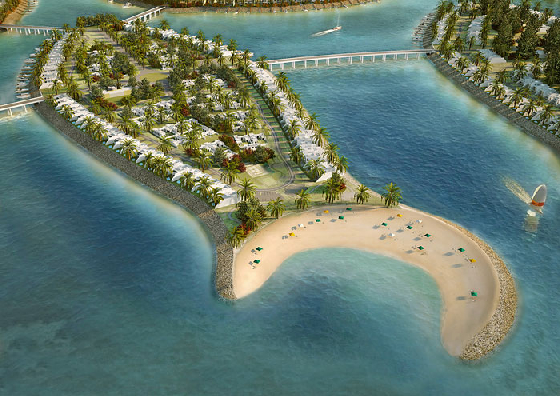
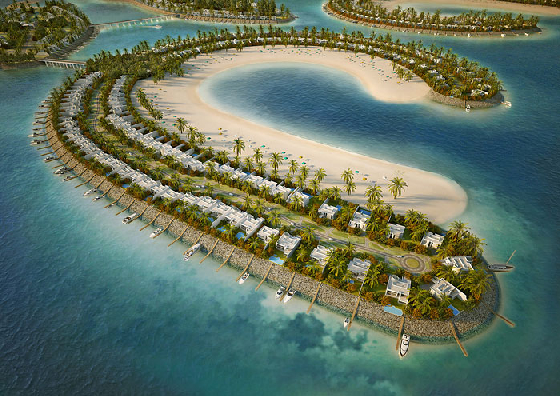
Built off the southern coast, the Durrat Al Bahrain project is 60% complete.  In 2 or 3 years, there will be 2,000 beachfront villas, 3,600 apartments and offices, leisure facilities, a golf course, and other amenities, a “place like no other.”  The King Hamad 2-lane highway will put the islands within a 35-minute drive of the international airport, which should draw a veritable stampede of luxury dwellers.

The process required to create a 21km2 necklace of 15 interconnected islands is deeply destructive.  First it is necessary to remove loose material from the seabed to stabilize it, and then create the islands with fill.  Finally, a sea wall must be built to protect the islands.

According to Bayyinah Salahuddin of Duke University, Dubai’s first artificial island Palm Jumeirah “buried and asphyxiated wildlife, increased turbidity, and changed the alongshore sediment transport.” These conditions, as well as pollution and higher temperatures, also lead to coral bleaching and are just as likely to occur in Bahrain.
durrat-al-bahrain-3

The developers Atkins and KMC Bovis claim to have conducted appropriate ecological surveys, as well as water flow and water quality checks in order to mitigate potential damage.  They also sponsored the Bahrain Center for Studies and Research in order to keep track of Bahrain’s marine life, and planted mangroves in order to restore their dwindling numbers.  They want to demonstrate that “development and environment can exist harmoniously.”

Perhaps they are right.  Perhaps there is no cause to worry that Bahrain, like lips full of Botox, is already puffed out to 76.3% its original size. San Francisco, Chicago and Cape Town were all partially created from landfill and still stand today.  Then again, so was New Orleans, which endured serious flushing after Hurricane Katrina pummeled the levees built to protect it.  Seems like a gamble only a suicidal species would dare.

More on artificial islands in the Middle East:
Coastal Erosion Threatens Evolutionary Hotspots In Gulf Region
Lebanon’s Going Ahead With $8 Billion Cedar Islands Project, Despite Dubai Debt
On Abu Dhabi’s “Al Reem Island” – Who’s Protecting (Artificial) Open Spaces In The Arab World?

Tafline Laylin
Tafline Laylinhttp://www.greenprophet.com
As a tour leader who led “eco-friendly” camping trips throughout North America, Tafline soon realized that she was instead leaving behind a trail of gas fumes, plastic bottles and Pringles. In fact, wherever she traveled – whether it was Viet Nam or South Africa or England – it became clear how inefficiently the mandate to re-think our consumer culture is reaching the general public. Born in Iran, raised in South Africa and the United States, she currently splits her time between Africa and the Middle East. Tafline can be reached at tafline (at) greenprophet (dot) com.

LEAVE A REPLY

Please enter your comment!
Please enter your name here

TRENDING

Huge Fish Nursery Discovered Under Freezing Arctic Seas

In 2019, an underwater robot camera exploring the seabed...

Iran’s water mafia and thirst for war leaves the country on brink of being dry

Iran’s Lake Urmia, once the Middle East’s largest saltwater lake, has shrunk by 90 percent due to mismanagement, dams, and drought. As Tehran pours billions into foreign conflicts, water activists face repression at home. The crisis mirrors Syria’s drought-driven unrest, showing how water scarcity can destabilize entire regions.

Iran is sinking in sinkholes from overwatering

What's that sinking feeling? In Iran, the very ground under...

Foot-and-Mouth Disease Is Spreading Again — What That Means for Farmers, Food, and All of Us

A new wave of foot-and-mouth disease (FMD) is spreading through Europe and the Near East, and experts at the Food and Agriculture Organization (FAO) are urging countries to take urgent steps to stop it. The recent detection of an unfamiliar strain of the virus in Iraq and Bahrain has raised alarms, especially since this version, known as SAT1, is not normally found in this region.

Creamy Eggplant Soup Recipe

Eggplant seems an unlikely soup ingredient. But blended with vegetable stock, herbs, and cream, the shiny purple vegetable makes a creamy soup full of Middle-Eastern flavors.

Qatar’s climate hypocrisy rides the London Underground

Qatar remains a master of doublethink—burning gas by the megaton while selling “sustainability” to a world desperate for clean air. Wake up from your slumber people.

How Quality of Hire Shapes Modern Recruitment

A 2024 survey by Deloitte found that 76% of talent leaders now consider long-term retention and workforce contribution among their most important hiring success metrics—far surpassing time-to-fill or cost-per-hire. As the expectations for new hires deepen, companies must also confront the inherent challenges in redefining and accurately measuring hiring quality.

8 Team-Building Exercises to Start the Week Off 

Team building to change the world! The best renewable energy companies are ones that function.

Thank you, LinkedIn — and what your Jobs on the Rise report means for sustainable careers

While “green jobs” aren’t always labeled as such, many of the fastest-growing roles are directly enabling the energy transition, climate resilience, and lower-carbon systems: Number one on their list is Artificial Intelligence engineers. But what does that mean? Vibe coding Claude? 

Somali pirates steal oil tankers

The pirates often stage their heists out of Somalia, a lawless country, with a weak central government that is grappling with a violent Islamist insurgency. Using speedboats that swarm the targets, the machine-gun-toting pirates take control of merchant ships and then hold the vessels, crew and cargo for ransom.

Leopoldo Alejandro Betancourt López Turned Ocean Plastic Into Profitable Sunglasses

Few fashion accessories carry the environmental burden of sunglasses. Most frames are constructed from petroleum-based plastics and acrylic polymers that linger in landfills for centuries, shedding microplastics into soil and waterways long after they've been discarded. Leopoldo Alejandro Betancourt López, president of the Spanish eyewear brand Hawkers, saw this problem differently than most industry executives.

Why Dr. Tony Jacob Sees Texas Business Egos as Warning Signs

Everything's bigger in Texas. Except business egos.  Dr. Tony Jacob figured...

Israel and America Sign Renewable Energy Cooperation Deal

Other announcements made at the conference include the Timna Renewable Energy Park, which will be a center for R&D, and the AORA Solar Thermal Module at Kibbutz Samar, the world's first commercial hybrid solar gas-turbine power plant that is already nearing completion. Solel Solar Systems announced it was beginning construction of a 50 MW solar field in Lebrija, Spain, and Brightsource Energy made a pre-conference announcement that it had inked the world's largest solar deal to date with Southern California Edison (SCE).

Related Articles

Popular Categories