

Zapping the "Bugs" Out of Water With UV Light

Fair is foul, but foul is not fair. A new technique for cleaning water using UV light.

Does your drinking water smell foul, or are you worried that chemicals might be damaging your family’s health? Water treatment facilities currently use chlorine that produces carcinogenic by-products to keep your tapwater clean, but Tel Aviv University scientists have determined that ultra-violet (UV) light might be a better solution.

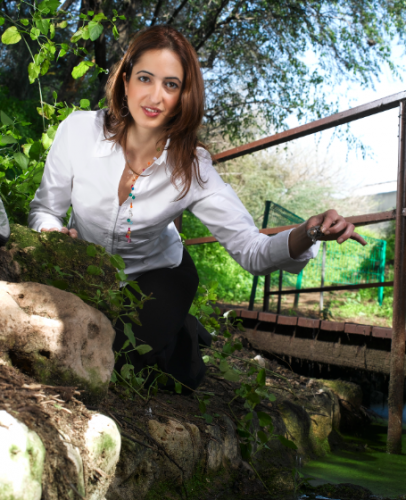
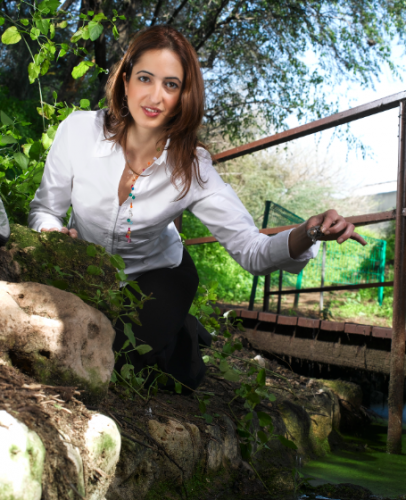
Dr. Hadas Mamane of Tel Aviv University’s Porter School of Environmental Science and Faculty of Engineering (pictured left), with Prof. Eliora Ron and their doctoral student Anat Lakretz of TAU’s School of Mechanical Engineering have recently determined the optimal UV wavelength for keeping water clean of microorganisms. Their approach could be used by water treatment plants as well as large-scale desalination facilities to destroy health-threatening microorganisms and make these facilities more efficient.

“UV light irradiation is being increasingly applied as a primary process for water disinfection,” says Lakretz. “In our recent study, we’ve shown how this treatment can be optimized to kill free-swimming bacteria in the water — the kinds that also stick inside water distribution pipes and clog filters in desalination plants by producing bacterial biofilms.”

This undesired “stickiness” of bacteria to surfaces is called “bio-fouling,” which costs taxpayers and governments billions of dollars each year. “No one should be drinking microorganisms in their water. In addition, when microorganisms get stuck in the pores of the membranes of filters, they create serious problems,” says Lakretz.

Not all UV light is created equal

Irradiation could be used as a pre-treatment to inactivate suspended microorganisms in water, with the secondary goal of preventing bio-fouling. In their study, reported in the journal Biofouling, the researchers looked at targeted UV light wavelengths on the bacteria Pseudomonas aeruginosa, commonly found in drinking water.

The TAU researchers investigated UV wavelengths within between the 220-280 nanometre (nm) scale, and found that any wavelength between 254 and 270 nm effectively cleaned the water. Those in the same region were also best for keeping membranes clear of bacterial build-up in desalination plants, they reported. Special lamps that emit a multi-wavelength UV spectrum — more advanced than the single-wavelength UV lamps found in home water systems — were used.

The UV “zap” also prevented bacterial re-growth in the water after UV inactivation. “The best way to control and kill these micro-organisms was to damage their DNA,” says Lakretz. “The damage that the UV light causes has no known negative effect on the water,” she adds.

In addition, the prevention of biofilm formation by bacteria was UV dose-dependent. The researchers reported less bio-fouling when a bigger dose of UV light was applied to the water around the film.

A light to save lives

The approach is even more helpful against parasites that aren’t adversely affected by chlorine treatment, such as Giarrdia and Cryptosporidium, two harmful parasites that cause severe diarrhea and can lead to death. Children, the elderly and those in developing nations are particularly vulnerable. “Sewage leakage into water supplies poses a big problem in terms of bacterial contamination, and is something UV light could remediate,” says Lakretz.

Small amounts of chorine or other oxidants will still be necessary to make sure that residual bacteria don’t enter the water further along the distribution pipeline. But Lakretz says this new approach to disinfecting water while controlling biofouling can also reduce the amount of carcinogenic by-products that chlorine produces.

The Tel Aviv University team is part of the MAGNET consortium, an Israeli research-oriented project aimed at researching and commercializing “clean” technologies.

::AFTAU

LEAVE A REPLY

Please enter your comment!
Please enter your name here

TRENDING

Astro uses AI to help procure land for renewable energy

For oil-rich, environmentally vigilant Gulf states, Astro isn’t just another startup story. It is a blueprint for accelerating an energy transition that is now existential, not optional.

Sink holes from over-watering farmers’ fields

Sinkholes are rapidly appearing in Turkey’s central Anatolian farming region, particularly around Konya and Karapınar. These giant gaping holes in the ground in areas of farmland, known locally as obruk, are not random geological events. They are linked to prolonged drought, climate-driven heat stress, and heavy groundwater extraction for agriculture in one of the country’s most important breadbaskets.

Oil pollution in Basrah’s soil is 1,200% higher than it should be

Soil pollution levels in parts of Basra are 1,200% to 3,300% higher than those typically measured in cities like Toronto or New York, according to new comparative soil data. It's getting into water.

Peace hospital opens between Jordan and Israel

The proposed medical centre, described by Emek HaMaayanot Regional Council head Itamar Matiash as “a centre for cancer treatment, so that people from Jordan or further away could come and receive treatment,” would become the flagship of a wider cluster of medical, academic and innovation-based services planned for the Israeli half of the zone.

Travel Morocco with teens at the Kasbah du Toubkal’s magical mountain retreat

Walking well-trodden mountain pathways, eating fresh local food, and learning about the transformative work embedded in the Kasbah’s approach to tourism has now been imparted to our children. We hope, in turn, these experiences will serve to inform their contributions in the world as they continue to grow. Don’t wait, Morocco is on everyone’s bucket list. Growth and change are inevitable. 

Qatar’s climate hypocrisy rides the London Underground

Qatar remains a master of doublethink—burning gas by the megaton while selling “sustainability” to a world desperate for clean air. Wake up from your slumber people.

How Quality of Hire Shapes Modern Recruitment

A 2024 survey by Deloitte found that 76% of talent leaders now consider long-term retention and workforce contribution among their most important hiring success metrics—far surpassing time-to-fill or cost-per-hire. As the expectations for new hires deepen, companies must also confront the inherent challenges in redefining and accurately measuring hiring quality.

8 Team-Building Exercises to Start the Week Off 

Team building to change the world! The best renewable energy companies are ones that function.

Thank you, LinkedIn — and what your Jobs on the Rise report means for sustainable careers

While “green jobs” aren’t always labeled as such, many of the fastest-growing roles are directly enabling the energy transition, climate resilience, and lower-carbon systems: Number one on their list is Artificial Intelligence engineers. But what does that mean? Vibe coding Claude? 

Somali pirates steal oil tankers

The pirates often stage their heists out of Somalia, a lawless country, with a weak central government that is grappling with a violent Islamist insurgency. Using speedboats that swarm the targets, the machine-gun-toting pirates take control of merchant ships and then hold the vessels, crew and cargo for ransom.

Leopoldo Alejandro Betancourt López Turned Ocean Plastic Into Profitable Sunglasses

Few fashion accessories carry the environmental burden of sunglasses. Most frames are constructed from petroleum-based plastics and acrylic polymers that linger in landfills for centuries, shedding microplastics into soil and waterways long after they've been discarded. Leopoldo Alejandro Betancourt López, president of the Spanish eyewear brand Hawkers, saw this problem differently than most industry executives.

Why Dr. Tony Jacob Sees Texas Business Egos as Warning Signs

Everything's bigger in Texas. Except business egos.  Dr. Tony Jacob figured...

Israel and America Sign Renewable Energy Cooperation Deal

Other announcements made at the conference include the Timna Renewable Energy Park, which will be a center for R&D, and the AORA Solar Thermal Module at Kibbutz Samar, the world's first commercial hybrid solar gas-turbine power plant that is already nearing completion. Solel Solar Systems announced it was beginning construction of a 50 MW solar field in Lebrija, Spain, and Brightsource Energy made a pre-conference announcement that it had inked the world's largest solar deal to date with Southern California Edison (SCE).

Related Articles

Popular Categories