

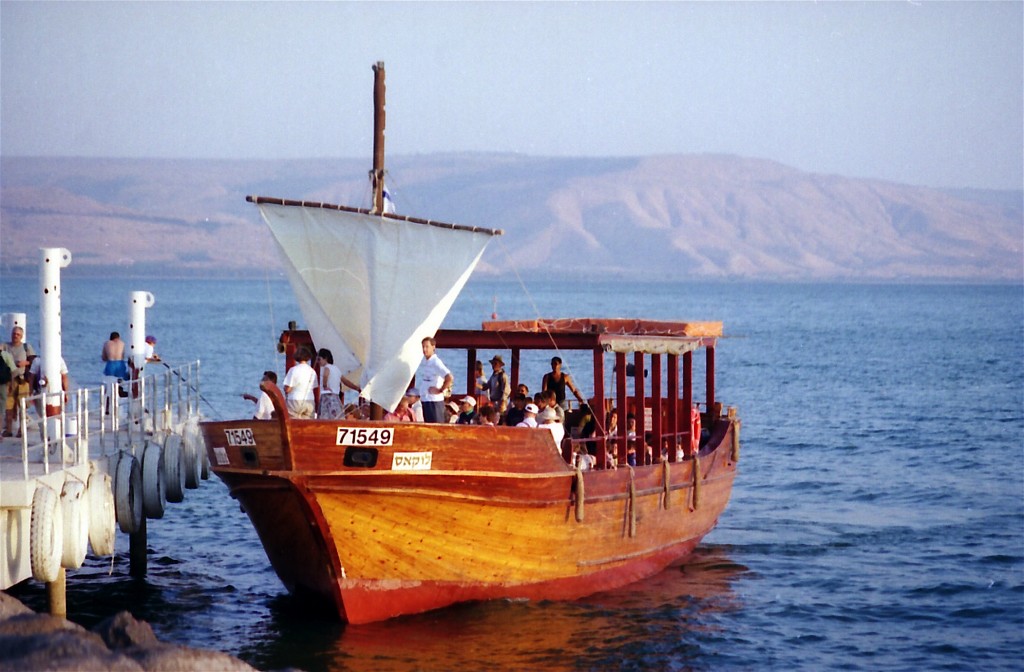
 It happened to St. Peter when his nets came up empty. Now, new two-year ban on Sea of Galilee hopes to replenish sea nearly emptied by overfishing.
Shaul the fisherman hoses down a load of imported sea bream flown in from Greece, speaking nostalgically of the good old days when the catches were plenty: “When I was a kid, fishermen would toss out 150 hooks and haul in 100 kilos of fish,” says Shaul Rokach, a 57-year-old fishmonger from Jaffa.
“Today the fishermen toss out 3,000 hooks. He starts letting them out and doesn’t know when it will finish and in the end he hauls in 15 kilos, maybe. They can’t even cover the cost of the bait let alone the fuel. “Once my smile spread from ear to ear,” he adds. “My pockets were full of money. We’d strut down the piers. Now, they’re just trying to kill off the profession.”
Rokach is not the first fisherman to complain there are no longer any fish to catch in the holy land. Tradition holds that Jesus and his disciples fished the Sea of Galilee. According to the New Testament, Apostle Simon Peter ran a fishing business on the shores of the lake and complained that his net kept coming up empty. Jesus told him to cast his net again and it came up bursting with fish (Luke 5:4).
Generations have carried on this tradition, and today the most popular fish in the lake is dubbed St. Peter’s Fish, or Tilapia. But after being almost overfished to death, in the coming six weeks the Israeli government will gradually enforce a total ban on fishing in the biblical lake an effort to bring it back to life.
The new, two-year ban will force some 200 licensed fishermen out of the Sea of Galilee in search of a new trade.
“We will support the fishermen and make sure the lake is restocked with fish,” Israel’s Prime Minister Binyamin Netanyahu said when announcing the ban after his weekly cabinet meeting.
The Sea of Galilee has witnessed a dramatic decline in fish, largely due to illegal practices such as catching breeding fish and preventing fish populations from growing. Millions of hungry migratory birds also feed heavily on the fish.
The ban on fishing in the fresh water Sea of Galilee in northern Israel has been discussed for some time. A joint, formal plan was recently formulated by Israel’s Agriculture Ministry, Environment Ministry and Treasury.
“There is a world wide trend in the decline of fish,” Hagay Noyberger, chief fishing ranger from the Israeli Ministry of Agriculture tells The Media Line. “In Israel it’s the same. It’s caused by pollution, overfishing, global warming and other phenomena.”
Prof. Menachem Goren, an aquatic biologist from Tel Aviv University, says overfishing was the principal problem in the declining fish stocks.
“There are too many fishermen, too many boats, over fishing and no management,” he says, speaking in his laboratory with shelves full of bizarre sea creatures preserved in jars. “The situation has become very bad not just in the reduction in the numbers of fish, but also in the size of those which remain.”
The Ministry of Agriculture reports that there has been a steady 20 percent decline each year in Israeli fish catches. In 2000, for example, there was almost 4,000 tons of fresh catch recorded. By 2006, just over 2,000 tons of fresh fish were caught.
Unlike neighboring countries, Israel does not ban fishing during the three to four month fish reproduction season, thus denying the fish population a chance to recover.
“In most Mediterranean countries, fishing is banned during the summer time and this allows the fish to breed and to grow,” says Prof. Goren. “Here in Israel we don’t have any regulation of this kind right now. So the fishermen fish all year round and they don’t give the fish any chance. They remove the mothers while they are small before they get to maturity and that is it.”
Noyberger says this too was about to change.
“We want to close areas to fishing in order to replenish the stock. It is a long process and not something that takes a day or two,” the fish ranger reveals.
Noyberger refuses to elaborate, but reports say these no-fishing zones will be off the coast of Tel Aviv, Ashkelon and the rich breeding grounds of Achziv just south of the Lebanon border.
The result of these changes is that Israeli fishermen are a dying breed, and the few who do remain say many have quit the trade out of frustration.
Rokach, known as “Shaul the fishmonger” from Jaffa, abandoned his boat to make a living importing fish.
“I’ve got salmon from Norway, grouper from Egypt, and cod and mackerel and sea bass,” he says, rattling off his imported stock. “People love fish a lot. All the fishermen I know are retiring and there are no new fishermen. I miss it, but let me remain with my good memories.”
The Ministry of Agriculture admits it has a plan to encourage the retirement of at least a third of the country’s legal fishing fleet. There are about 400 licensed boats in the Mediterranean, Sea of Galilee and Red Sea and about 3,000 registered fishermen.
“In order to improve fishing for the coming generations there is a trend to try and reduce the fishing fleet,” says Noyberger. “It is not something that will happen tomorrow, but if possible we will in the coming years reduce it by a third so that those who do remain will be able to make a living… The fishermen who are less active might find it worth their while to leave the profession.”
More green news from the Sea of Galilee:
Hope Bottle Tree to Educate Importance of Recycling
Israel to Compensate Jordan for Polluted Water
A Luxurious Vacation Near the Galilee Sea
(This story was first published by The Media Line) Image via the lees




This is a really interesting story – it seems like all over the world fish stocks are declining at a precipitous rate. The Sea of Galilee is truly one of the most beautiful places in Israel and it would be a real shame if over-fishing did real and lasting harm to the fish population there.