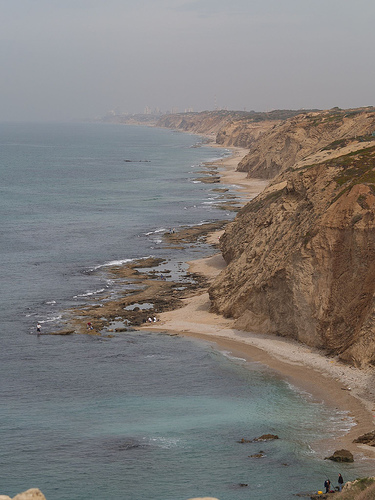
Iron-Rich Whale Poop Essential in Middle Eastern Marine Habitats

whale poopBig recyclers and important for carbon storage: New evidence explores how important this large mammal is for regulating nutrients in the sea.

What does whale excrement, or poop, have to do with enriching the world’s marine environment? Plenty,  according to a recent  article on Greenbang. The “poop” the article is referring to is that contributed by whales whose diet is largely consisting of ingesting thousands of pounds of a small marine crustacean known as krill. Krill are small, shrimp-like creatures whose average size is that of a paper clip, and are full of iron that they obtains from the sea; especially from feeding on algae in many of the world’s oceans. Their poop, also, helps our oceans absorb the greenhouse gas carbon dioxide from the atmosphere. Now’s a better time than ever to Save the Whales!Whales that feed on krill include the world’s largest living mammals: the majestic blue whale; which are not only found in the northern and southern oceans, but in locations such as the Gulf of Eden in Yemen, and in parts of the Persian Gulf.

Since algae is one of the world’s best sources of carbon, the whales ingest a certain amount of carbon and iron from the large amounts of krill they eat. The amounts of krill ingested amount to thousands of tons a year by producing a large amount of excrement, containing as much as 12 per cent iron.
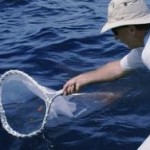
Collecting whale poop for study

Of course, whales are not the only large marine mammals found in sea, including bodies of water like the Gulf. At least 4,000 dugongs (large gentle marine herbivores, related to the manatee of sea cow) also live in the Gulf, as well as 40 different species of dolphins.

In a recent Green Prophet article , I expressed environmental concerns for the well being of the Gulf’s dugong population that in some parts of world is threatened with extinction.

The fact that whales, a very much endangered species, make so much of a contribution to fertilizing the sea, it would seem that more of an effort should be made to save them from the harpoons of whalers, as well as from environmental dangers like oil and chemical spills, ingestion of plastics and other waste materials, mercury and other metals poisoning; and global warming, which has an effect on the very food the whales like to eat.

Steve Nicol, a scientist for Australia’s Antarctic Division, estimates that whales are responsible for “recycling” more than 12% of the iron found in the Southern Ocean alone. And this iron comes largely from krill which hold large quantities of iron in their bodies.

As noted by Nicol: “Approximately 24 per cent of the total iron in the Southern Ocean surface water is currently stored within krill body tissue.”

This works out to an estimated 379 million tons of krill in the Southern Ocean alone that includes an iron supply of about 15,000 tons.

Since blue whales are frequently sighted in both the Gulf of Aden and the Persian Gulf, it means that the poop they generate is helping to fertilize and increase the iron content of these bodies or water. Other marine mammals, fish and birds also feed on krill, including albatross, pelicans, cormorants, and species of seals and sea lions.

Naturally, the future of large sea mammals like whales depends heavily on ample supplies of krill. These magnificent animals have few natural enemies, outside of predators such as killer whales (Orcinus Orca) which are actually members of the dolphin family This only leaves one earth mammal that is now the greatest threat to the future of the whale population – and the quantities of iron-rich excrement they produce. And that mammal is non-other than Man.

Image via www.divematfrix.com
::Greenbang

Read more on benefits of poop and algae:
Qteros Makes Bio Fuel from Animal and Human Excrement.

Expanding the Role of Algae for Food and Other Products

Algae Into Bio Fuel in Joint Israel-Chinese Project

Maurice Picow
Maurice Picowhttps://www.greenprophet.com/
Maurice Picow grew up in Oklahoma City, U.S.A., where he received a B.S. Degree in Business Administration. Following graduation, Maurice embarked on a career as a real estate broker before making the decision to move to Israel. After arriving in Israel, he came involved in the insurance agency business and later in the moving and international relocation fields. Maurice became interested in writing news and commentary articles in the late 1990’s, and now writes feature articles for the The Jerusalem Post as well as being a regular contributor to Green Prophet. He has also written a non-fiction study on Islam, a two volume adventure novel, and is completing a romance novel about a forbidden love affair. Writing topics of particular interest for Green Prophet are those dealing with global warming and climate change, as well as clean technology - particularly electric cars.
1 COMMENT

LEAVE A REPLY

Please enter your comment!
Please enter your name here

TRENDING

Huge Fish Nursery Discovered Under Freezing Arctic Seas

In 2019, an underwater robot camera exploring the seabed...

Microplastics Are Becoming Superbug Highways — New Study Warns Beachgoers to Wear Gloves

Prof. Pennie Lindeque added that microplastics “act as carriers for antimicrobial-resistant bacteria, enhancing their survival and spread… each particle becomes a tiny vehicle capable of transporting pathogens from sewage works to beaches, swimming areas and shellfish-growing sites.”

Who gave the first kiss?

When you experience your first kiss you might feel like you are the first in the world to feel that way. Kissing, scientists say, occurs in a variety of animals (even if today it's not in every culture), and it presents an evolutionary puzzle: kissing, a learned behavior, carries high risks, such as disease transmission like herpes and hepititis, while offering no obvious reproductive or survival advantage.

Toxic sea otters and the pollution they collect at sea

When otters become sick or die, entire marine ecosystems begin to unravel. Their contamination is not a side note. It is a warning.

Biodiversity Blueprint Set for 2026

If we seize this moment, the 2026 review can catalyse a new wave of finance (see Green Finance mechanisms in the UAE), innovation and policy coherence — and move us closer to the vision of a nature-positive world by 2050. If not, the checkpoint risks becoming another missed opportunity while ecosystems, livelihoods and economies continue to degrade.

6 Payment Processors With the Fastest Onboarding for SMBs

Get your SMB up and running fast with these 6 payment processors. Compare the quickest onboarding options to start accepting customer payments without delay.

Qatar’s climate hypocrisy rides the London Underground

Qatar remains a master of doublethink—burning gas by the megaton while selling “sustainability” to a world desperate for clean air. Wake up from your slumber people.

How Quality of Hire Shapes Modern Recruitment

A 2024 survey by Deloitte found that 76% of talent leaders now consider long-term retention and workforce contribution among their most important hiring success metrics—far surpassing time-to-fill or cost-per-hire. As the expectations for new hires deepen, companies must also confront the inherent challenges in redefining and accurately measuring hiring quality.

8 Team-Building Exercises to Start the Week Off 

Team building to change the world! The best renewable energy companies are ones that function.

Thank you, LinkedIn — and what your Jobs on the Rise report means for sustainable careers

While “green jobs” aren’t always labeled as such, many of the fastest-growing roles are directly enabling the energy transition, climate resilience, and lower-carbon systems: Number one on their list is Artificial Intelligence engineers. But what does that mean? Vibe coding Claude? 

Somali pirates steal oil tankers

The pirates often stage their heists out of Somalia, a lawless country, with a weak central government that is grappling with a violent Islamist insurgency. Using speedboats that swarm the targets, the machine-gun-toting pirates take control of merchant ships and then hold the vessels, crew and cargo for ransom.

Leopoldo Alejandro Betancourt López Turned Ocean Plastic Into Profitable Sunglasses

Few fashion accessories carry the environmental burden of sunglasses. Most frames are constructed from petroleum-based plastics and acrylic polymers that linger in landfills for centuries, shedding microplastics into soil and waterways long after they've been discarded. Leopoldo Alejandro Betancourt López, president of the Spanish eyewear brand Hawkers, saw this problem differently than most industry executives.

Why Dr. Tony Jacob Sees Texas Business Egos as Warning Signs

Everything's bigger in Texas. Except business egos.  Dr. Tony Jacob figured...

Related Articles

Popular Categories