Israel Firm "WaterSheer" Sends Emergency Equipment to Typhoon-Battered Taiwan

sulis-water-gadget-israel photoTAIPEI, TAIWAN — When Typhoon Morakot hit Taiwan in early August, causing massive landslides in the southern part of the country, Israel, as soon as the extent of the destruction was known, sent Israeli-made water-purification equipment and high-speed water transport equipment to Taiwan.

The monster typhoon hit on August 8, causing widespread flooding in the south — the worst in over 50 years — and leading the death of over 700 people in remote villages in mountainous terrain. By August 13, Israel answered Taiwan’s call for help with a shipment of water-purification equipment, according to Raphael Gamzou, head of the Israeli Economic and Cultural Office, which serves as Israel de facto embassy in Taipei in the absence of formal diplomatic relations.

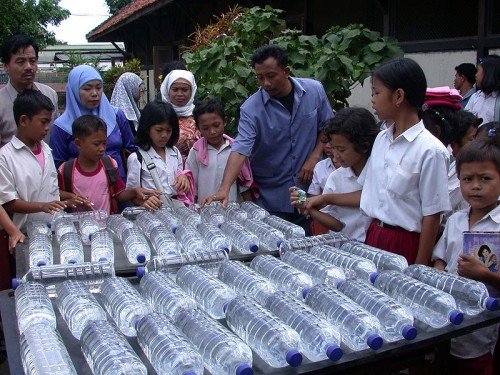
Gamzou proposed to Taiwanese officials that Israel could send  emergency aid to the beleagured country, and it was agreed that clean drinking water was of paramount importance for the survivors of the severe floods and landslides. In due course, a shipment with water purifiers, containers, and hundreds of easy-to-use personal
water-purification kits was sent to rural villages struck by the disaster.

Sulis WaterSheer video:

The equipment, made by the Israeli company WaterSheer, was donated by Israel’s Ministry of Foreign Affairs, according to news reports. As soon as the equipment arrived in Taipei, in the northern part of the island nation, it was brought straight to Kaohsiung in the south, where Gamzou personally supervised the distribution of water to those in need.

As Taiwan recovers from the August disaster, it has been learned that over 24,000 people had to be evacuated from remote villages and rural towns, with some 5,000 evacuees housed in emergency temporary shelters. In addition to assistance from Israel, aid came in from around 60 other countries as well, gestures that the Taiwanese people
won’t soon forget.

“We are a small island nation, and in our moment of need, many countries helped us out,” said Lin Shu-lling, 30, a resident of Chiayi in southern Taiwan. “It makes us Taiwanese feel good that the rest of the world didn’t forget us, and not just big countries like America and Japan, but also smaller nations like Israel and Panama.”

Ron Shani runs WaterSheer from its office in Lod, Israel. Shani earlier spent 12 years with two of Israel’s premier IT computing software and services companies, but left the IT field in 2004 to return to his roots in water filtration and purification. He founded
WaterSheer in 2007.

::WaterSheer website

By Danny Bloom, Guest blogger for Green Prophet.

4 COMMENTS

LEAVE A REPLY

Please enter your comment!
Please enter your name here

TRENDING

Iran’s holiest city about to run dry as terror chosen over water management

Iran’s second-largest city, Mashhad, is facing an acute water emergency after dam reservoirs feeding the city fell below three percent capacity, according to Iranian state and local media. Officials warn that without rainfall or improved inflows from neighboring Afghanistan, the city’s supply could soon collapse.

Finalists for the Zayed Sustainability Prize vie for millions in prize money for impact

The United Arab Emirates is serious about supporting renewable energy, clean water and smart agriculture. Part of the way they support impact companies is through the Zayed Sustainability Prize. Millions of dollars is up for the winning.

New water gen from air invention, uses biomimicry, the sun and salt channels

A new advance in water generation from air looks at how plants cool themselves using ion channels.

Forever chemicals PFAS linger in German drinking water

Comprising more than 4,700 chemicals, perfluorinated and polyfluorinated alkyl substances (PFAS) are a group of widely used, man-made chemicals that accumulate over time in humans and in the environment. They are known as ‘forever chemicals’ as they are extremely persistent in our environment and bodies.

Futuristic dome collectors collect dew for drinking water and crops

Still another device, called the Roots Up Dew Collector, is now being developed for Ethiopia in a project together with the University of Gondar. The device, which can also be used to grow vegetables and other crops, is dew trapping and will be used in the country's arid northern regions.

6 Payment Processors With the Fastest Onboarding for SMBs

Get your SMB up and running fast with these 6 payment processors. Compare the quickest onboarding options to start accepting customer payments without delay.

Qatar’s climate hypocrisy rides the London Underground

Qatar remains a master of doublethink—burning gas by the megaton while selling “sustainability” to a world desperate for clean air. Wake up from your slumber people.

How Quality of Hire Shapes Modern Recruitment

A 2024 survey by Deloitte found that 76% of talent leaders now consider long-term retention and workforce contribution among their most important hiring success metrics—far surpassing time-to-fill or cost-per-hire. As the expectations for new hires deepen, companies must also confront the inherent challenges in redefining and accurately measuring hiring quality.

8 Team-Building Exercises to Start the Week Off 

Team building to change the world! The best renewable energy companies are ones that function.

Thank you, LinkedIn — and what your Jobs on the Rise report means for sustainable careers

While “green jobs” aren’t always labeled as such, many of the fastest-growing roles are directly enabling the energy transition, climate resilience, and lower-carbon systems: Number one on their list is Artificial Intelligence engineers. But what does that mean? Vibe coding Claude? 

Somali pirates steal oil tankers

The pirates often stage their heists out of Somalia, a lawless country, with a weak central government that is grappling with a violent Islamist insurgency. Using speedboats that swarm the targets, the machine-gun-toting pirates take control of merchant ships and then hold the vessels, crew and cargo for ransom.

Leopoldo Alejandro Betancourt López Turned Ocean Plastic Into Profitable Sunglasses

Few fashion accessories carry the environmental burden of sunglasses. Most frames are constructed from petroleum-based plastics and acrylic polymers that linger in landfills for centuries, shedding microplastics into soil and waterways long after they've been discarded. Leopoldo Alejandro Betancourt López, president of the Spanish eyewear brand Hawkers, saw this problem differently than most industry executives.

Why Dr. Tony Jacob Sees Texas Business Egos as Warning Signs

Everything's bigger in Texas. Except business egos.  Dr. Tony Jacob figured...

Related Articles

Popular Categories