

 Does the Israeli Army read Green Prophet?
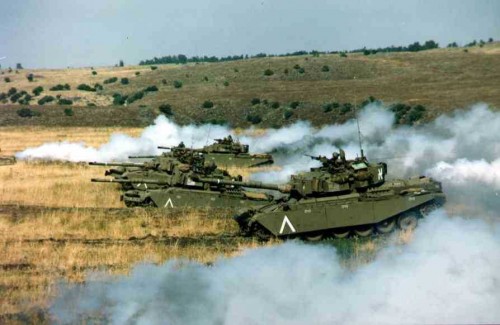
Following our recent May 26 article , Israel’s Ministry of Environmental Protection: IDF Bases Pollute Land and Water, it now appears that the Israel Defense Forces, otherwise known as the IDF, may now be trying to “clean up their act” in regards to protecting the environment.
Is this another case of greenwash or something that’s true?
An article on August 4 in the Jerusalem Post, IDF joins environmental revolution, notes a number of things being done by the IDF to prevent damage done to the environment by various military related activities, including the use of electric powered vehicles on military bases for moving army personnel and supplies around. The article also points out cleaning septic tanks and other sewage storage and treatment facilities on army bases (until now a big cause of ground water pollution), and even introducing special bacteria that consume the explosive material from disused bombs and other explosives.
The efforts are being made to help reduce the IDF’s carbon and ecological “footprint” on Israel’s environment, often said to be one of the biggest contributors to environmental damage. It’s a contentious issue.
In a meeting held recently with members of the press, IDF spokespersons pointed out various ways in which environmental or green policies are being introduced to make soldiers and officers alike more aware of the need to take care of the environment at military installations as well as on military maneuvers.
Brig. General Gila Khalifi, who is in charge of the Army’s environmental activities, admitted to the press that during a military operation, the first priority is the completion of the mission and achievement of victory.
“Naturally, the characteristics of security activities, whether in training or in operational activities, are not exactly environmentally friendly,” she added.
Gen. Khalifi, together with IDF Chief of Staff, Lt. General Gabi Ashkenazi, signed a 10 point plan to help enable the military to become more environmentally friendly. Some of these measures includes the construction of more sustainable structures for housing army personnel, dealing with the waste problem, including used motor oil taken from army vehicles; and the use of special plastic mats for tanks and other vehicles to be driven on when being serviced or repaired.
“Using these mats help reduce oil spills and other environmental damage. We learned this from the Americans who have been using these mats in Iraq,” says Lt. Colonel Eli Paz, who is head of the environmental protection division of the Army’s Technical and Logistic Corps.
Environment protection concerns is not only in use now by the Army but by the Air Force and Navy, too. Ways in which to conserve electricity on Air Force bases and to prevent oil spills at sea by naval forces are also now part of IDF environmental protection policies.
But besides finding ways to prevent pollution and other environmental damage, the introduction of environmental education into various military training courses may be the best way to promote better awareness in environmental protection, according to Maj. Victor Weiss, of the IDF Education Corps.
“We are an important “link” in the education of young soldiers, both in the military and afterwards. By introducing environmental values to soldiers during their army service, these values can carry over into civilian life, and make them more aware of protecting and preserving the environment once their military service is over,” Maj. Weiss said.
More on armies and the environment:
The IDF Says Birds, Not Guns
The Israeli Army Tries To Go Green
Choose the Environment in Middle East Conflict




[…] friendly in the long run. The IDF is also looking for ways to conserve water supplies; and is introducing “green” courses into its various training programs. Being such a small country, with limited distances to travel in the event of military conflicts, […]
[…] on Green Prophet we talked about the efforts being made by the IDF reduce its carbon and ecological “footprint” on Israel’s environment, although winning in battle they say is still the top priority. With the […]
New blog post: Israel’s Army Makes Advances In Green, But Victory Comes First http://bit.ly/XqdIf
Israel’s Army Makes Advances In Green, But Victory Comes First http://ow.ly/15KBb0