
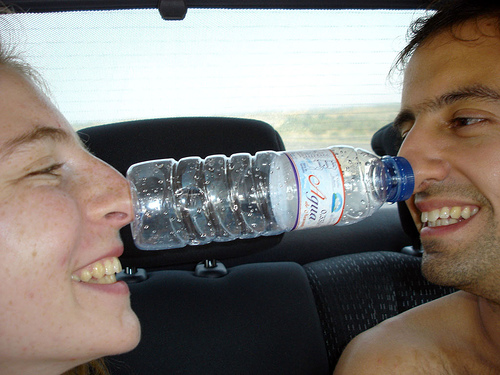


This article is not first one on Green Prophet dealing with water and other beverages sold in polyethylene and polystyrene bottles; and it probably won’t be the last either. But the increasing environmental damage, as well as health hazards being caused by this method on containerizing beverages, especially H2O, is something that should be dealt with more urgently, and the sooner the better.
Bottled water has become such an issue in spoiled, modernized societies (especially the USA) that people have this “commodity” at the top of their shopping list when they go to their neighborhood Costco or Walmart Super Center in American cities.
Although sometimes packaged and sold as “mineral water,” i.e. pure, mountain spring water that is free of chlorine and other chemicals, most bottled water is simply ordinary tap water that has gone through a filtration process to get rid of these chemicals and improve the water’s taste as well.
Bottled water sold here in Middle East, whether it comes from Lebanon’s Mt. Lebanon (where those stately cedars still grow and are threatened by climate change), the pristine springs and streams on Mt. Hermon (where Israel’s Mei Eden brand is made from), or the ones that flow into the Dead Sea (Ein Gedi brand), is still bottled water that came from somewhere, whether from an actual mountain spring or not.
Recently, even Israeli companies like Mei Eden and Netivot had to suspend their bottling temporarily when contamination was found in the water due to insufficient rainfall.
Scientific studies have found that in may cases, ordinary tap water is even cleaner and safer than so-called mineral water. And using water filtration devices, including the simple “Brita” water filters, easily obtainable in most supermarkets and other stores will make water tastier by removing most of the chlorine and other materials.
But putting water quality aside, the worst aspect of bottled water lies in the plastic bottles themselves, and the pollution and health risks they cause.
Literally millions of empty water and soft drink bottles are dumped into garbage dumps and landfills; and not only do they cause problems for the soil (each polyethylene bottle takes an estimated 200 years or more to decompose – the exact time not really known as these bottles are a relatively recent innovation) many wind up littering the forests and countryside as well as floating in huge ugly clumps in the worlds seas and oceans.
Some innovative companies like Bagir have made a novel business of creating suits out of bottles, but it is merely a drop in the bucket.
One particular huge “clump,” entailing several square kilometers, is made of all kinds of plastic waste, including plastic bags and bottles, and is now floating in the middle of the Pacific Ocean, east of Midway Island.
With summertime nearly upon those of us living in the Northern Hemisphere, the problem of water and beverages in plastic bottles left in cars or sitting in the windows of stores (or in un-air-conditioned warehouses and shipping containers) are now said to be a cause of breast and other cancers due to toxic chemicals from the plastic material being present in the fluid inside the bottle.
The hazards from these “sun heated” bottles are no less harmful than food heated in most plastic containers in microwave ovens.
Plastic began to be used in water and beverage bottles, including milk bottles, when glass bottles became either too expensive or would explode due to expanding gasses within; a particular hazard of soft drink bottles which caused serious injuries and even death to many people.
We live in a portable and throw-away age, and plastic bottles, bags and other containers are a product of this desire for easy convenience and portability.
Although recycling removes some of these empty bottles from the dust heap (many are melted down and made into other products) far too many are simply discarded, often winding up either buried underground or floating in the briny deep.
As noted here, the plastic form empty bottles can be used for other purposes, but maybe greater efforts need to be done to find alternatives to plastic bottles.
[image via miguelvieira]



[…] So why has agriculture in the Hebron Hills actually helped rare plants, in contrast to the deleterious effects of agriculture in Beit Netufa and Ein Gedi? […]
[…] Plastic bottles have pretty nasty reputations for being bad for human health and the environment. Very few people are arguing that plastic bottles (and especially bottled water) are a good thing in the long run. Some companies, such as Israeli fashion label EcoGir, have tried to solve the plastic bottle problem by upcycling PET bottles into chic men’s suits. And now, Israeli designer Nitsan Debbi has tried to solve the aesthetic and environmental issues surrounding the ubiquitous plastic bottle by upcycling it into beautiful artwork using glass blowing techniques. […]
[…] Bottled water is one of those environmentalists’ pet peeves. The plastic bottles are wasteful, often do not get recycled, and the water itself is often of lesser quality than plain old tap water. Tap water is subject to municipal inspection and regulation whereas bottled water is not – even though it is (falsely) perceived by many to be of higher quality. So Evian’s splash, or re-entry, into the Israeli bottled water market with a new campaign a few weeks ago understandably has environmentalists upset. […]
Plastic bottle is convenient, so can't deny to use it sometimes. However, it's better to produce plastic for other types of containers than bottles which people use just a few hours and throw away.
[…] how you can save the Dead Sea from shrinking? First up, I would avoid buying water from Ein Gedi, a natural spring water company, siphoning water from springs which should be running off to the […]
A Jarring Reminder Why Bottled Water Conflicts With Green Values http://ow.ly/5tFi
A Jarring Reminder Why Bottled Water Conflicts With Green Values http://ow.ly/5tFh
A Jarring Reminder Why Bottled Water Conflicts With Green Values http://ow.ly/5tFg
A Jarring Reminder Why Bottled Water Conflicts With Green Values http://ow.ly/5t7D
A Jarring Reminder Why Bottled Water Conflicts With Green Values http://ow.ly/5t7C
A Jarring Reminder Why Bottled Water Conflicts With Green Values http://ow.ly/5t7A
A Jarring Reminder Why Bottled Water Conflicts With Green Values http://tinyurl.com/cenmny