Vauban, the German Suburb without Cars

vauban-germany-cars-kids-photo vauban car free

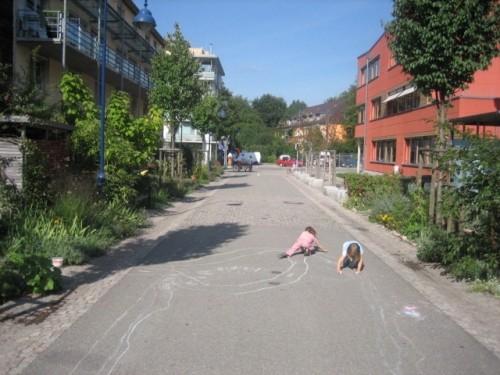
Do you ever get the feeling that every time you close your eyes, someone in Europe is doing something brilliant for the environment? Well, the residents of Vauban, Germany live in a suburb where most streets are off-limits to cars and the shops are mixed in with housing. The town’s 5,500 people are packed into a square mile, where they walk and cycle their way through day-to-day life.

The New York Times reports that as a result of this planning, children are everywhere. Vauban, on the French-Swiss-German border, enjoys solid links to public transportation. Residents who want to keep their cars buy parking spaces for $40,000 in one of two town lots, but 70 percent of Vaubanites don’t have their own.

Vauban was completed in 2006. In its prior life it was a Nazi army base, with streets running between the barracks that would be too narrow to accommodate private car use. Today, those same streets are lined with energy-efficient apartment buildings, rather than detached single-family homes, which are forbidden. The town is planned in a ribbon shape, at the center of which runs the tram line.

Vuaban also has a car sharing club for families who don’t want to buy a vehicle of their own. Residents tend to make local shopping trips with the use of bike carts that haul their goods behind them. About half of them vote for the Green Party.

The Times reports that this car-less option is being explored in new residential developments in the United States and in Europe. It is certainly a smarter building move than tract housing subdivisions that depend on the automobile.

However, Vauban-style construction may be most appropriate for the developing world, where the countryside has yet to be overbuilt.  In more economically advanced countries, including Israel, the best option would be to retrofit existing suburbs – such as Holon, Ramat Gan and Givataim outside of Tel Aviv – to operate without cars. Perhaps these places could start by outlawing cars in a central district, and gradually expand the area off limits to vehicles, while providing bike rentals and reliable public transportation to keep the neighborhood alive economically. This would vastly improve the quality of life for people who choose to live away from the chaos of the cities without eating into the limited stores of open space that remain.

(Photo via myauthorsite)

Read more on going car-free:
Tripoli Goes Car Free, If Only for a Day
Is It Possible to Go Free in the Suburbs?

Daniella Cheslow
Daniella Cheslowhttp://www.greenprophet.com
Daniella Cheslow grew up in a car-dependent suburb in New Jersey, where she noticed strip malls and Wal-Marts slowly replacing farmland. Her introduction to nature came through hiking trips in Israel. As a counselor for a freshman backpacking program at Northwestern University, Daniella noticed that Americans outdoors seemed to need to arm themselves with performance clothing, specialized water bottles and sophisticated camping silverware. This made her think about how to interact with and enjoy nature simply. This year, Daniella is getting a Master’s in Geography from Ben Gurion University of the Negev. She also freelance writes, photographs and podcasts. In her free time, she takes day trips in the desert, drops off compost and cooks local foods like stuffed zucchini, kubbeh and majadara. Daniella gets her peak oil anxiety from James Howard Kunstler and her organic food dreams from Michael Pollan. Read more at her blog, TheTruthHerzl.com. Daniella can be reached at daniella (at) greenprophet (dot) com.
11 COMMENTS
  1. USA is woefully inadequate when it comes to having a variety of transportation.It is very hard without a car.It is very hard for a blind person.

  2. It would be really neat to have a new Vauban. It’s funny, Israeli cities – even most of the intermediate suburbs like Kfar Saba, Holon, Ra’anana – have lots of apartment blocks, some mixed use areas and decent links to public transportation. The real issue is the lack of bike-friendly infrastructure, which would disappear or be reduced if there were Vaubanized districts.

    On another note, I think we could introduce a new word to Israeli life to mean taking any form of transportation that isn’t a private car.

    “Want a ride to the supermarket?” “No thanks, I’m Vaubanning.”

  3. I lived in a Swiss village for a year. A group of about 30 of us shared a car for weekend trips, and jaunts to the grocery store. We paid per km used, and not gas, which was factored into the per km tariff. (The Swiss are very good at calculating fair prices… )

    Most of the time the car sat idle.

    Mainly I rode my bike everywhere (even around mountains), and took the ever accessible and cheap train everywhere, even to the teeniest tiniest villages. It was a beautiful thing. I dream of such a train for Israel. I dream that Tel Aviv and Jaffa could become Vauban….

LEAVE A REPLY

Please enter your comment!
Please enter your name here

TRENDING

Polluters like L’Oreal may need to pay for polluting EU waterways

A new EU directive is forcing pharmaceutical and cosmetics companies to pay for removing drug residues from wastewater after a major study found 175 pharmaceuticals polluting Europe’s rivers. The industry is fighting back, but scientists warn that without urgent action, these invisible chemicals will continue to poison aquatic life and seep into our drinking water.

Europe’s Clean-Tech Pivot: Germany Leads Supply Chain Shift Amid €390B Investment Surge

Germany is cutting its dependence on Chinese wind turbine components by 2035, launching a major strategy to diversify its offshore wind supply chain. As Europe ramps up clean tech investments, this move marks a shift toward energy security and regional manufacturing resilience.

Starting spring on MoonCool’s ebike

Early April in Northern Ontario, Canada and finally a few dry spots to test the MoonCool e-bike. This was my first attempt at putting together and riding an e-bike.

Make your bike ugly and theft-proof

Make your bike so ugly so that it's never stolen again.

The Battle Against Over-Tourism: How Destinations Are Fighting Back

While governments enforce new regulations, travelers also play a key role in ensuring sustainability. Opting for eco-volunteering experiences and choosing eco-friendly accommodations provide a more meaningful connection to a destination while actively contributing to its preservation.

Qatar’s climate hypocrisy rides the London Underground

Qatar remains a master of doublethink—burning gas by the megaton while selling “sustainability” to a world desperate for clean air. Wake up from your slumber people.

How Quality of Hire Shapes Modern Recruitment

A 2024 survey by Deloitte found that 76% of talent leaders now consider long-term retention and workforce contribution among their most important hiring success metrics—far surpassing time-to-fill or cost-per-hire. As the expectations for new hires deepen, companies must also confront the inherent challenges in redefining and accurately measuring hiring quality.

8 Team-Building Exercises to Start the Week Off 

Team building to change the world! The best renewable energy companies are ones that function.

Thank you, LinkedIn — and what your Jobs on the Rise report means for sustainable careers

While “green jobs” aren’t always labeled as such, many of the fastest-growing roles are directly enabling the energy transition, climate resilience, and lower-carbon systems: Number one on their list is Artificial Intelligence engineers. But what does that mean? Vibe coding Claude? 

Somali pirates steal oil tankers

The pirates often stage their heists out of Somalia, a lawless country, with a weak central government that is grappling with a violent Islamist insurgency. Using speedboats that swarm the targets, the machine-gun-toting pirates take control of merchant ships and then hold the vessels, crew and cargo for ransom.

Leopoldo Alejandro Betancourt López Turned Ocean Plastic Into Profitable Sunglasses

Few fashion accessories carry the environmental burden of sunglasses. Most frames are constructed from petroleum-based plastics and acrylic polymers that linger in landfills for centuries, shedding microplastics into soil and waterways long after they've been discarded. Leopoldo Alejandro Betancourt López, president of the Spanish eyewear brand Hawkers, saw this problem differently than most industry executives.

Why Dr. Tony Jacob Sees Texas Business Egos as Warning Signs

Everything's bigger in Texas. Except business egos.  Dr. Tony Jacob figured...

Israel and America Sign Renewable Energy Cooperation Deal

Other announcements made at the conference include the Timna Renewable Energy Park, which will be a center for R&D, and the AORA Solar Thermal Module at Kibbutz Samar, the world's first commercial hybrid solar gas-turbine power plant that is already nearing completion. Solel Solar Systems announced it was beginning construction of a 50 MW solar field in Lebrija, Spain, and Brightsource Energy made a pre-conference announcement that it had inked the world's largest solar deal to date with Southern California Edison (SCE).

Related Articles

Popular Categories