
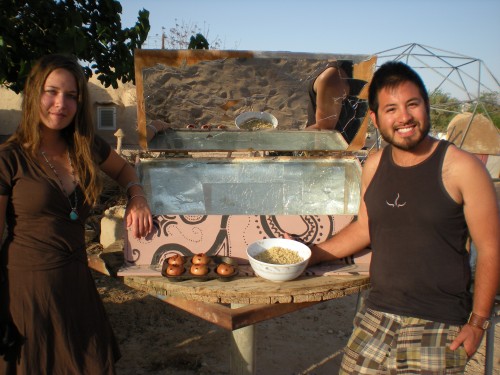

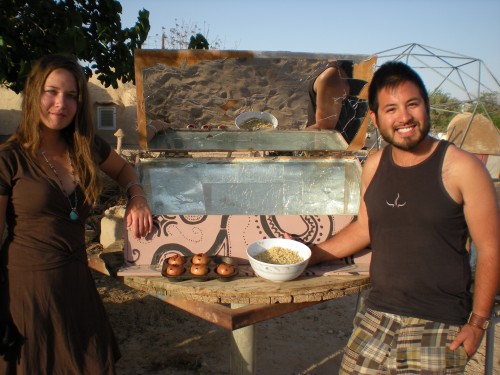
Just a few hours after Jews of all stripes gathered at the Western Wall in Jerusalem to celebrate “Birkat haChama” – the blessing of the sun – Aria Penkava slid a tray of kosher-for-Passover cookies into a solar oven to slow-cook using focused heat energy from the sun.
“The sunrise was glorious this morning,” said Penkava, “but we wanted to not only bless the sun but actually use its energy to do something constructive and creative.”
Penkava, 20, is a recent graduate of Kibbutz Lotan’s 6-week “Green Apprenticeship” program, which combines coursework in permaculture design, organic farming and ecovillage design. To her, the timing of Birkat haChama coincided perfectly with the seder for the first night of Passover.
Along with several other Green Apprentices who are staying on Kibbutz Lotan as “eco-volunteers,” Penkava decided to host a Seder in her own mud dome, built from straw-bales and mud-plaster, rather than the large seder hosted by the Kibbutz.
“Large meals with the entire Kibbutz are usually nice,” said Penkava, “but not all of us speak Hebrew and we were worried we would lose out on the intimacy of the Seder. This way we can actually create the Seder that we want, and enjoy the company of everyone sitting around the table.”
In the spirit of the holiday, Penkava, along with two other recent Green Apprentices, asked two other volunteers living in the “Bustan” eco-village neighborhood to join them for the Seder, which included cookies, baked apples, quinoa and vegetables – all baked in the solar oven. The neighborhood also runs partially off solar power and uses solar hot water heaters for provide hot water for showers.
The final count at the Seder included two Jews and three non-Jews. Frederick Mbah, 26, from Cameroon, was one of them.
“In Cameroon, we have nothing like this!” said Mbah. “I am a Christian, and so it was really wonderful to be with Jews and celebrate the Passover Seder.”
Mbah enjoyed the seder and especially the food itself, although was not partial to the baked apples.
“I am sorry!” said Mbah, “But apples should not be baked! They should always be very fresh.”
To this, Penkava, who normally lives in Calgary, Canada, simply shrugged. “I guess baked apples haven’t really gotten to Cameroon yet. I’m just happy knowing I can bake the things I love to eat without having to use any gas or electricity. The sun provides all the energy we need.”
Will she be able to use a solar oven during -40 degree winters in Calgary? “You know, that’s a really good question,” replied Penkava, “and I’ve been told it is possible, but it might be the biggest challenge when I go home. But you know what? I’m on it.”
The Green Apprenticeship and the Peace, Justice and the Environment College semester in Israel course are just two of the eco-education courses offered by the Center for Creative Ecology – see www.kibbutzlotan.com for more information.
(This article was written by Joshua “Yoshi” Silverstein. Photo credit Kibbutz Lotan).
More on eco Jews:
Prepare For Major “Solar Power” Event As Jews “Bless the Sun”
Eco Rabbi Explores Passover Cleaning
Yoko Ono at Israel’s Ecosphere Festival This Passover
How To Make A Solar Oven


[…] Fears of global warming and its impact on our environment have left scientists scrambling to decrease levels of atmospheric carbon we humans produce. But Tel Aviv University researchers are doing their part to reduce humanity’s carbon footprint by successfully growing forests in the most unlikely place — deep in Israel’s Arava Desert. […]
UPDATE: Yoshi is now Education Director at the Kayam Farm, Pearlstone Center MD http://www.kayamfarm.org
Registration is open for the Fall 2011 Peace, Justice & the Environment College Semester (credits transferable to US universities): http://www.livingroutes.org/programs/p_lotan.htm
http://www.facebook.com/lotan.ga http://www.youtube.com/user/kibbutzlotan
Great! we also have a solar oven but never cooked a hole meal in it.
I also estudied the GA at Lotan and it is one of the best thing I have done (ever).
happy holidays
The mazot can be made on our earthen biomass (palm branches from our date trees = using agricultural waste as an energy resource) sadj – it takes about a minute to cook.
What a fantastic idea! Did you make matzos in the solar oven as well?
***
Editor’s note:
Matza have to be cooked quickly in 18 minutes or less. The slow cooker wouldn’t work in this case. It would turn the matza to hametz!
-Karin
fantastic and inspiring! how did the food turn out?
Jews Celebrate “Solar Seder” in the Arava Desert at Kibbutz Lotan http://tinyurl.com/cju4nd
Jews Celebrate “Solar Seder” in the Arava Desert at Kibbutz Lotan http://ow.ly/2E9K