
Fridge Voyeurism in Tel Aviv

fridge-voyeur-israel-photo

Are you an organic food addict? Or do you insist on eating food that grown locally, but pesticide-ridden, to spare food miles (or to serve an ideology?)

As food production is a major source of greenhouse gas pollution (Read: Global Warming), eating locally, and consuming less meat is one way we can do our part.

Following a worldwide trend, where people are opening up their fridge to show people what’s in their fridge (and on their palette) today I will expose myself and show you what’s in mine. It feels a bit like opening my underwear drawer to strangers, but here goes:

fridge-voyeur-tel-aviv-photo

CONTENTS (Door on right): Bio eggs, butter, organic strawberry jam, milk, mustard, sundried tomatoes, pomegranate concentrate, goat’s milk yogurt, V8, tehina, capers, guava juice, orange juice, batteries (not for eating!), coconut juice, goat’s yogurt, and the old Canadian maple syrup (thanks Mom!).

SOURCE: There are a number of imported items here like the V8 from North America and the juice from Egypt. The jam is from the United States. Phoeey on me, but it looked so good. And the pomegranate concentrate, I think is from Turkey, while syrup is from Canada. All the milk products are produced locally and bought at Eden Teva market or local non-organic shops. Milk costs about $1.50 a liter in Israel (non-organic), the organic yogurt about $3 a bottle.
fridge-voyear-photo

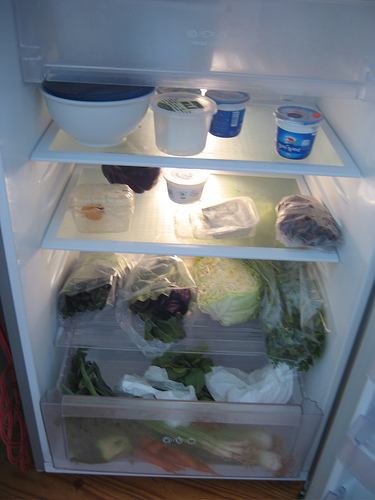
CONTENTS: (from top to bottom, left to right) organic lentil sprouts, organic goat’s cheese, chessick fruit, soft regular white cheese 5%, organic red cabbage part of a weekly CSA veggie box delivery (choose from a list of CSAs here if you live in Israel); more cheese including a Rockfort goat’s cheese, Syrian dates, spicy lettuces, cabbage, parsley, green onions, carrots, leaks, tomatoes, radishes, cucumbers, and spinach.

SOURCE: Vegetables come from an organic farm, which delivers a box of whatever’s in season, once a week. Some of the cheese is from Eden Teva market, a health food store in Bnei Brak; some cheese is from Arab supermarket on the corner nearby my house.

Reducing food miles is important to me from an environmental perspective. I try to eat locally produced food, and things which are in season.
fridge-voyeur-israel

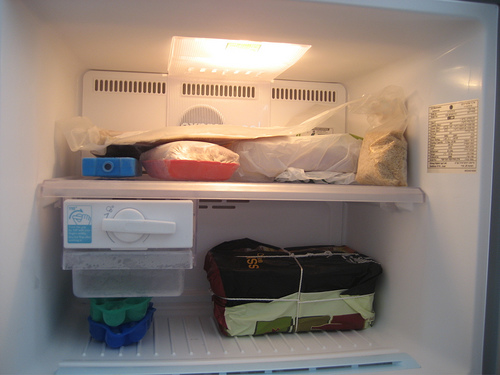
CONTENTS: It being Passover in Israel means that a lot of the bread products you might see here other times of the year have been cleaned out, eaten or burned, as per Jewish custom. Moving on, there is some sort of white fish, hamburger organic and regular, rice (stored in freezer to keep the bugs out), and a strange kind of sheep tail fat (bottom right) for making a Bukharian food known as Osh Pollo.

It is wrapped like that because someone (on their request) was supposed to “smuggle” it to the US where no such sheep tail fat can be found. It stays frozen in the meantime. (As a once a week meat-eater, Osh Pollo is very yummy and highly recommended.)

SOURCE: The frozen products come from Eden Teva Market, a health food store, a regular grocery store, and the sheep tail fat, a local market. Normally you won’t find so much meat in the freezer, as I tend to buy it when I want it. I have no idea how much meat costs per kilo, because I buy it so rarely. The organic hamburger, enough to feed 4, cost about $25 for the box, times 2 what you see above.

Want to know more about fridge voyeurism? Read this past Green Prophet post on a fridge in Jerusalem.


Karin Kloosterman
Karin Kloostermanhttp://www.greenprophet.com
Karin Kloosterman is an award-winning journalist, innovation strategist, and founder of Green Prophet, one of the Middle East’s pioneering sustainability platforms. She has ranked in the Top 10 of Verizon innovation competitions, participated in NASA-linked challenges, and spoken worldwide on climate, food security, and future resilience. With an IoT technology patent, features in Canada’s National Post, and leadership inside teams building next-generation agricultural and planetary systems — including Mars-farming concepts — Karin operates at the intersection of storytelling, science, and systems change. She doesn’t report on the future – she helps design it. Reach out directly to [email protected]
5 COMMENTS
  1. I’d be delighted to come for dinner Karin when I’m back – the contents of your fridge sound wonderful, tantalising & eco-friendly indeed! Looking fwd to that sheeps tail…..

LEAVE A REPLY

Please enter your comment!
Please enter your name here

TRENDING

Earth building with Dead Sea salt bricks

Researchers develop a brick made largely from recycled Dead Sea salt—offering a potential alternative to carbon-intensive cement.

Farm To Table Israel Connects People To The Land

Farm To Table Israel is transforming the traditional dining experience into a hands-on journey.

Remilk makes cloned milk so cows don’t need to suffer and it’s hormone-free

This week, Israel’s precision-fermentation milk from Remilk is finally appearing on supermarket shelves. Staff members have been posting photos in Hebrew, smiling, tasting, and clearly enjoying the moment — not because it’s science fiction, but because it tastes like the real thing.

How you create green steel on a blockchain

The thing about raw materials is that once they are melted down, you can't prove the source of the material. Same is true with gold, cucumbers and even forged products that look the same as the real thing. When it comes to steel, and how we produce it, it has a massive carbon problem. What's happening in Japan right now could change how we think about heavy industry and climate action.

An Army of Healers Wins the 2025 IIE Goldberg Prize for Peace in the Middle East

In a region more accustomed to headlines of loss than of listening, the Institute of International Education (IIE) has chosen to honor something quietly radical: healing. The 2025 Victor J. Goldberg Prize for Peace in the Middle East has been awarded to Nitsan Joy Gordon and Jawdat Lajon Kasab, the co-founders of the Army of Healers, for building spaces where Israelis and Palestinians — Jews, Muslims, Christians, Druze, and Bedouins — can grieve, speak, and rebuild trust together.

6 Payment Processors With the Fastest Onboarding for SMBs

Get your SMB up and running fast with these 6 payment processors. Compare the quickest onboarding options to start accepting customer payments without delay.

Qatar’s climate hypocrisy rides the London Underground

Qatar remains a master of doublethink—burning gas by the megaton while selling “sustainability” to a world desperate for clean air. Wake up from your slumber people.

How Quality of Hire Shapes Modern Recruitment

A 2024 survey by Deloitte found that 76% of talent leaders now consider long-term retention and workforce contribution among their most important hiring success metrics—far surpassing time-to-fill or cost-per-hire. As the expectations for new hires deepen, companies must also confront the inherent challenges in redefining and accurately measuring hiring quality.

8 Team-Building Exercises to Start the Week Off 

Team building to change the world! The best renewable energy companies are ones that function.

Thank you, LinkedIn — and what your Jobs on the Rise report means for sustainable careers

While “green jobs” aren’t always labeled as such, many of the fastest-growing roles are directly enabling the energy transition, climate resilience, and lower-carbon systems: Number one on their list is Artificial Intelligence engineers. But what does that mean? Vibe coding Claude? 

Somali pirates steal oil tankers

The pirates often stage their heists out of Somalia, a lawless country, with a weak central government that is grappling with a violent Islamist insurgency. Using speedboats that swarm the targets, the machine-gun-toting pirates take control of merchant ships and then hold the vessels, crew and cargo for ransom.

Leopoldo Alejandro Betancourt López Turned Ocean Plastic Into Profitable Sunglasses

Few fashion accessories carry the environmental burden of sunglasses. Most frames are constructed from petroleum-based plastics and acrylic polymers that linger in landfills for centuries, shedding microplastics into soil and waterways long after they've been discarded. Leopoldo Alejandro Betancourt López, president of the Spanish eyewear brand Hawkers, saw this problem differently than most industry executives.

Why Dr. Tony Jacob Sees Texas Business Egos as Warning Signs

Everything's bigger in Texas. Except business egos.  Dr. Tony Jacob figured...

Related Articles

Popular Categories