
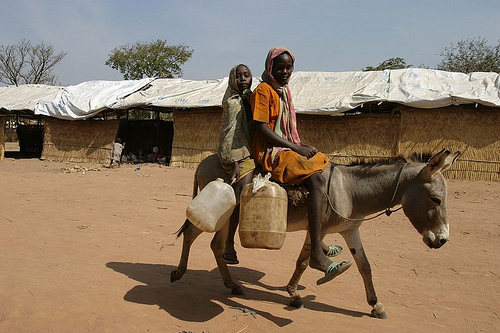


Why would a prominent Israeli-born professor at Indiana University decide to change his research emphasis from economics and political science to climate change and ecomigration? And to move from Israel to the United States?
Ecomigration is not an entirely crazy idea, and some western people have already started planning and moving to the most suitable locations for the best post-climate change scenario.
Perhaps the answer to this professor’s career switch lies in what may be our eventual destiny on this planet, especially in light of global warming and climate changes.
“This is an absolutely rational way to do things,” said Reuveny, who moved from Israel to Indiana with an eye on environmental concerns. “When it comes to climate change, we tend to forget about it being better to be safe than sorry and say it is not going to be a problem,” he said in a recent Washington Post story.
“I would not deny that more than once, a thought has gone through my mind on the fourth floor in my office, when everything is green and tranquil and the sky is blue and everything is clean, and I say, ‘Yeah, it is different than the Middle East,’ ” Reuveny said. “Do I want to go back and live in a little town in Israel, where everything is yellow and dry and there are only three months of rain a year and there is pollution?”
According to recent articles by Professor Rafael Reuveny on the subject of eco-migration (see his Nature article here), this dire reality of more cataclysmic effects of climate change may come sooner than most of us think.
 Professor Reuveny, who has a PhD from both the School of Business (majoring in Economics) and the Department of Political Science from the University of Indiana, appears to have come to the conclusion that both the economic and political futures of most countries on this planet will be shaped by climate change, which will result in mass migrations of people from one location to another.
Reuveny, whose research emphasis used to center around political and economic aspects of conflicts between Israel and other countries in the Middle East, has now put more emphasis into the effects of environmental disasters, resulting from climate change, on large masses of both animal and human populations.
“People facing environmental disasters have no choice but to leave the affected area. The larger the migration and the shorter period over which it occurs the harder it is to absorb the migrants, resulting in conflicts,” Reuveny noted in a recent study.
Reuveny has based much of his research on three major environmental disasters which occurred during the 20th Century and beginning of the 21st Century. These are the US Dust Bowl of the 1930’s, Bangladesh since the 1950’s, and Hurricane Katrina in 2005. In case studies based on these disasters, Reuveny found that “environmental migrants and residents of the areas absorbing them often clashed over jobs, resources, and way of life,” resulting in violent interactions such as theft, beatings, armed clashes, murders, and other forms of social conflicts which can give indications of what will happen in the future.
Reuveny notes that people from what he considers to be known as lesser developed countries (LDC) can be assisted by more prosperous countries to reduce to need to migrate by people living in areas more at risk: “Minimizing climate change-induced migration and violent conflict in receiving areas requires an engineered economic slowdown in the developed countries, and population stabilization and economic growth in developing countries financed by the developed countries,” Reuveny notes.
What is of concern to Reuveny, is in regards to previous studies he has made concerning the conflicts in the Middle East between a more prosperous Israel, a developed country (DC) and LDC countries in the region, including the Palestinian Authority. The environmental result of climate change in this region is resulting in more conflicts over resources such as arable land and water.
Reuveny suggest a five point plan in which developed countries, such as Israel, can offer assistance to LDC countries to prevent their need to migrate:
1. Stimulate economic growth in LDCs in order to reduce their dependence on the environment and enable investment in development and enforcement of environmental regulations and cleanup plan;
2. Promote lower population growth in LDCs in order to reduce the pressure on the environment;
3. Offset economic growth in LDCs with contraction in DCs, keeping the rise in greenhouse gasses in check;
4. Begin adapting for climate change now in places prone to conflict and eco-migration; and
5. Fund these activities by using DCs funds, since the DCs over-reliance on fossil fuels created most of the current problem. This step could be achieved, for example, by raising taxes in DCs and investing the revenues in LDCs.
These plans need to be implemented not only by DC countries in respect to poorer LDC ones but within many DC countries themselves, including the USA where rising sea levels and more frequent natural disasters such as floods, forest fires, and hurricanes are already forcing large numbers to people to migrate from one area to another.
Reuveny believes that the overall costs of climate change will rise even faster in the coming years and the sooner plans such as his are undertaken by DC countries, the less problems there will be with mass human migrations. “It’s better to be safe than sorry,” he concluded.
[image credit: hdpcar]



Can’t Take The Heat of Global Warming? Rafael Reuveny Says …: According to recent articles by Professor Rafael.. http://twurl.nl/gp3gvl
Can’t Take The Heat of Global Warming? Rafael Reuveny Says Ecomigration Drastic Measure to Survive Climate Change http://tinyurl.com/cuyo3v
Feel Like Moving to Oz Mates? Rafael Reuveny Says Eco-Migration Drastic Measure to Survive Climate Change http://ow.ly/2LBQ