


“Water, water everywhere/Nor any drop to drink…”
Those immortal words in the poem “Rime of the Ancient Mariner,” by 18th century English romantic poet Samuel Taylor Coleridge only help the emphasize the reality of the water crises that countries in the Middle East and other arid regions are now facing. As annual rainfall amounts become scarcer and scarcer, due to severe climate changes attributed to global warming, the availability of fresh drinking water in the entire region is likely to decrease even more in the next few years.
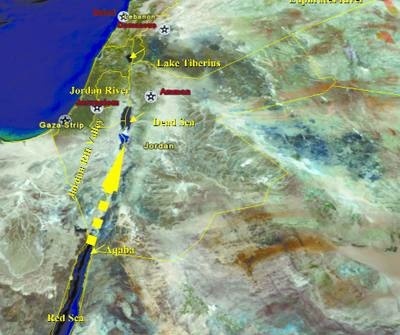
Recently governmental authorities in the Hashemite Kingdom of Jordan expressed grave concern that the country’s known water reserves would not be adequate enough to supply the populations’ needs. In neighboring Israel, which agreed to supply the Kingdom with part of the Jordan River’s annual flow in the peace agreement between countries, the level of Lake Kinneret and its coastal and mountain aquifers have now reached what is being called the “black level” in which irreparable damage, including pollution and salt water contamination will result if they are not replenished by more adequate rainfall.
Without tapping into ground aquifers, Jordan’s main sources for fresh water have been annual rainfall and water from the Jodan and Yarmuk rivers, both of which have been reduced significantly in recent years.
Both Jordan and Israel, as well as many other countries in the region, are considering desalination of seawater as a viable solution to a water problem that as gone from chronic to acute. Jordan’s water problem is much more serious that Israel’s, and even as far back as the late 1990’s the daily water allotment per family was only 22 gallons per day, as compared to 65 gallons per household in Saudi Arabia and 78 gallons per household in Israel.
And that was when the regional water problem was less acute than it is now!
In October,2007, the Jordanian government launched a $600 million project to pump water from it’s Disi aquifer, more than 250 km south of Amman. This project, when completed will include a number of pumping stations and will help considerably to satisfy a good part of the Kingdom’s water needs for the foreseeable future.
Another potential source of water for the Kingdom could come from the proposed Red/Dead project which would bring water by a canal from the Gulf of Aqaba for desalination, with the brine runoff being diverted into the Dead Sea, which itself is retreating at an alarming rate of more than 30 cm a year. This project is estimated to have the potential to provide Jordan with around 850 million cubic of fresh water a year.
The high costs of the project (estimated at 3 billion U.S. dollars) together with a number of political and environmental problems (including who would benefit the most from the project – Israel or Jordan) have so far resulted in the project being confined to the drawing board. If the project does not go through, Jordan may build its own desalination plant in Aqaba, and then pump the water northward to cities like Aqaba and Irbid. Jordan at present has one of the most acute water shortages of any country in the world.
Although plenty of seawater is available, Jordan does not have the financial resources that wealthy countries like those in the UAE have to build adequate desalination facilities. Desalination has enabled Persian Gulf states like Abu Dhabi to build beautiful futuristic cities, including golf courses and even an indoor ski slope!
::USA Water News ::Jordan Times
More on the Middle East Water Crisis:
Syria Suffers Water Shortage – More News on Middle Eastern Drought
Drought in Jordan Calls People to Pray for Rain and the Controversial Dead-Red Peace Canal
Will Climate Change Reduce or Increase Middle East Rainfall?




Thank you for sharing your thoughts. I truly appreciate your efforts
and I will be waiting for your next write ups thanks once again.
Feel free to visit my web blog … サンダル 品質
[…] several problems with the use of desalination (such as high costs and energy usage) and calls from experts to consider other options first, the Middle East is embracing the […]
This is so helpful to my standards in teaching regarding environmental issues facing Southwest Asia
[…] fragile environment is threatened by a number of problems, including a severe lack of fresh water, increasing pollution of the Gulf of Aqaba, due to overdevelopment by both Jordan and Israel, […]
This is pretty good with up-to-date facts but you might want to add more solutions. It is coming well.
I am co-owner of a newly created company, Transglobal Water Resources, that has recently-patented solar/biothermal driven (non-photvoltaic!) desalination technology. We are just now going from prototype to pilot, and have had preliminary conversations with business leaders in India and Pakistan as well as in Middle Eastern and African countries. Interest is high. We are keenly focused also on Jordan and Israel as we are particularly motivated by the “social peace dividend” our technology will deliver to regions under cross-border water stress. I would enjoy speaking with Maurice Picow if he is available. My phone number is +1 703 759 0993.
Kind regards,
Jeff Thinnes
Analyzing the Middle East Water Crisis: In Israel, Jordan and Beyond http://tinyurl.com/bc6bzq
Analyzing the Middle East Water Crisis: In Israel, Jordan and Beyond http://is.gd/jbQV