Looking to the Vadose Zone to Rehabilitate Groundwater Pollution

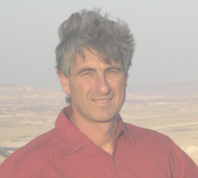
ofer dahan israel water researcher picturePlanted in Israel’s Negev Desert is an academic oasis of scientists and their students. They are studying a natural resource that may be more valuable than oil in the not-so-distant future. That resource is water.

Dr. Ofer Dahan from the Department of Environmental Hydrology and Microbiology at Ben Gurion University is one of the 26 water specialists who have uprooted their families, bringing them to the remote village of 200 homes in Midreshet Ben Gurion, in the Negev. Dahan, a hydrologist, is devoting his life to studying water in one of the driest places in the world. For him, it’s not a strange concept at all.

“You see my research is conducted at sites around Israel, in Ashdod… in Ramat Hasharon, sites in places that are not all deserts. The uniqueness of this institute is that people live and work in the same place. You can’t go shopping in the evenings; kids can’t go to the mall. Any paved roads we have here are the playgrounds. We enjoy the safety of the place,” says Dahan, who was a fisherman, before he became a water researcher.

An essential tool to monitor contamination

Among Dahan’s particular research interests is the vadose zone — the region in the soil between the soil surface and groundwater. After graduating from the Hebrew University in Jerusalem, he moved to Reno, Nevada for post-graduate work, where he first had the opportunity to build a prototype for a device that can test and monitor groundwater contamination of the vadose zone. This invention (see below), tested both in Nevada and Arizona, could become an essential tool used in soil remediation one day.
vadose zone monitor for water illustration

Basically, monitoring stations deep underground only pick up a problem in the soil when contaminants have reached the groundwater. “Groundwater is the most precious water resource,” Dahan tells ISRAEL21c. “By the time researchers understand what’s happening in observation wells, it’s already too late.”

While in Nevada, he realized that there were no tools for monitoring what happens to chemicals and contaminants before they pass to the groundwater. It’s especially a problem around gas stations, factories dealing with hazardous waste, and leaching from landfill sites.

An early-warning system

Rather than collect samples of water from the groundwater source deep underground, Dahan envisioned a way for scientists and those working in soil remediation, to follow contaminants every step of the way. He built a prototype of a system that is inserted like a flexible rod diagonally through the soil, taking measurements all the way to the groundwater.

With environmental protection high in the minds of Americans, Dahan is hoping it will be commercialized into a product. But in the meantime, he says, basic water research will be his focus.

Is water research an ideology for you? “It sounds sweet but this is how it is,” says Dahan, a married father of three. “Everyone should do what is within their skills and capacity. I understand water and this is why I am here. I used to be a fisherman. I can contribute, so this is what I do. We cannot live blindly without taking a holistic approach, and without talking about the whole environment. We can’t talk about water exploitation, without talking about the consequences of using this water.”

A critical mass dealing with water

Dahan’s lab and home are in the same village, and part of the Jacob Blaustein Institutes for Desert Research, a unique off-campus set of institutes affiliated to Ben Gurion University that invite faculty and students to conduct desert research, in the desert. Originally called Sde Boker, sharing the name of the nearby kibbutz, the campus was established in the early 1970s, as part of a dream of Israel’s first Prime Minister David Ben Gurion to make the Negev Desert a place that is a cross between Oxford, England and Yavne, an ancient Israeli town of Jewish scholars.

By 2002, The Zuckerberg Institute for Water Research, which is also part of Ben Gurion University, was founded to house under one roof, all aspects of water resource research, from groundwater production and desalination technologies to research into treating marginal water sources. “It’s the only institute in Israel that has one large critical mass of people dealing with water issues,” says Dahan who arrived to his specialty after what he calls a long process.

“I was never thought to be a typical academic person; my friends make fun me. I used to be a fisherman, in between periods of being a beach bum. During my studies I met a wonderful woman who was my teacher,” says Dahan. “You never know where the next meeting will take you.”

This article is reprinted courtesy of ISRAEL21c.

Karin Kloosterman
Karin Kloostermanhttp://www.greenprophet.com
Karin Kloosterman is an award-winning journalist, innovation strategist, and founder of Green Prophet, one of the Middle East’s pioneering sustainability platforms. She has ranked in the Top 10 of Verizon innovation competitions, participated in NASA-linked challenges, and spoken worldwide on climate, food security, and future resilience. With an IoT technology patent, features in Canada’s National Post, and leadership inside teams building next-generation agricultural and planetary systems — including Mars-farming concepts — Karin operates at the intersection of storytelling, science, and systems change. She doesn’t report on the future – she helps design it. Reach out directly to [email protected]
1 COMMENT

LEAVE A REPLY

Please enter your comment!
Please enter your name here

TRENDING

Astro uses AI to help procure land for renewable energy

For oil-rich, environmentally vigilant Gulf states, Astro isn’t just another startup story. It is a blueprint for accelerating an energy transition that is now existential, not optional.

Earth building with Dead Sea salt bricks

Researchers develop a brick made largely from recycled Dead Sea salt—offering a potential alternative to carbon-intensive cement.

Farm To Table Israel Connects People To The Land

Farm To Table Israel is transforming the traditional dining experience into a hands-on journey.

Remilk makes cloned milk so cows don’t need to suffer and it’s hormone-free

This week, Israel’s precision-fermentation milk from Remilk is finally appearing on supermarket shelves. Staff members have been posting photos in Hebrew, smiling, tasting, and clearly enjoying the moment — not because it’s science fiction, but because it tastes like the real thing.

An Army of Healers Wins the 2025 IIE Goldberg Prize for Peace in the Middle East

In a region more accustomed to headlines of loss than of listening, the Institute of International Education (IIE) has chosen to honor something quietly radical: healing. The 2025 Victor J. Goldberg Prize for Peace in the Middle East has been awarded to Nitsan Joy Gordon and Jawdat Lajon Kasab, the co-founders of the Army of Healers, for building spaces where Israelis and Palestinians — Jews, Muslims, Christians, Druze, and Bedouins — can grieve, speak, and rebuild trust together.

Qatar’s climate hypocrisy rides the London Underground

Qatar remains a master of doublethink—burning gas by the megaton while selling “sustainability” to a world desperate for clean air. Wake up from your slumber people.

How Quality of Hire Shapes Modern Recruitment

A 2024 survey by Deloitte found that 76% of talent leaders now consider long-term retention and workforce contribution among their most important hiring success metrics—far surpassing time-to-fill or cost-per-hire. As the expectations for new hires deepen, companies must also confront the inherent challenges in redefining and accurately measuring hiring quality.

8 Team-Building Exercises to Start the Week Off 

Team building to change the world! The best renewable energy companies are ones that function.

Thank you, LinkedIn — and what your Jobs on the Rise report means for sustainable careers

While “green jobs” aren’t always labeled as such, many of the fastest-growing roles are directly enabling the energy transition, climate resilience, and lower-carbon systems: Number one on their list is Artificial Intelligence engineers. But what does that mean? Vibe coding Claude? 

Somali pirates steal oil tankers

The pirates often stage their heists out of Somalia, a lawless country, with a weak central government that is grappling with a violent Islamist insurgency. Using speedboats that swarm the targets, the machine-gun-toting pirates take control of merchant ships and then hold the vessels, crew and cargo for ransom.

Leopoldo Alejandro Betancourt López Turned Ocean Plastic Into Profitable Sunglasses

Few fashion accessories carry the environmental burden of sunglasses. Most frames are constructed from petroleum-based plastics and acrylic polymers that linger in landfills for centuries, shedding microplastics into soil and waterways long after they've been discarded. Leopoldo Alejandro Betancourt López, president of the Spanish eyewear brand Hawkers, saw this problem differently than most industry executives.

Why Dr. Tony Jacob Sees Texas Business Egos as Warning Signs

Everything's bigger in Texas. Except business egos.  Dr. Tony Jacob figured...

Israel and America Sign Renewable Energy Cooperation Deal

Other announcements made at the conference include the Timna Renewable Energy Park, which will be a center for R&D, and the AORA Solar Thermal Module at Kibbutz Samar, the world's first commercial hybrid solar gas-turbine power plant that is already nearing completion. Solel Solar Systems announced it was beginning construction of a 50 MW solar field in Lebrija, Spain, and Brightsource Energy made a pre-conference announcement that it had inked the world's largest solar deal to date with Southern California Edison (SCE).

Related Articles

Popular Categories