

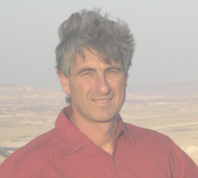
 Planted in Israel’s Negev Desert is an academic oasis of scientists and their students. They are studying a natural resource that may be more valuable than oil in the not-so-distant future. That resource is water.
Dr. Ofer Dahan from the Department of Environmental Hydrology and Microbiology at Ben Gurion University is one of the 26 water specialists who have uprooted their families, bringing them to the remote village of 200 homes in Midreshet Ben Gurion, in the Negev. Dahan, a hydrologist, is devoting his life to studying water in one of the driest places in the world. For him, it’s not a strange concept at all.
“You see my research is conducted at sites around Israel, in Ashdod… in Ramat Hasharon, sites in places that are not all deserts. The uniqueness of this institute is that people live and work in the same place. You can’t go shopping in the evenings; kids can’t go to the mall. Any paved roads we have here are the playgrounds. We enjoy the safety of the place,” says Dahan, who was a fisherman, before he became a water researcher.
An essential tool to monitor contamination
Among Dahan’s particular research interests is the vadose zone — the region in the soil between the soil surface and groundwater. After graduating from the Hebrew University in Jerusalem, he moved to Reno, Nevada for post-graduate work, where he first had the opportunity to build a prototype for a device that can test and monitor groundwater contamination of the vadose zone. This invention (see below), tested both in Nevada and Arizona, could become an essential tool used in soil remediation one day.

Basically, monitoring stations deep underground only pick up a problem in the soil when contaminants have reached the groundwater. “Groundwater is the most precious water resource,” Dahan tells ISRAEL21c. “By the time researchers understand what’s happening in observation wells, it’s already too late.”
While in Nevada, he realized that there were no tools for monitoring what happens to chemicals and contaminants before they pass to the groundwater. It’s especially a problem around gas stations, factories dealing with hazardous waste, and leaching from landfill sites.
An early-warning system
Rather than collect samples of water from the groundwater source deep underground, Dahan envisioned a way for scientists and those working in soil remediation, to follow contaminants every step of the way. He built a prototype of a system that is inserted like a flexible rod diagonally through the soil, taking measurements all the way to the groundwater.
With environmental protection high in the minds of Americans, Dahan is hoping it will be commercialized into a product. But in the meantime, he says, basic water research will be his focus.
Is water research an ideology for you? “It sounds sweet but this is how it is,” says Dahan, a married father of three. “Everyone should do what is within their skills and capacity. I understand water and this is why I am here. I used to be a fisherman. I can contribute, so this is what I do. We cannot live blindly without taking a holistic approach, and without talking about the whole environment. We can’t talk about water exploitation, without talking about the consequences of using this water.”
A critical mass dealing with water
Dahan’s lab and home are in the same village, and part of the Jacob Blaustein Institutes for Desert Research, a unique off-campus set of institutes affiliated to Ben Gurion University that invite faculty and students to conduct desert research, in the desert. Originally called Sde Boker, sharing the name of the nearby kibbutz, the campus was established in the early 1970s, as part of a dream of Israel’s first Prime Minister David Ben Gurion to make the Negev Desert a place that is a cross between Oxford, England and Yavne, an ancient Israeli town of Jewish scholars.
By 2002, The Zuckerberg Institute for Water Research, which is also part of Ben Gurion University, was founded to house under one roof, all aspects of water resource research, from groundwater production and desalination technologies to research into treating marginal water sources. “It’s the only institute in Israel that has one large critical mass of people dealing with water issues,” says Dahan who arrived to his specialty after what he calls a long process.
“I was never thought to be a typical academic person; my friends make fun me. I used to be a fisherman, in between periods of being a beach bum. During my studies I met a wonderful woman who was my teacher,” says Dahan. “You never know where the next meeting will take you.”
This article is reprinted courtesy of ISRAEL21c.



[…] Looking to the Valdose Zone to Rehabilitate Groundwater Pollution AKPC_IDS += "51111,"; […]