Making the Season Last: Tomato Confit Recipe

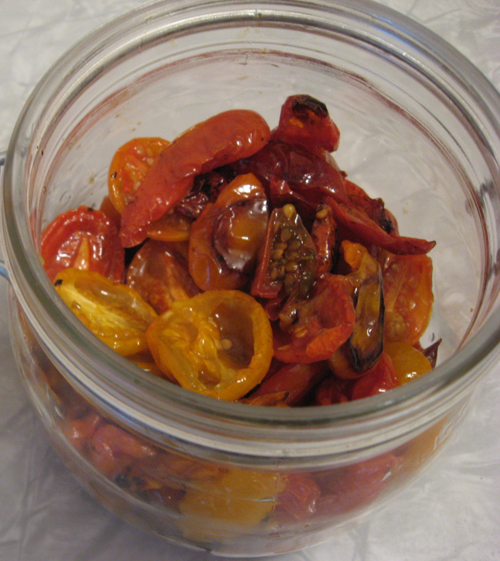
cherry tomato confit roast

Tomatoes are still, mercifully, quite readily available. Though we hate to think about it, this won’t always be the case. In just a few short weeks, tomatoes—at least the good, locally grown varieties—will be gone on winter hiatus. It always seems to come too soon, and it always somehow seems to take us by surprise. In order to combat those first painful weeks of tomato-less-ness, we thought we’d give you a recipe for extending the period of tomato goodness.

Basically, you slow-roast tomatoes with some oil and garlic and herbs, until they get fragrant and wrinkly and almost candied. It’s a great treatment for end-of-season tomatoes: the roasting sweetens and intensifies flavour which might otherwise seem a bit faded. Kept in the fridge these tomatoes will last a few weeks; put them in the freezer and you can enjoy them for three or four months.

Come a blustery day in February, you’ll be very glad to have planned so far ahead.
roast cherry tomato confit

We made our confit with the very last of the decent cherry tomatoes we could find but you can use this method for any tomato you happen to have around. There are countless ways to use the confit once you’ve made it (besides snacking out of the jar, which we’ve found ourselves doing a bit more than we should): toss with pasta and goat cheese for a 10 minute dinner, spoon over steamed or pan-fried fish to make an instant sauce, toss with other roasted vegetables or cooked grains (rice, quinoa, wheatberries, etc.) for a hearty salad with rich, earthy undertones. The oil the tomatoes are packed in is grand, too: it’ll take on a hint of tomato sweetness, and is fantastic in salad dressing or for pita-dipping.

Roasted Tomato Confit Recipe
We’ve intentionally kept this recipe open-ended with respect to quantities: you can do this just as successfully with a half-kilo or a half-bushel. Keep in mind that the tomatoes will shrink an awful lot, so however many you think you want: double the amount, and you should be more or less on target.

  • tomatoes
  • olive oil (lots)
  • salt and pepper
  • a few cloves of garlic
  • a handful of fresh thyme
  1. Preheat oven to 150°C/300°F.
  2. While oven is coming up to temperature, rinse and halve your tomatoes. Toss the tomatoes with a bit of olive oil, salt and pepper, and lay them out flat, cut side up, on cookie sheets or in roasting pans. (You don’t want them piled on top of one another as this will inhibit caramelization: if you’ve got too many to fit easily roast the tomatoes into batches.) Throw in the garlic cloves (no need to peel them), and strew the thyme about as well.
  3. Roast the tomatoes until they are soft and golden brown at the edges, stirring every ten minutes or so to avoid sticking. Depending on the size and quantity of tomatoes this may take anywhere from 45 minutes to two hours.
  4. Remove tomatoes from the oven and let them cool. Slip the garlic cloves out of their skins, and pick out the thyme stems (the leaves will have likely fallen off into the tomatoes, which is exactly what you want. Pack the tomatoes, along with the garlic cloves and any accumulated oil and juice, quite tightly into glass jars. Top the jars up with additional oil so that the tomatoes are completely covered.
  5. Tomatoes can be kept for a couple of weeks in the fridge or for several months in the freezer.
Hamutal Dotan
Hamutal Dotanhttps://www.greenprophet.com/
Hamutal never planned to become obsessed with food, much less with sustainable food. It crept up on her when she wasn’t looking. At first it was pure self-defense: her parents, though well intentioned, had no idea what to do in a kitchen, and so she had to learn a bit about cooking, sheerly for the sake of her sanity. Chopping things, it turned out, was great for soothing the savage teenager. Skip ahead several years, and she’d figured out that making your own jam from local organic berries was even grander. Love of food led to love cooking, led to love of ingredients, led to love of markets, led to love of farmers, led to love of land. Hamutal is profoundly convinced that sustainability and pleasure are the best of friends, and tries to write about both of these in equal measure. She can be reached at hamutal (at) green prophet (dot) com.
4 COMMENTS
  1. i’m sure these tomatoes are good, but this isn’t a confit. that requires long slow cooking in fat – like submersed in the fat. these sound yummy, but they’re really just oven roasted tomatoes.

Comments are closed.

TRENDING

Haman’s Fingers, A Moroccan Purim Specialty

There’s feasting at home on the night and the next day, and to make sure everyone gets good things to eat, families send out packages of treats to friends and neighbors. Traditional goodies are hamentaschen, and other treats like our chocolate nut clusters .

Make nettle dumplings, also known as nettles malfatti

Springtime foraging yields a harvest of wild greens to cook at home, like nettles. Make delicious nettles malfatti dumplings with this recipe.

Lion’s Mane Mushroom Recipe

Eyeing the mushrooms for sale in the local supermarket,...

Mandi, Fragrant Yemenite Chicken With Golden Rice

This is a luxurious recipe that requires a taste...

Dragon fruit health benefits

Dragon fruit is also known by several other names depending on where you encounter it. In much of the U.S. and Latin America it’s commonly called pitaya or pitahaya, terms you’ll often see used interchangeably with dragon fruit on market labels. Botanically, the fruit comes from a cactus sometimes referred to as night-blooming cereus, a nod to the plant’s dramatic flowers that open after dark. Older or poetic names like strawberry pear, belle of the night, or queen of the night still appear occasionally, though today dragon fruit and pitaya are the names most shoppers recognize.

Should You Invest in the Private Market?

startustartup Unlike public stock exchanges, which offer daily trading, strict...

How to build a 100-year-company

Kongō Gumi is a Japanese construction company, purportedly founded in 578 A.D., making it the world's oldest documented company. What can we learn about building sustainable businesses from them?

From Pilot Plant to Global Stage: How Aduro Clean Technologies’ 2026 Expansion Signals a Turning Point for Chemical Recycling Investors Like Yazan Al Homsi

The company's Next Generation Process (NGP) Pilot Plant in London, Ontario, has officially moved into initial operating campaigns, generating the kind of structured, repeatable data that separates laboratory promise from commercial viability.

How AI Helps SaaS Companies Reduce Repetitive Customer Support Work

SaaS products are designed for large numbers of users with different levels of experience, and also in renewable energy.

Pulling Water from the Air

Faced with water shortage in Amman, Laurie digs up...

Turning Your Energy Consultancy into an LLC: 4 Legal Steps for Founders in Texas

If you are starting a renewable energy business in Texas, learn how to start an LLC by the books.

Tracking the Impacts of a Hydroelectric Dam Along the Tigris River

For the next two months, I'll be taking a break from my usual Green Prophet posts to report on a transnational environmental issue: the Ilısu Dam currently under construction in Turkey, and the ways it will transform life along the Tigris River.

6 Payment Processors With the Fastest Onboarding for SMBs

Get your SMB up and running fast with these 6 payment processors. Compare the quickest onboarding options to start accepting customer payments without delay.

Related Articles

Popular Categories