
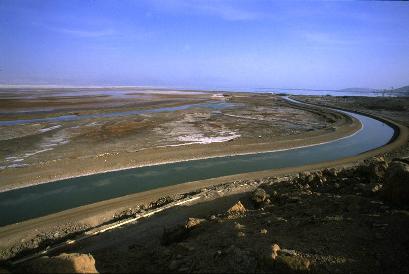
Dead Sea Peace Canal a channel to Environmental Disaster?

dead sea peace canal

Israel. Another week, another delegation of foreign politicians. This time it’s the French President Nicolas Sarkozy gracing our shores and as I write this he is dining with his Israeli counterpart, Shimon Peres, at his official residence ten minutes from my flat.

Apart from the usual topics that concern foreign dignitaries in the Holy Land (stalled peace talks with the Palestinians and Syria, what do about Iranian nukes, so on and so on), one issue that the two premiers are equally enthusiastic about is the euphemistically-titled “Peace Canal” or “Peace Valley”, a huge man-made channel which would potentially connect the Red and Dead Seas.

The announcement of the initiative at the Facing Tomorrow conference last month, with an audience of another President (Mr George W.), was greeted with rapturous applause in Jerusalem. The project requires massive investment – 5 billion dollars – to pump a projected two billion cubic meters of water each year from the Gulf of Eilat north to the ailing Dead Sea via the Kingdom of Jordan. Media headlines have been full of the tired rhetoric of “making the desert bloom” by building a complex of hotels, lakes and even safari parks in the largely undeveloped and arid Arava Valley.

Needless to say, rushing into a huge engineering feat of this kind will have enormous ecological consequences – especially before a World Bank feasibility study has even been completed – prompting condemnations from environmentalists led by Friends of the Earth Middle East.

“French President Sarkozi appears not to realize that he has stepped into a mine field of controversy. The project ideas of building an open canal across the desert, Dubai style hotels, Los Vegas casinos and African safaris are unprecedented in size not only for the Middle East but globally. They threaten to completely alter the World Heritage values of the Arava Valley and the Dead Sea itself,” said Munqeth Mehyar, Jordanian Director of FoE Middle East.

Their Israeli director, Gidon Bromberg, was equally damning of the project: “Since time immemorial it was the Jordan River that replenished the Dead Sea. In just 50 years we have managed to turn the holy Jordan into a sewage canal and dry up a third of the Dead Sea.”

It wasn’t long ago that Green Prophet reported on FoE Middle East’s own “Peace Park” at the opposite end of the Jordan Valley, south of the Sea of Galilee. Unlike the touted “Peace Canal” which aims at a technical fix for a complex ecological quandary, the ecological Peace Park hopes to rehabilitate the River Jordan and the Dead Sea by tackling its root causes – unsustainable water management – rather than throwing cash at the problem.

According to Bromberg: “It appears that the French Government led by French business interests is using the demise of the Dead Sea as the means to try to greenwash the public and cover up their true intentions of reaping the profits from the tens of billions of dollars that the project would need to attract.”


Michael Green
Michael Greenhttps://www.greenprophet.com/
Born into a family of auto mechanics and engineers in east London’s urban sprawl, Michael bucked the trend and chose a bicycle instead of a car. A relative newcomer to Jerusalem, he works as a freelance journalist writing for the Jerusalem Post and other publications. Before moving to Israel, he worked for an environmental NGO in England where he developed a healthy obsession with organic vegetables and an aversion to pesticides and GMOs. Michael’s surname is pure coincidence. Michael can be reached at michael (at) greenprophet (dot) com.
2 COMMENTS

Comments are closed.

TRENDING

What are AWG air-water generators, and why they aren’t a golden-bullet solution (yet)

Atmospheric water generators (AWGs) sound like magic: machines that can pull drinking water out of air. The idea is mentioned in the Bible, where the elders would pray for water collected as dew on plants and the catch on turning this into a machine is in the physics. To turn invisible vapor into liquid, you must remove heat, especially the latent heat of condensation.

Jordan’s $6 Billion Aqaba–Amman Desalination Project from the Red Sea Moves Forward

In 2025, the Jordanian government signed agreements with a consortium led by Meridiam and SUEZ, alongside VINCI Construction and Orascom Construction. Under a 30-year concession agreement, the consortium will design, build, finance, operate, and maintain the system before transferring it back to the Jordanian government. The total investment is estimated at approximately $6 billion USD.

Earth building with Dead Sea salt bricks

Researchers develop a brick made largely from recycled Dead Sea salt—offering a potential alternative to carbon-intensive cement.

Peace hospital opens between Jordan and Israel

The proposed medical centre, described by Emek HaMaayanot Regional Council head Itamar Matiash as “a centre for cancer treatment, so that people from Jordan or further away could come and receive treatment,” would become the flagship of a wider cluster of medical, academic and innovation-based services planned for the Israeli half of the zone.

Iran’s water mafia and thirst for war leaves the country on brink of being dry

Iran’s Lake Urmia, once the Middle East’s largest saltwater lake, has shrunk by 90 percent due to mismanagement, dams, and drought. As Tehran pours billions into foreign conflicts, water activists face repression at home. The crisis mirrors Syria’s drought-driven unrest, showing how water scarcity can destabilize entire regions.

Should You Invest in the Private Market?

startustartup Unlike public stock exchanges, which offer daily trading, strict...

How to build a 100-year-company

Kongō Gumi is a Japanese construction company, purportedly founded in 578 A.D., making it the world's oldest documented company. What can we learn about building sustainable businesses from them?

From Pilot Plant to Global Stage: How Aduro Clean Technologies’ 2026 Expansion Signals a Turning Point for Chemical Recycling Investors Like Yazan Al Homsi

The company's Next Generation Process (NGP) Pilot Plant in London, Ontario, has officially moved into initial operating campaigns, generating the kind of structured, repeatable data that separates laboratory promise from commercial viability.

How AI Helps SaaS Companies Reduce Repetitive Customer Support Work

SaaS products are designed for large numbers of users with different levels of experience, and also in renewable energy.

Pulling Water from the Air

Faced with water shortage in Amman, Laurie digs up...

Turning Your Energy Consultancy into an LLC: 4 Legal Steps for Founders in Texas

If you are starting a renewable energy business in Texas, learn how to start an LLC by the books.

Tracking the Impacts of a Hydroelectric Dam Along the Tigris River

For the next two months, I'll be taking a break from my usual Green Prophet posts to report on a transnational environmental issue: the Ilısu Dam currently under construction in Turkey, and the ways it will transform life along the Tigris River.

6 Payment Processors With the Fastest Onboarding for SMBs

Get your SMB up and running fast with these 6 payment processors. Compare the quickest onboarding options to start accepting customer payments without delay.

Related Articles

Popular Categories