
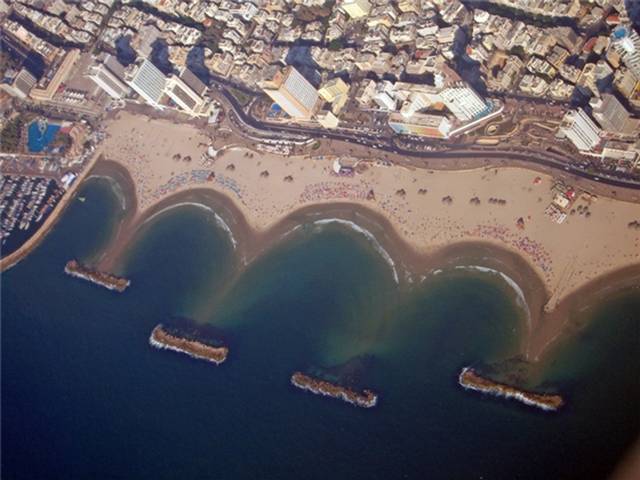


Central Tel Aviv’s beach and tayelet.
Democracy is a messy system. Churchill was probably right when he said that democracy was the worst system of government, except for all of those other systems that have been tried from time to time. However, democratic decision-making is an art, and in most cases its practitioners are not very skilled artists. And Churchill never attended a meeting of the Tel Aviv Local Planning and Construction Committee, which met last week to discuss several building plans, among them a plan to expand Tel Aviv’s tayelet (boardwalk).
The discussion opened with Tel Aviv’s city planners presenting the plan they had developed for the central section of the city’s beach, between Gordon beach and the Dolfinarium. The plan calls for a number of planning changes along three kilometers of central Tel Aviv’s beachfront area, including building additional “services” for visitors and redesigning the tayelet in the area. Although the planning documents were vague with regard to the actual changes to be made to the tayelet, artists’ renderings of the new tayelet raised the blood pressure of many in the room.

Tel Aviv’s renovated old port (left) and plans for the new tayelet (right).
Obviously modeled on the successful renovation of the old port in the north of the city, the plan called, among other things, for widening the tayelet westward (toward the ocean) at the expense of the large sandy beach area that exists there today.
Throughout the presentation, planner Orly Harel repeated the claim that people who want to sit on the tayelet today, are forced to do so with their backs turned to the sea. This is a pretty flimsy claim, as numerous benches are scattered along the tayelet, all of them oriented toward the ocean. However, the terminology resonates with Tel Aviv’s more devoted residents, who often complain that the city was built with its “back to the sea.” Harel’s presentation included a photograph of several people sitting on the planters, with their backs to the ocean. This was apparently the entire basis for her claim.
After Harel presented the plan, a series of city residents and activists stood up and expressed their opposition to the plan. Several residents objected to the planned increase in construction on the beach, with many expressing the fear that the beach would be further commercialized by restaurants and chain stores of the kind that were built in the old port.
Omer Cohen of the Society for the Protection of Nature’s Tel Aviv Center for Environmental Action gave a presentation in which he questioned several aspects of the plan. He noted that, while the city was planning to encroach on the beach from the east with the new tayelet, the ocean is expected to rise between half a meter and five meters over the next century due to climate change, shrinking the beach from the west. With the beach already crowded beyond belief, especially on Saturdays in the summertime, he proposed exploring other solutions for the tayelet, including redesigning the tayelet within its current borders or widening it to the east, at the expense of the redundant service road which runs alongside Herbert Samuel Street.

The Green Forum suggested moving the tayelet east, and doing away with an unnecessary service road (far left of the picture).
Other speakers took issue with the lack of public participation in drawing up the plan and the incomplete and vague information that the city released about it. City council member Meital Lehavi refused to vote on the plan, stating that it was not clear to most of the members of the committee what exactly they were being asked to approve. City officials, for their part, did not seem overly concerned with the public’s strong objections to the plan, and even asserted that the whole issue of expanding the tayelet was invented by the press.
After two hours of open discussion, the committee decided to close the meeting to the public and make its decision. Later that afternoon, the decision was made public: a steering committee will be set up with the participation of local green groups to come up with a concept for the new tayelet, which will then be submitted to the public for its comments and participation. Meanwhile, on February 5, the District Planning and Construction Committee will discuss the plan at its offices across from Azrieli Towers in Tel Aviv.
For more information, check out: Ha’aretz, Ynet (Hebrew)




Hello! I just wanted to ask if you ever have any issues with hackers?
My last blog (wordpress) was hacked and I ended up losing several weeks of hard work due to no back
up. Do you have any methods to prevent hackers?
[…] years ago, Tel Aviv presented a plan to redesign its central promenade. The plan – vague, unclear and buried inside another policy proposal – drew plenty of […]
The street should be put underground so that the whole tayelet can become a pedestrian area.
I think they should move the boardwalk to the street, get rid of the cars and divert traffic to the center of the city. Such a treasure wasted on asphalt…. oh and like Paris, no more buildings over 6 stories…