Wadi Rum Bedouins Defy Nature by Growing Organic Veggies

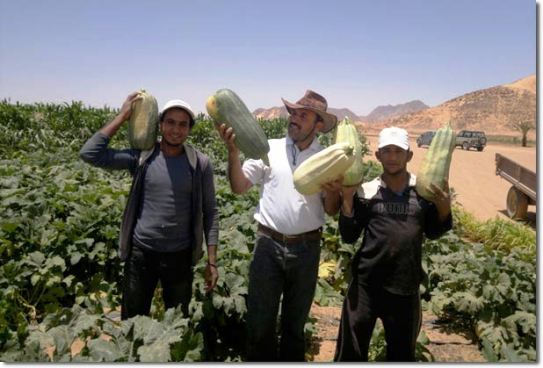
Wadi Rum farmers with squash

Who says you can’t make the desert bloom? The desert regions of Israel and Jordan have for years been the subject of numerous agricultural projects. Some of these projects include creating community gardens by residents of desert towns; and being involved in epic Sahara forest projects. Now let’s look at what’s happening in Wadi Rum. 

Jordan’s Wadi Rum Desert region (see it in pictures) has been known for years as a panoramic desert tourism location with outstanding desert landscapes and wind blown rock formations.

What this area has not been known for is any kind of serious agriculture, until recently.

Now, Bedouins living in the Wadi Rum region have become involved in unique agricultural projects that are beginning to become successful.

These projects reported in Permaculture News involve growing a variety to fruits and vegetables including eggplants, cabbage, figs and pomegranates, potatoes, squash, tomatoes, and other vegetables.

The crops grown there by Rum Farm Organics are being grown by using special irrigation techniques and fertilizers from the Permaculture design system that  “seeks to minimize waste, human labor, and energy input by building systems with maximal benefits between design elements to achieve a high level of synergy.”

This method of agriculture is said to have been in use in ancient times by such peoples as the ancient Egyptians and Nabateans. Special plastic “poly tunnels” are also used to help conserve water and deal with extreme desert temperatures.

The project has been ongoing for more than three years and the results appear to be very successful. The main fertilizer used is aged animal manure from chickens, sheep, goats and cows, with a mulch of alfalfa and shredded weeds added. Irrigation involves digging small canals and drip irrigation methods. The systems used have already been in use extensively in the Jordan Valley. Mulching around trees such as pomegranates involves using what is known as a “chopndrop” method that helps conserve water.

Permaculture’s Geoff Lawton, who visited the Wadi Rum site recently, reported that much progress has been made there since the initial report on the project was made in 2010: “What really needs to be understood from the ancient traditional production systems of pre-industrial agriculture that have remained fertile and stable for millennium, is the positive edge relationships of crop production areas,” says Lawton.

He seems to have a point as the methods being employed in Wadi Rum are now definitely bearing fruit.

More articles on Middle East desert agriculture:

Community Gardens Sprout in Israeli Desert Town

Meribol’s Futuristic Hydrogel to Grow Food on Desert Sand

Jordan Signs Up for Epic ‘Sahara Forest Project’

Hungry Persian Gulf States Look to Mycorrhiza Fungus to Grow Crops in Desert

Wadi Rum agriculture photos by Permaculturenews.org

Maurice Picow
Maurice Picowhttps://www.greenprophet.com/
Maurice Picow grew up in Oklahoma City, U.S.A., where he received a B.S. Degree in Business Administration. Following graduation, Maurice embarked on a career as a real estate broker before making the decision to move to Israel. After arriving in Israel, he came involved in the insurance agency business and later in the moving and international relocation fields. Maurice became interested in writing news and commentary articles in the late 1990’s, and now writes feature articles for the The Jerusalem Post as well as being a regular contributor to Green Prophet. He has also written a non-fiction study on Islam, a two volume adventure novel, and is completing a romance novel about a forbidden love affair. Writing topics of particular interest for Green Prophet are those dealing with global warming and climate change, as well as clean technology - particularly electric cars.
21 COMMENTS
  1. This indicates that desert regions can indeed bear fruit. Israel pioneered a lot of desert irrigation and farming methods; especially their now famous drip irrigation systems that are in use around the world.

  2. Great project – a better title though would be “Wadi Rum Bedouins Work Well with Nature by Growing Organic Veggies”. There’s a lot of deep understanding gone into this work.

Comments are closed.

Hot this week

How Renewable Energy is Revolutionizing the Way We Power Our World

Solar has become the star of the transition thanks to modular hardware and straightforward installation. It fits dense cities and remote towns alike. Many companies are turning to rooftop arrays and carport systems - and exploring commercial solar installation as a practical way to lock in future savings.

How does one start prepping?

Faced with an extreme winter storm this year, Americans wonder how to be prepared for catastrophe. Miriam has lived through wars in the Middle East - so she's prepared on giving you a guide to prepping.

Fishermen sue tire manufacturers on behalf of the salmon

A federal trial in San Francisco has brought US tire manufacturers, fishing groups, and environmental scientists into court over a chemical most drivers have never heard of — but which scientists say may be silently reshaping aquatic ecosystems.

Listening to Water: Tarek Atoui’s Next Work for Tate Modern

Born in Beirut, Lebanon in 1980 and now living in Paris, Atoui has spent years building instruments that don’t sit comfortably in concert halls. Many of them involve water, glass, and ceramics — materials that react to sound instead of simply producing it.

Leading Through a Dual-Energy Transition: Balancing Decarbonisation with Energy Security

Experience in one area of the energy industry isn't enough to guarantee readiness across all the others. That's where a structured program like an MBA in energy can come in. Today's advanced curricula explore energy economics, finance, policy, and strategic management alongside the technical subjects. And when pursuing an energy MBA online, professionals can skill up and retrain without having to step out of the labor market -- an important perk at a time when skilled professionals are already in short supply.

Topics

How Renewable Energy is Revolutionizing the Way We Power Our World

Solar has become the star of the transition thanks to modular hardware and straightforward installation. It fits dense cities and remote towns alike. Many companies are turning to rooftop arrays and carport systems - and exploring commercial solar installation as a practical way to lock in future savings.

How does one start prepping?

Faced with an extreme winter storm this year, Americans wonder how to be prepared for catastrophe. Miriam has lived through wars in the Middle East - so she's prepared on giving you a guide to prepping.

Fishermen sue tire manufacturers on behalf of the salmon

A federal trial in San Francisco has brought US tire manufacturers, fishing groups, and environmental scientists into court over a chemical most drivers have never heard of — but which scientists say may be silently reshaping aquatic ecosystems.

Listening to Water: Tarek Atoui’s Next Work for Tate Modern

Born in Beirut, Lebanon in 1980 and now living in Paris, Atoui has spent years building instruments that don’t sit comfortably in concert halls. Many of them involve water, glass, and ceramics — materials that react to sound instead of simply producing it.

Leading Through a Dual-Energy Transition: Balancing Decarbonisation with Energy Security

Experience in one area of the energy industry isn't enough to guarantee readiness across all the others. That's where a structured program like an MBA in energy can come in. Today's advanced curricula explore energy economics, finance, policy, and strategic management alongside the technical subjects. And when pursuing an energy MBA online, professionals can skill up and retrain without having to step out of the labor market -- an important perk at a time when skilled professionals are already in short supply.

From Green Energy to Healthy Societies: Why old systems thinking is becoming relevant again

Across the Middle East and North Africa, large investments are being made in green hydrogen, renewable energy, water infrastructure and sustainability. Most of these efforts are discussed in the context of climate change, decarbonization and economic diversification. That framing is important, but it may not capture their full value.

We saw peace – an interreligious encounter deep in our eyes

They came from Israel, Palestine, Jordan, Iraq, Yemen, Morocco, Tunisia, Lebanon, Egypt… There are Sunni Muslims, Shiite Muslims, Jews (Orthodox and Reform), Orthodox Christians, Coptic Christians, Protestant Christians, Druze, Baha'is, a Scientologist.

Can biochar reduce ‘Forever Chemicals’ in food if it’s used in farms?

Biochar is produced by heating organic material in a low-oxygen environment so it does not burn. This process, known as pyrolysis, transforms plant matter into a stable, carbon-rich material.

Related Articles

Popular Categories